 My weekend in Miami was full of sunshine, culture and ethnic diversity. Add in ease of access (inexpensive, direct flights between ORF-MIA) and warm friendship as soon as I landed. Essentially, it had all the elements of a perfect weekend.
Friday night we enjoyed delicious Thai food at one of the many, small restaurants on the newly-paved pedestrian street in Coral Gables, Miracle Mile (sounds like Chicago but that’s what they call it). After dinner we attended the hugely entertaining musical comedy, “It Shoulda Been You” at Actors’ Playhouse in the Miracle Theater. I recommend this play to anyone wanting to sit back and laugh.
Saturday morning we were among the first to arrive at Vizcaya, the opulent estate built in the 1920’s by James Deering of the Deering Harvester (agriculture equipment) family. 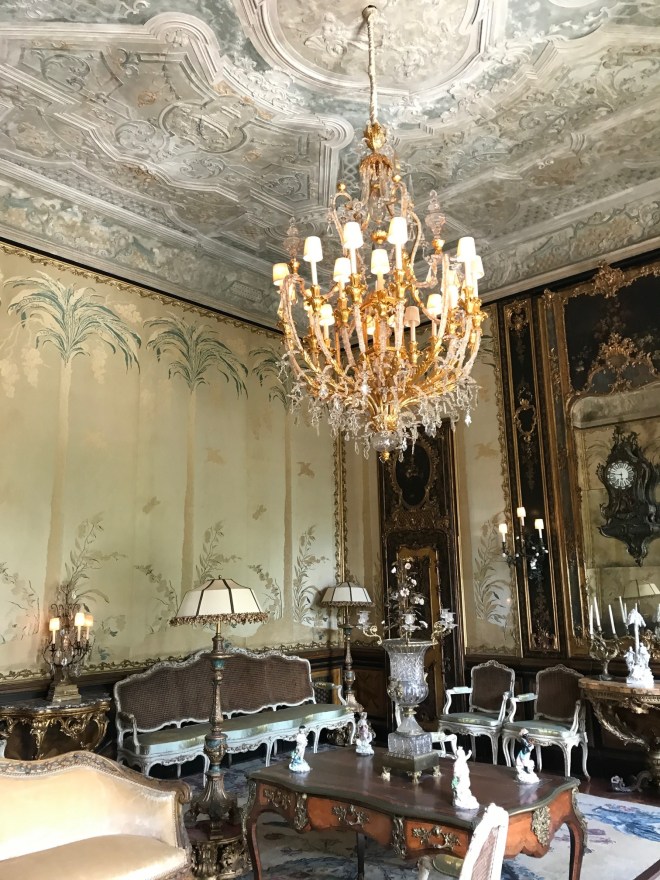 The home itself is full of beautiful architectural detail, elegant furnishings and art while the patios and gardens are steamed in European design with heavy Italian influence; especially Venetian.
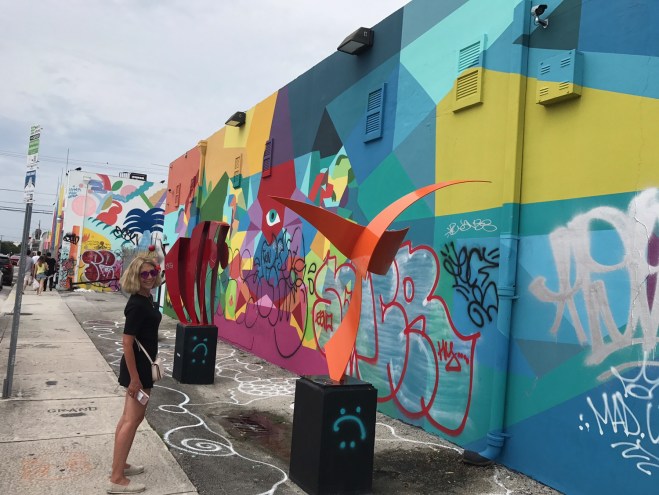
  Although we could have stayed all day, we left in time to fit in a stroll through the Wynnwood Art District famous for street art.
 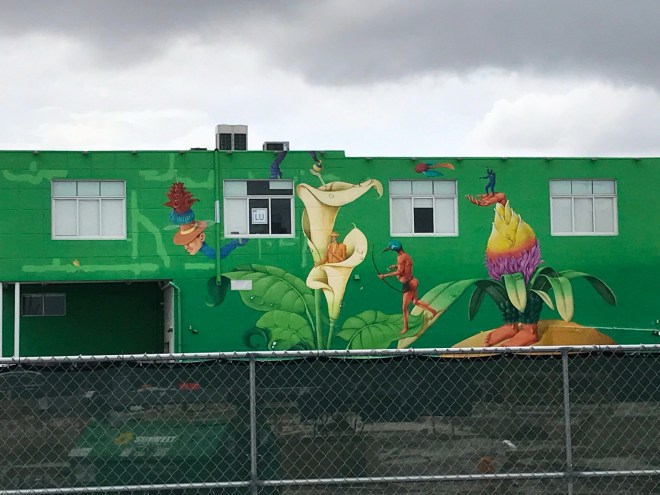 I couldn’t choose a favorite mural because each design is original and wonderful in its own way.
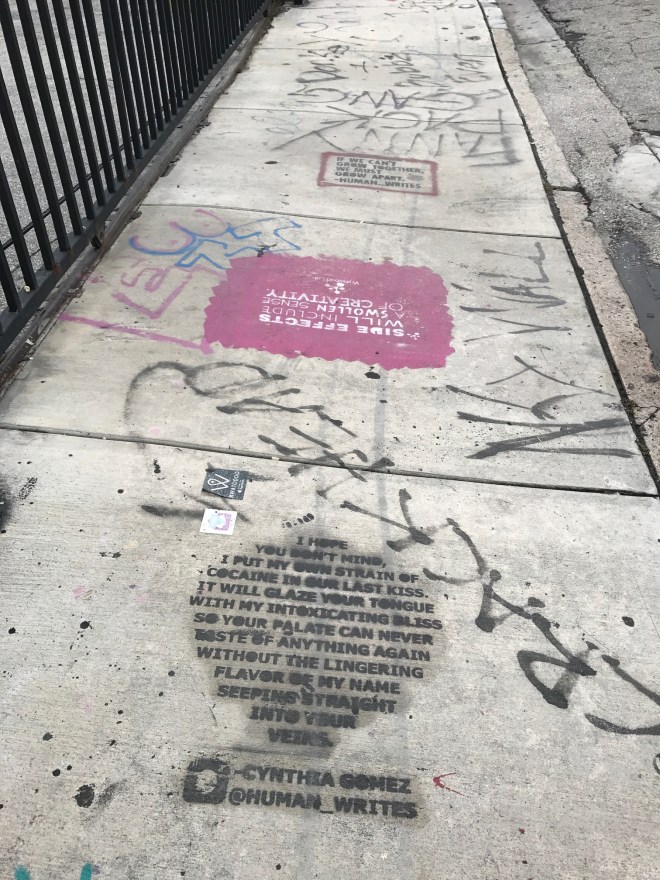
 Even the sidewalks are covered in art and poetry.
 I have no idea how long the paintings last or when they might be changed but I’d hate to see some of these painted over.
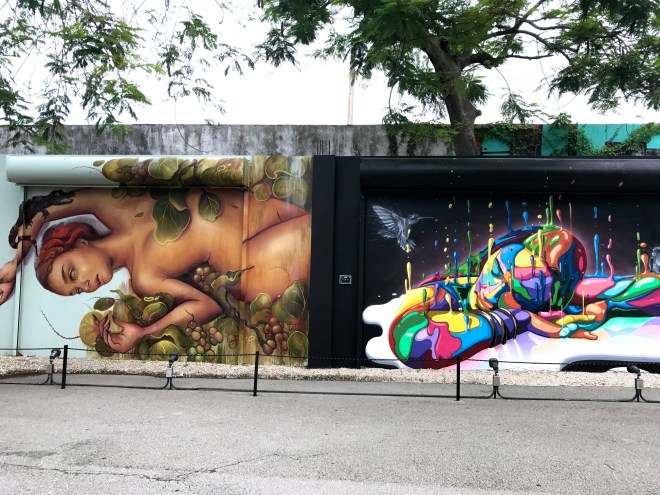 The area appears to be an old warehouse district gentrified and filled with hipster cafes and galleries. We enjoyed it by day then returned after dark to see the street party complete with a DJ, dance floor and adult refreshments. Police had a heavy presence but everyone seemed chill.
  Leaving Wynnwood it was a short drive to South Beach. I was told that “el elemento” has changed. The high-fashion models and Rolls Royces were missing but it’s still full of interesting people and places.
 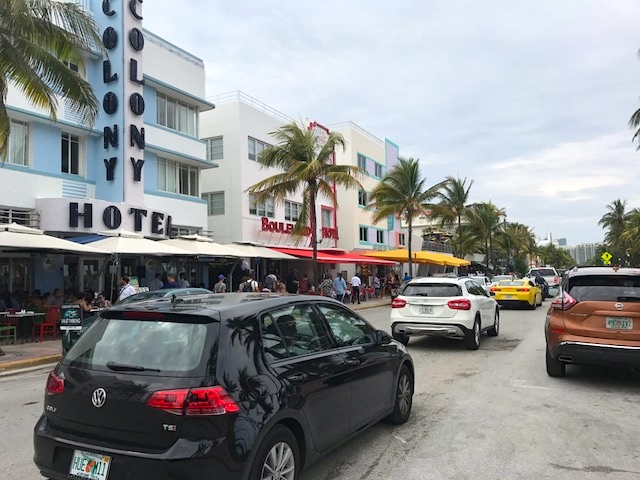 Virtually every cafe, restaurant and bar had a sidewalk cafe with patrons watching the parade of characters pass by. We passed the seemingly requisite man with a boa constrictor around his neck and plenty of women with almost no clothes on.
  The beach is wide and welcoming complete with the art deco lifeguard stands.
  The Versace Villa is now a hotel and younger people have never heard how Gianni Versace was shot on his door steps. Hard to believe that this summer marks 20 years since the high-profile murder and huge funeral.
 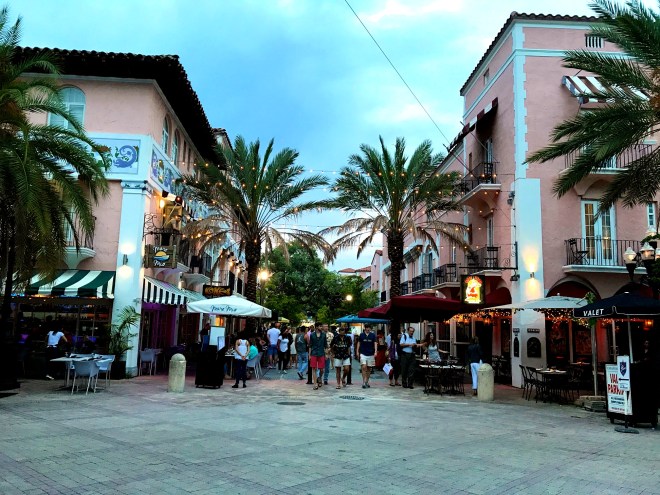 We went on a South Beach walking tour that ended a couple blocks off the beach on Espanola Way. Smaller than the Lincoln Street pedestrian mall, Espanola has a quaint, old-Cuba feel. OK, I’ve never been to Cuba but this is what I imagine an Americanized version to be.
Sunday morning was prime time was brunch on Biscayne Bay.  The rest of the day was filled with the Frost Museum (formerly the Miami Science Museum), the Perez Art Museum and Museum Park.
 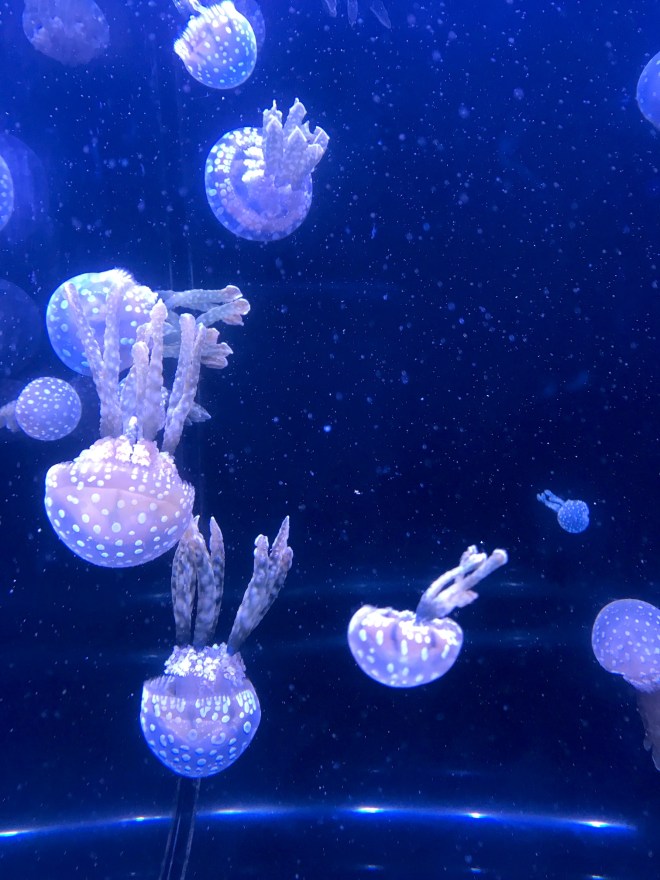 The Frost is new and really is state-of-the-art. Complete with an aquarium and planetarium, it’s multi-storied and inviting for all ages. The Perez (pictured below) is a contemporary art museum.
  The Perez and Frost share a big park area that is my favorite type of architecture where indoors and outdoors are blended without sharp divides. I recommend going, even if only to enjoy the park and lounge in one of the many creative seating areas on beautiful Biscayne Bay. You’ll have your choice of hammock-swing-chairs, teak benches laid on stairs, and several other comfortable and fun arrangements among tropical vegetation.
  Overlooking the horrible traffic, lack of reasonable mass transportation and no bike lanes (more than a couple people blew their horns and/or shouted at me with total disregard of the “share the road” signs), everything I visited was within relatively close proximity. I actually had to approach several clerks at a department store to find one who spoke English. Miami is still part of Florida but with a unique vibe. Thus, their motto: “It’s so Miami!”
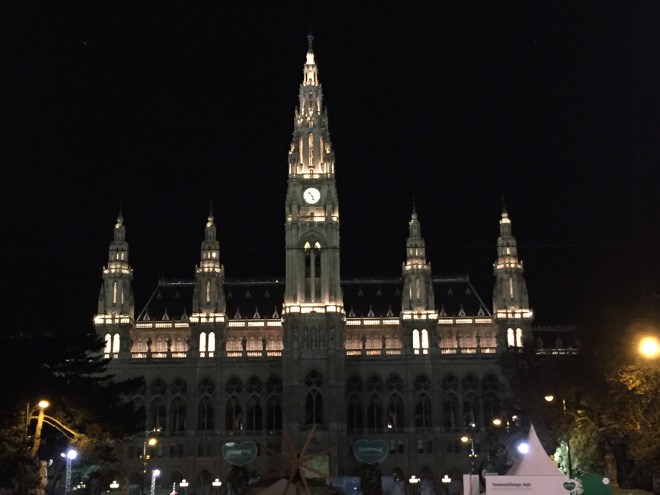 Vienna is an explosion of beauty. Look in any direction, and you’ll see architectural grandeur in bold, Roman columns, Gothic arches and steeples, detailed frescoes, mosaics and baroque gilding. The styles span the last five centuries but the beautiful, light colored stone is a uniting element.
 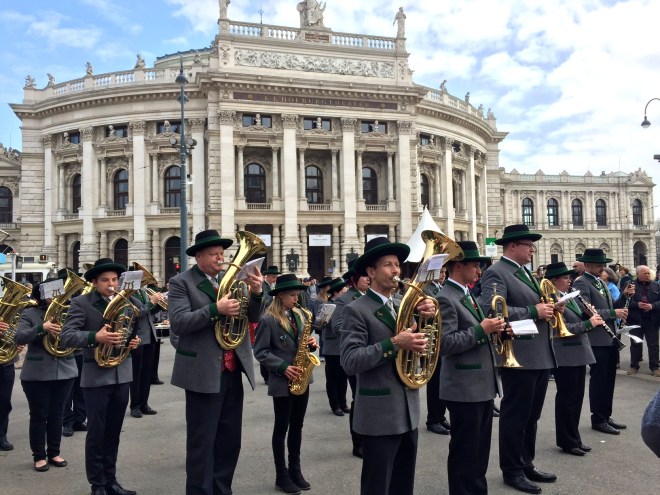 Upon arriving in Vienna last Sunday morning, I was privileged to attend a mass at St. Augustine’s Cathedral. The beauty of the building, inside and out, was matched by the ceremony of the service complete with a magnificent organ and choir.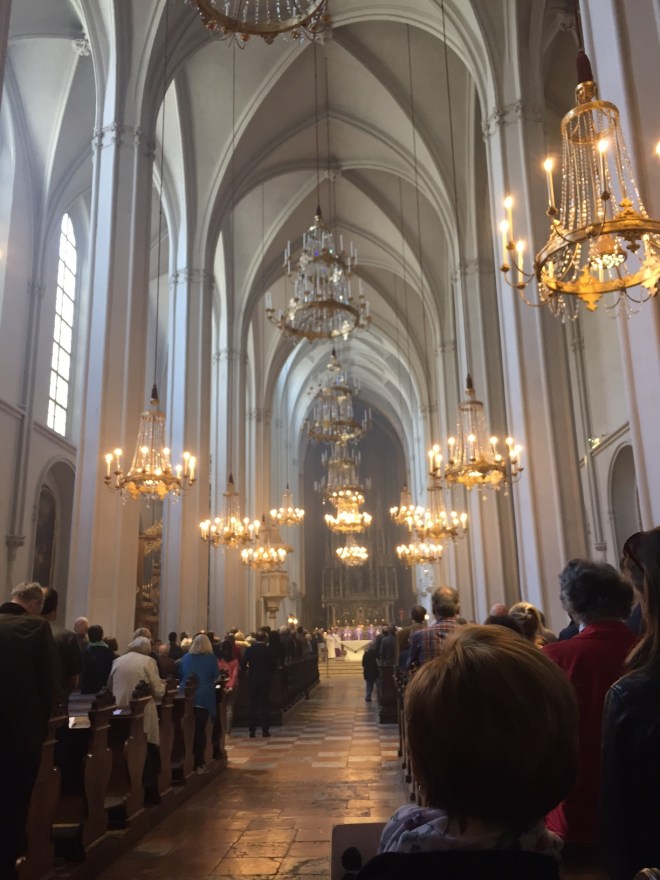

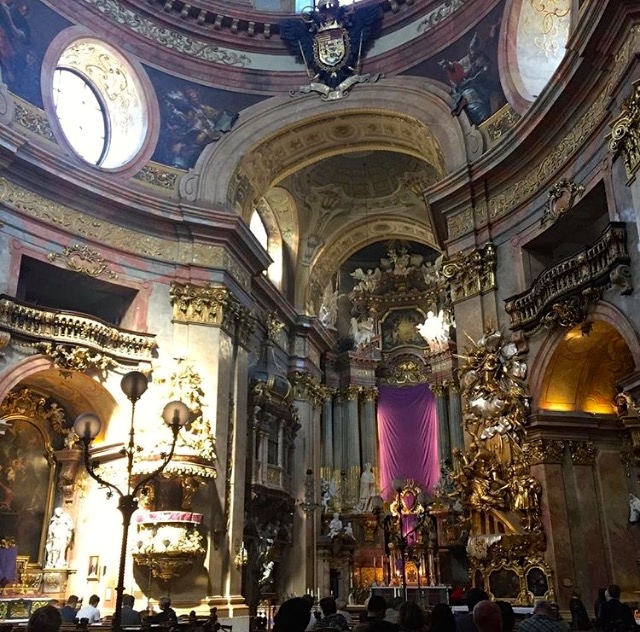 Every building has a story. For example, in 1714 St. Charles Church (Karlskirche) was commissioned by Emperor Charles VI to honor the saint of plague sufferers at the end of the plague that killed more than 8,000 people. Building materials and funds to erect the cathedral were gathered from all over the Habsburg Empire—Sardinia, Italy, Hungary and more. It took two years to plan the church then twenty years to complete the construction. In each of the six side chapels there are paintings of Jesus, always wearing a red robe with a blue drape, healing the sick or performing miracles. It’s difficult to imagine how it could have been designed or built without computers, cranes, and modern tools yet it was constructed so well that it stands today. A picture of Karlskirche is below.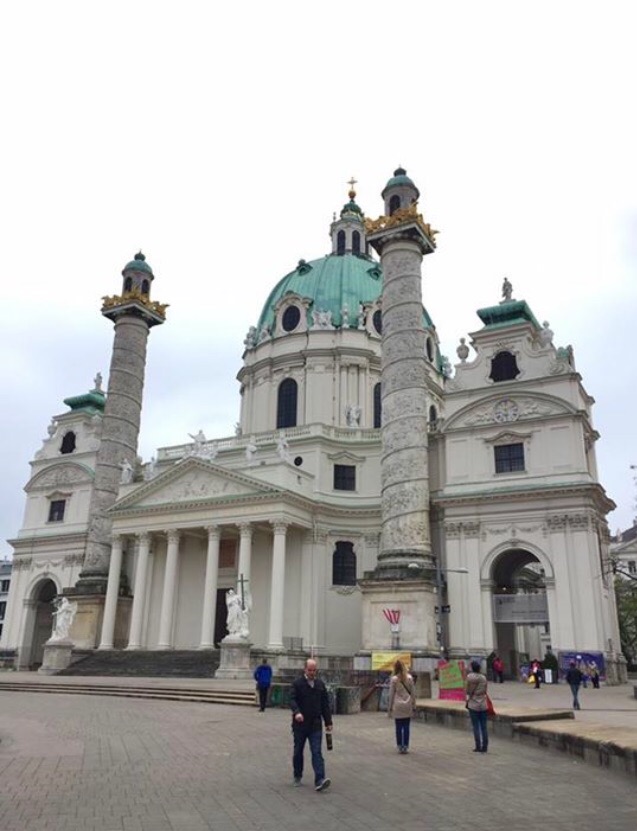
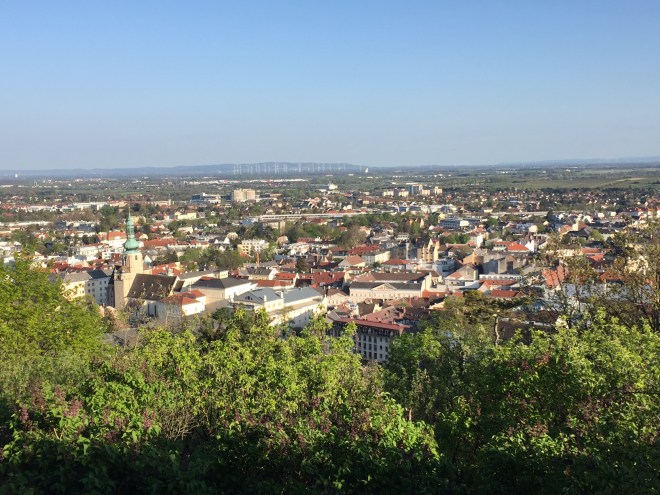
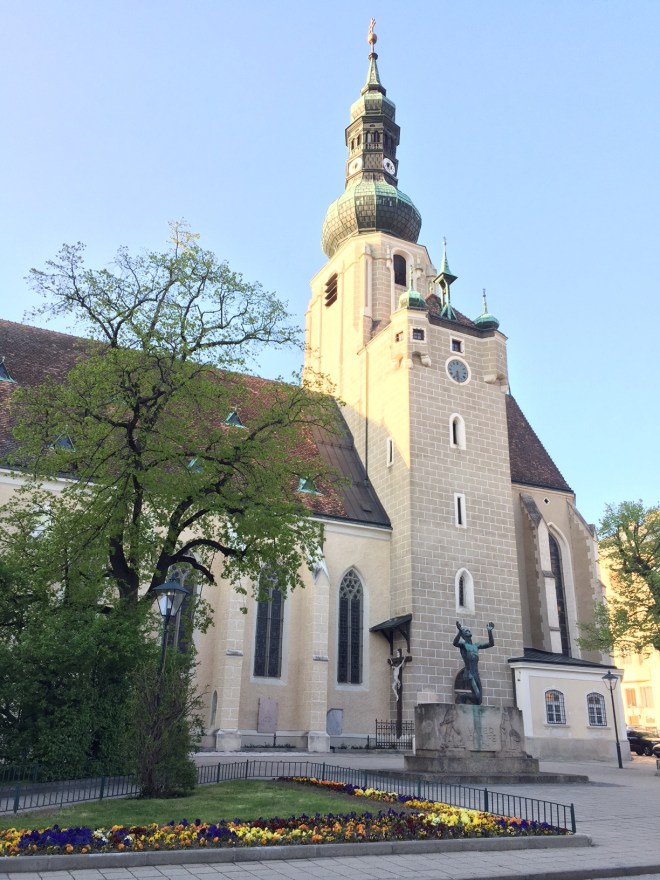 Another small town I visited, Eisenstadt, is the home of Haydn, and has two lovely churches, one of which houses his tomb. Many of the churches had music written for and originally performed during special masses by the great composers.
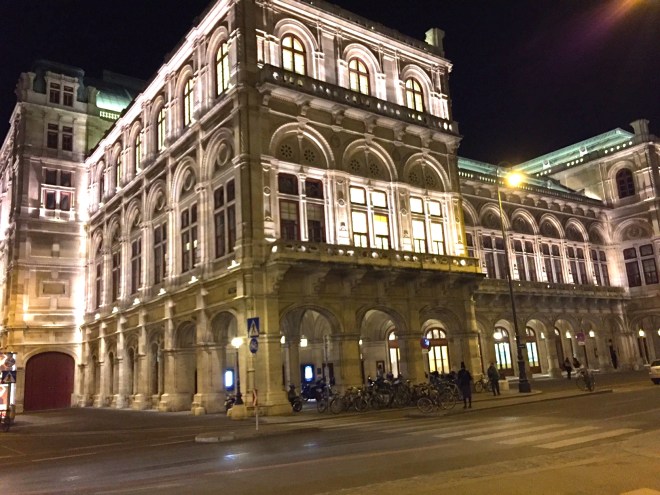
 Government buildings, museums and performing arts halls in Vienna are almost as grand as the cathedrals. Trying to get a good picture of the State Opera House was almost impossible because it’s so large. In fact, all of my pictures pale in comparison to reality.
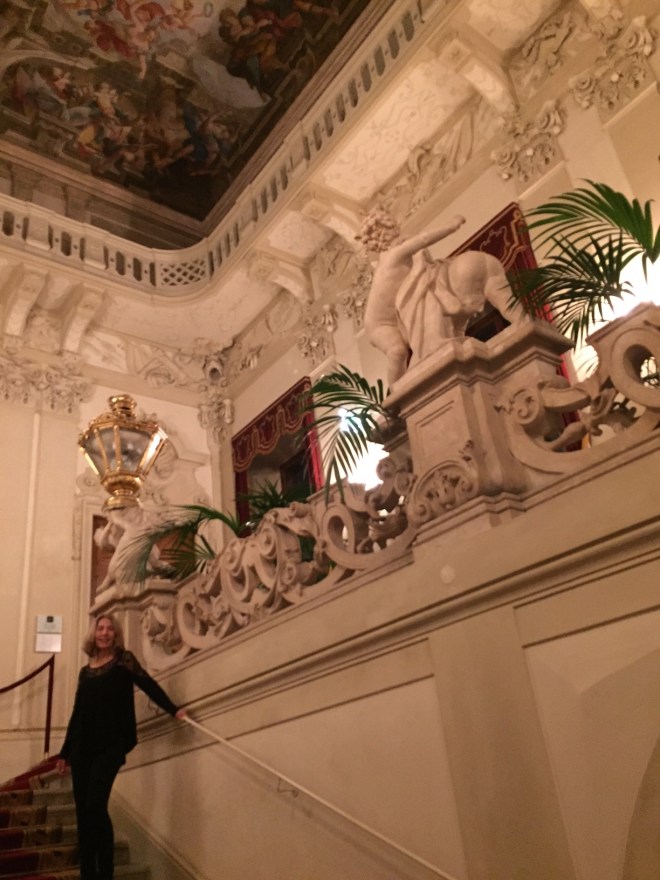
  Walking the streets you’ll notice mounted signs telling the history of a particular building generally including the date is was built, when it was renovated, and if anything important happened at that site such as an artist or a composer lived there. The dates remind me how young the United States is. It’s not uncommon to see buildings erected in the 14th century still in full use today. One former royal palace has been converted to residential condominiums. Ducking down side alleys and in through open doors to take a look can yield unexpected splendor. This stairway is in a commercial office building housing an auction business.
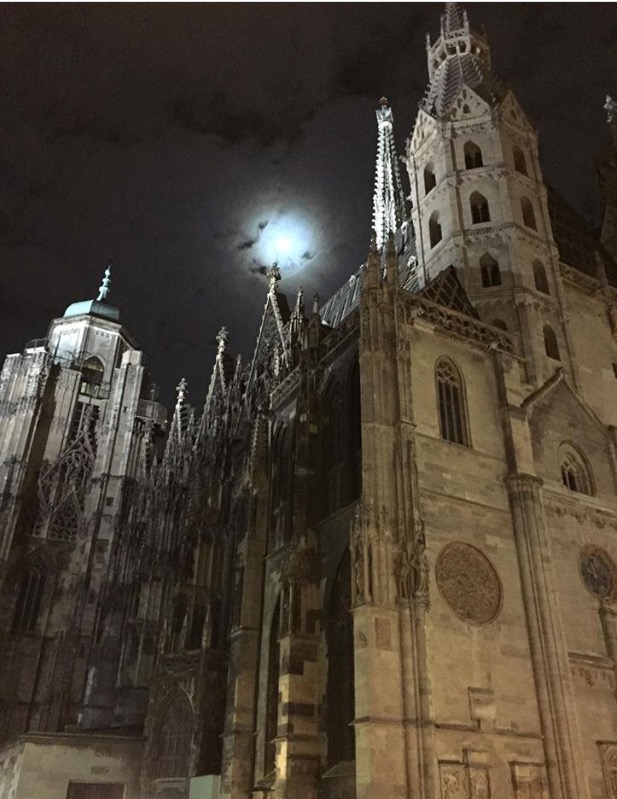
 And, the beauty is not found just by day. At night the same buildings take on a magical aura; especially, if you’re as lucky as I was to see them by a full moon.
 Then there are the palaces. One of my favorite was the Schonbrunn Palace, the summer home of Maria Theresa, her husband, and their sixteen children, high on a hill with a compelling view of Vienna below. Painted in her characteristic deep yellow, it’s both elegant and grand. (Side Note: Never underestimate a woman! Emperor Charles VI died when his daughter, Maria Theresa, was 23. There being no sons, she was next in line to rule the House of Habsburg but she was not expected to retain control, given that she was a woman. The position made her the absolute sovereign of Austria, Hungary, Croatia, Bohemia, Transylvania, Mantua, Milan, Lodomeria and Galicia, the Austrian Netherlands and Parma. During her 40-year reign she earned respect and admiration, escorted in economic and education reform including school for girls, ended discrimination against Jews, and ruled with advice from wise counsel. She married off the 10 of her 16 children who reached adulthood, including Marie Antoinette, to positions that strengthened Austria’s standing giving her the nickname of Europe’s mother-in-law. Even after her sons reached adulthood and she was expected to cede to Francis and Joseph, she kept a strong hold on her position preferring to share power but not relinquish it thereby setting a succession plan in place.)
 Getting to the palace is an easy trip just outside the city and would be perfect for an afternoon picnic if the weather is nice. To be fair, it’s easy to get almost everywhere. The public transportation system of underground, streetcars, buses and trains is inexpensive, efficient and convenient. There are bike paths all over the city and some of the main streets are pedestrian-only. Climbing the many steps to the highest point of the back lawn to enjoy the view and take this picture reminds me why it’s important to travel now while I have strong legs.
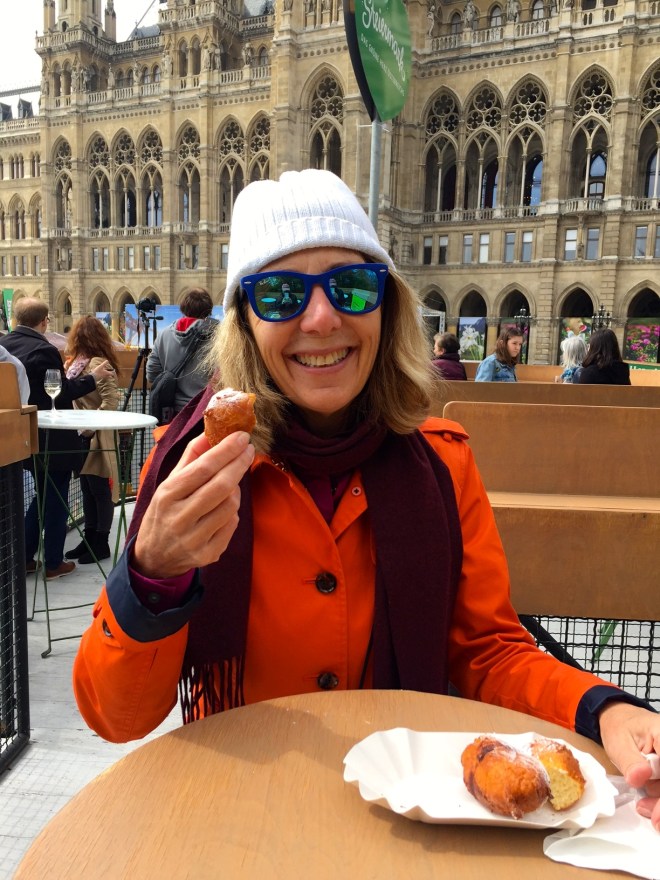 I must admit that I had low expectations and was happily surprised to discover how wrong I was. Vienna has delicious and affordable local cuisine everywhere. Although I’ve been pescatarian (vegetarian who eats fish) for almost 15 years, I expanded my diet to sample the wiener schnitzel and wurst for which Austria is so famous. The mustard is especially tasty.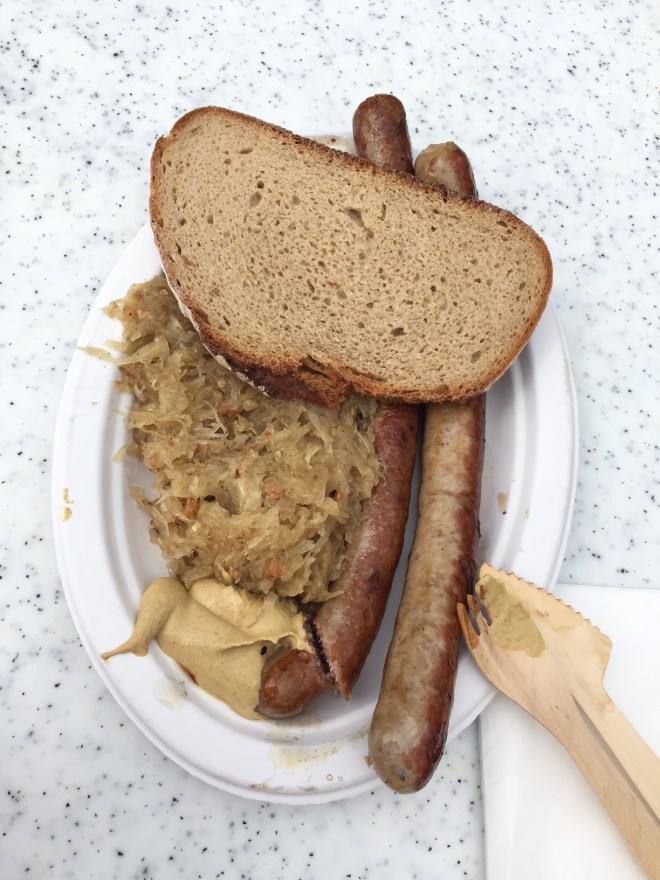
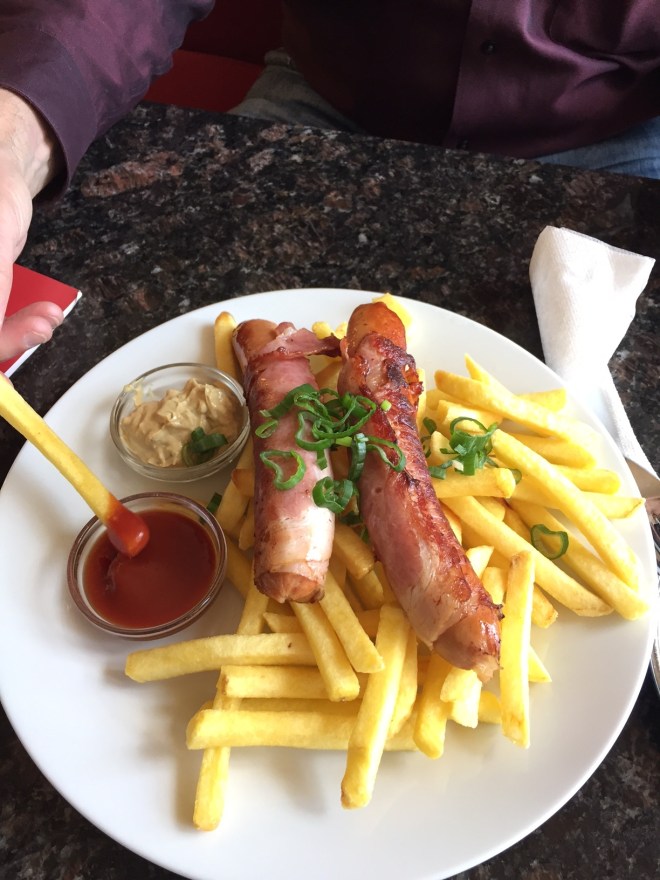 I must have seen half a dozen signs claiming to having the “original” wiener schnitzel. This one was bought at a festival; cooked fresh as ordered and was quite delicious.
 Menus and markets are full of influence from nearby Germany, Greece, Hungary and France. I can’t tell you what I enjoyed most. Among my favorites are the breads, cheeses and wines. The breads are rich and hearty, full of flavor and seeds; nothing like a loaf of American bread that is tasteless carbohydrates in comparison. There were plenty of open markets and small stores selling fresh foods with pride.
 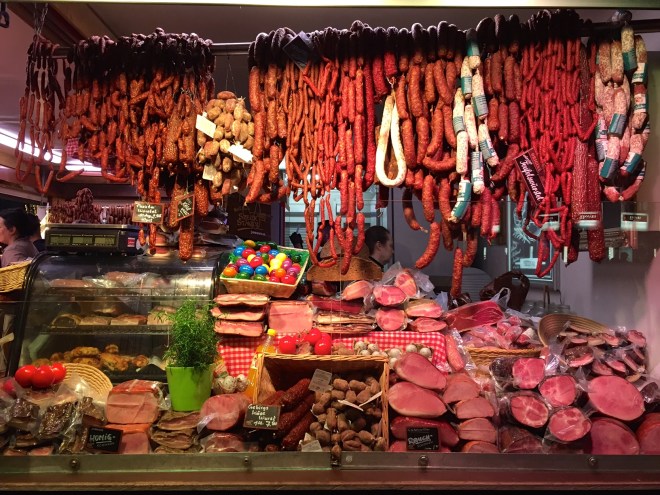 The cheeses were so plentiful and readily available that I quickly lost count of what I was eating and resigned myself to savoring the taste. As good as the bread and cheese are, they’re greatly enhanced by a glass of local wine. Both the red and white wines are blends of local grapes from the vineyards that you pass whenever you go out of the city. The whites tend to be light and fruity while the reds are more full-bodied. Both are served in a small glass and are quite inexpensive by American standards (about $4 US). But, wait! You must save room for dessert! Vienna is best known for the Sachertorte but I passed on the dense chocolate cake in favor of the lighter apple strudel with vanilla sauce, crepe with plum filling or custard, and a huge variety of doughnuts and pastries served with delicious coffee.
 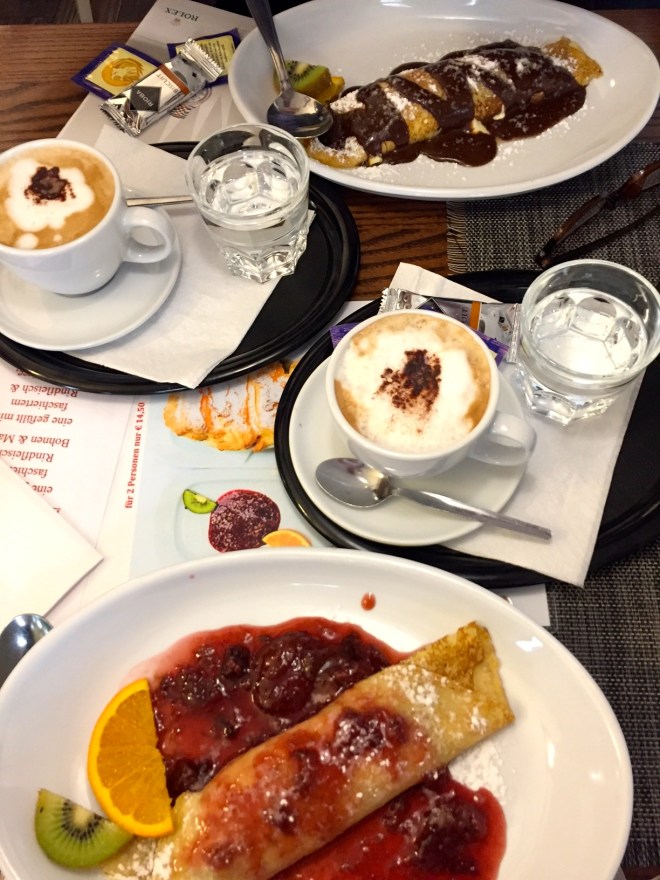 The plums are a spring treat that you can get in a multiple of desserts.
 The apple strudel is covered in a custard they refer to “vanilla sauce” and covered in powdered sugar. Yes, it’s as good as it looks.
 Again, I wasn’t expecting good coffee as I generally think of South/Central America or the Middle East for rich coffee but the melange (coffee with steamed milk) and espresso were perfect in the morning then again in the afternoon with a pastry.
  Daily afternoon tea time should be enjoyed at one of many coffee house for which Austria is well known. I was incredibly fortunate to have a travel companion who showed me the cool places with old pictures on the walls and many stories of times past such as Kleines Cafe and Hawelka Cafe. It was like stepping back in time.
 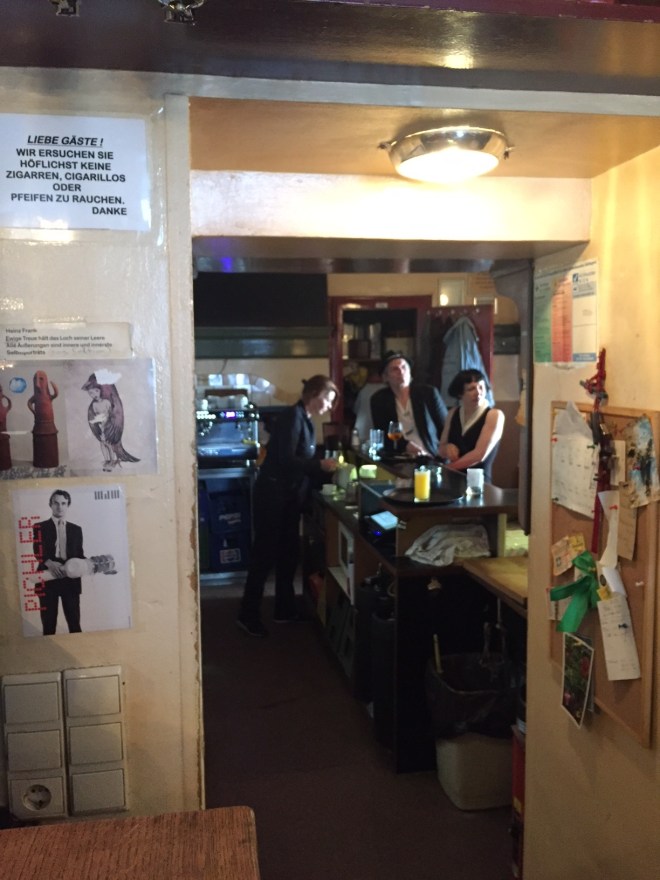 Not to be missed, the newer places such as the Imperial Hotel and the Hyatt have their own beauty and history.
  The lavish Hyatt is built in the old national mint, later used as a court for war crimes then as a bank.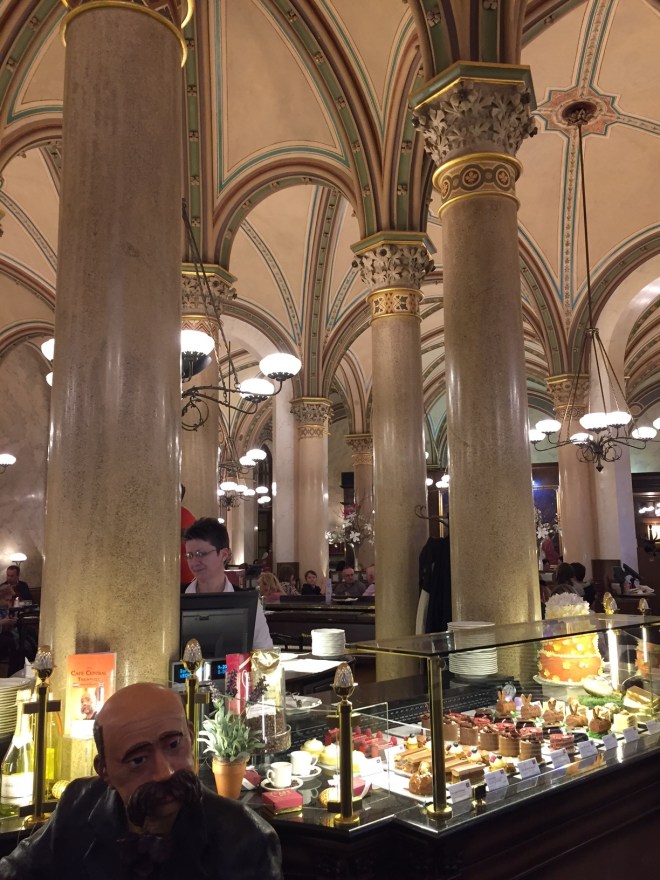
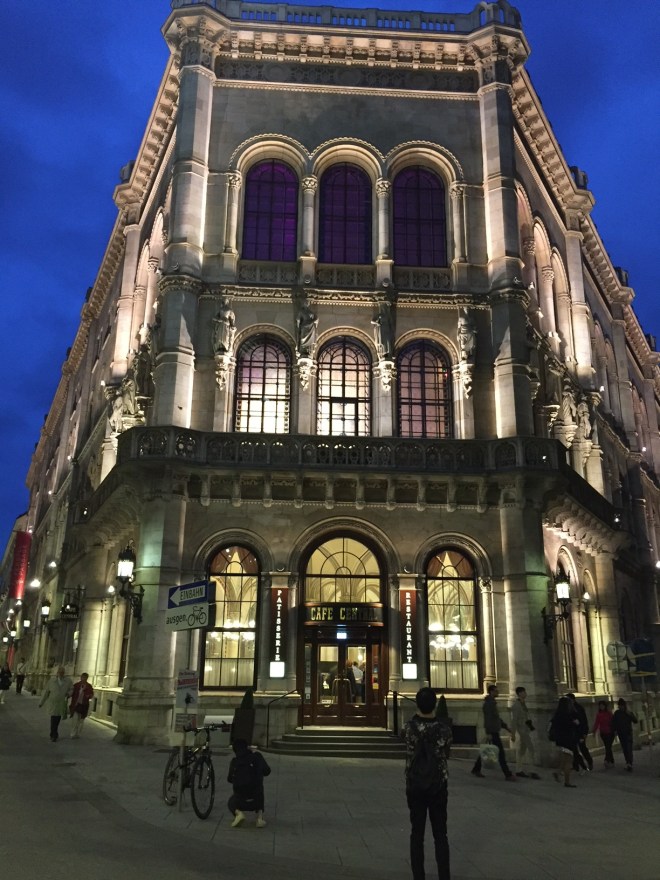
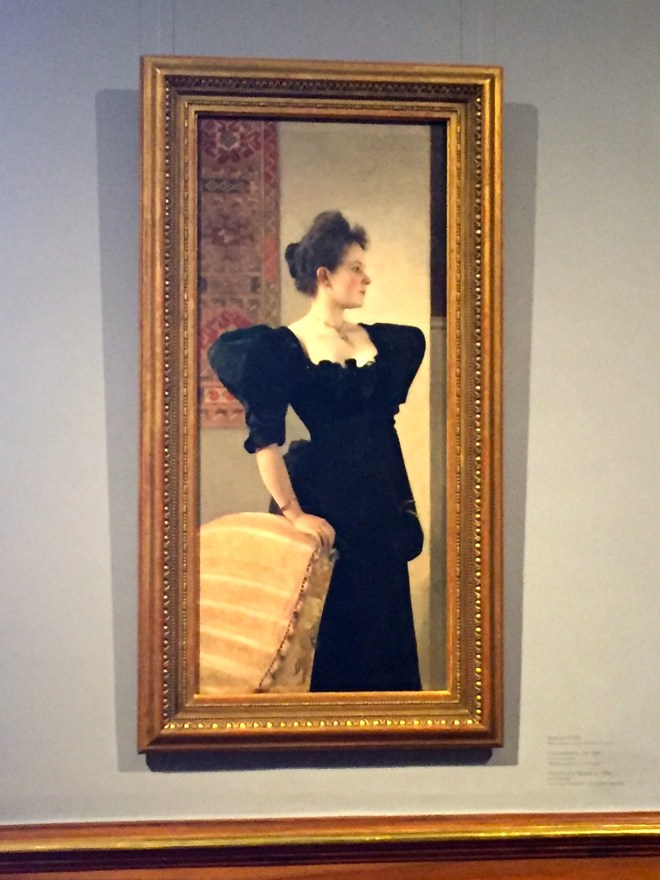
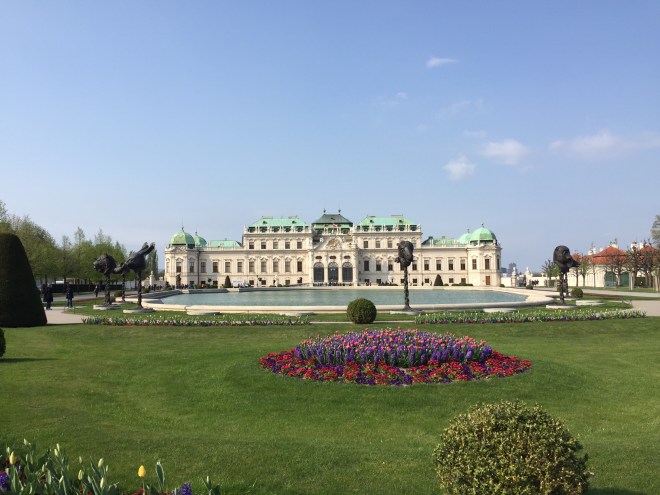
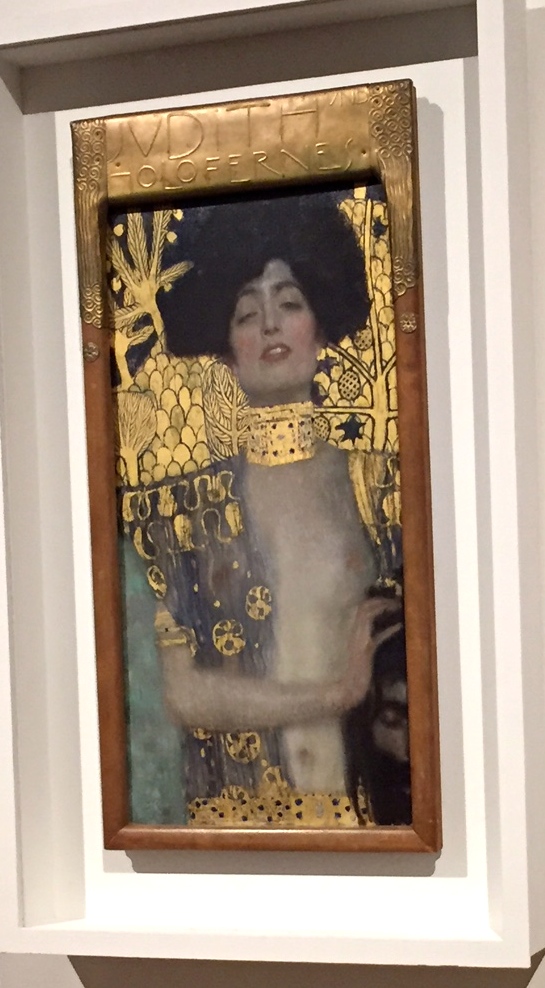 The Leopold and Belvedere Museums are worthy of more time than I could give them and I highly recommend both. Pictured below is the front of the Belvedere. If your time allows, it has a lovely cafe for lunch or afternoon tea and offers a majestic setting for a reprieve for tired feet.
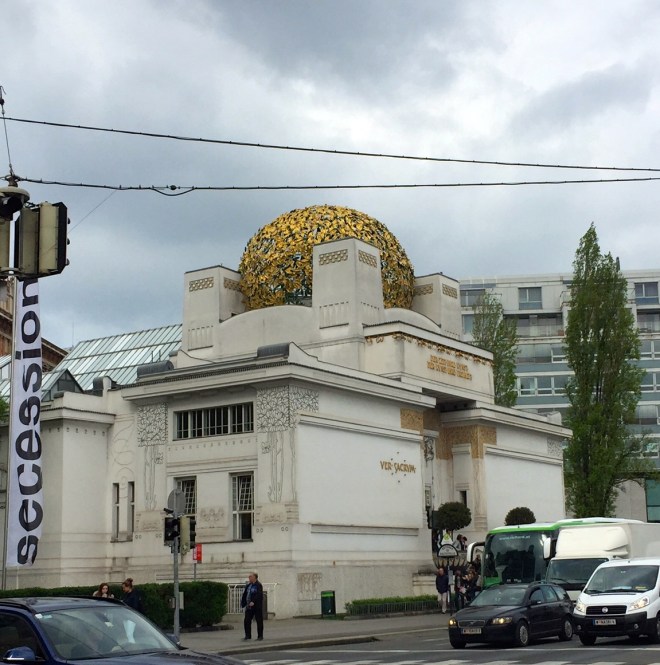
 The Museum of Contemporary Art was a bit disappointing to me but that’s probably just my taste in art, or lack thereof. The Secession is not to be missed as the building with the gold leaf globe on top designed by the artists themselves and the work inside are all part of the beginning of what is commonly known as “art nouveau”.
  On the top floor is the Beethoven frieze that Gustav Klimpt painted in 1901 in honor of the famous Austrian composer for the 14th Secessionist Exhibition. The frieze tells the story of human desire for happiness in a world of external and internal evil forces then ends in happiness found in the arts, as at the end of Beethoven’s 9th Symphony when he incorporates the poem “Ode to Joy” by Schiller.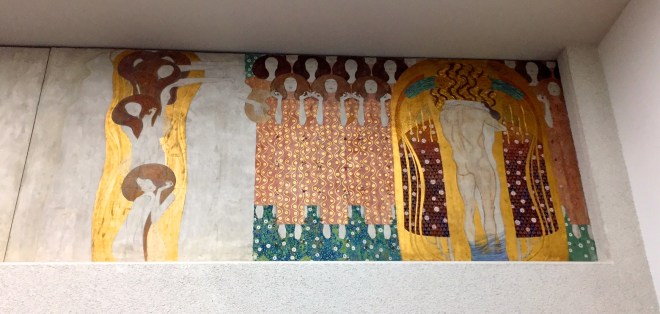
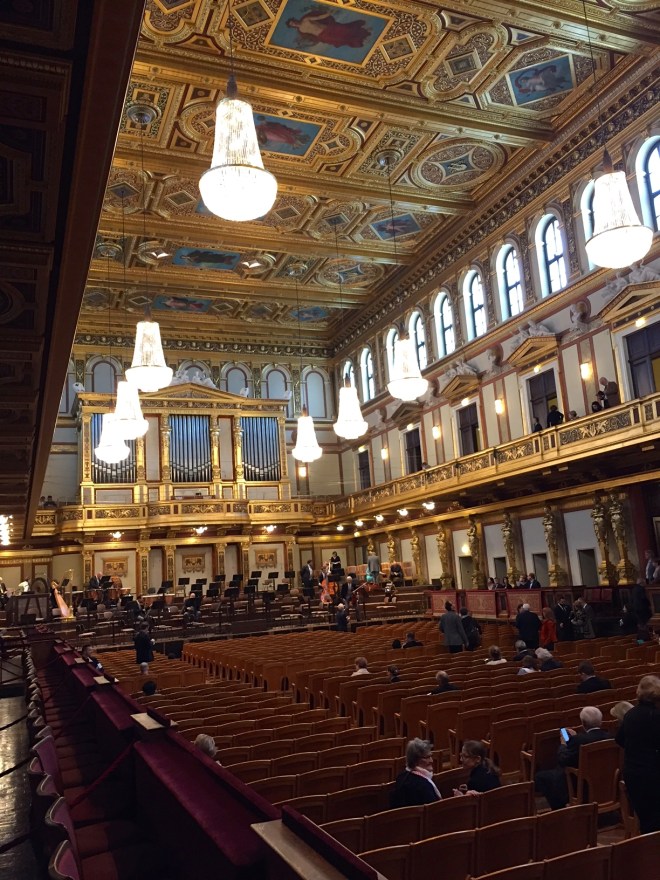 The beautiful Musikverein which is home to the Vienna Philharmonic takes your breath away. Our seats on the stage, just behind the percussion section, offered an amazing view of one of the most highly respected conductors and orchestras in the world. The list of famous Austrian composers is huge but it includes Mozart, Strauss, Schubert, Bruckner, Mahler and Haydn. I can think of no better place to hear this beautiful music than in its homeland.
  Vienna celebrates music at every turn. Here’s a statue in honor of Wolfgang Amadeus Mozart (1756-1791).
 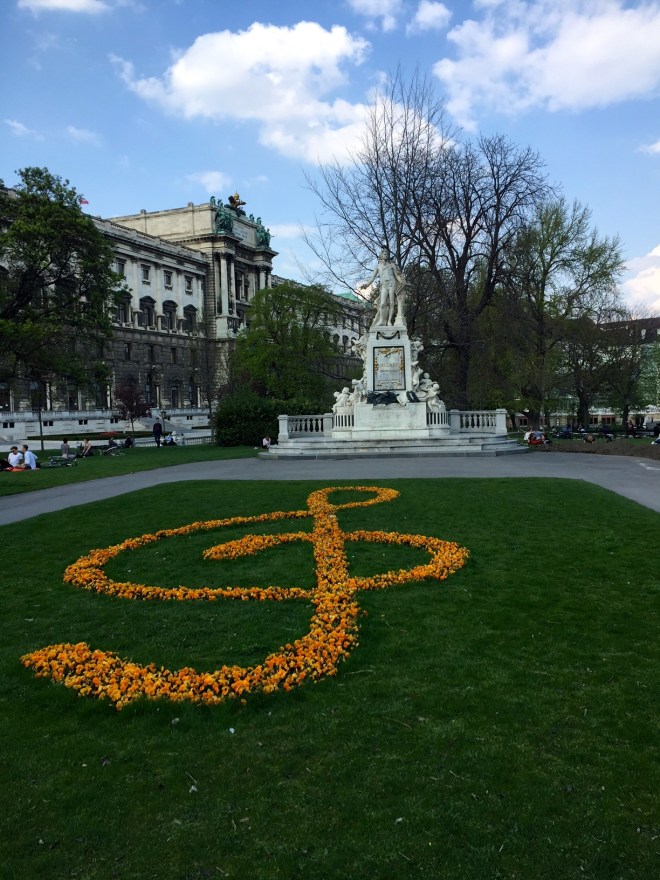 “A man should hear a little music, read a little poetry, and see a fine picture every day of his life, in order that worldly cares may not obliterate the sense of the beautiful which God has implanted in the human soul.”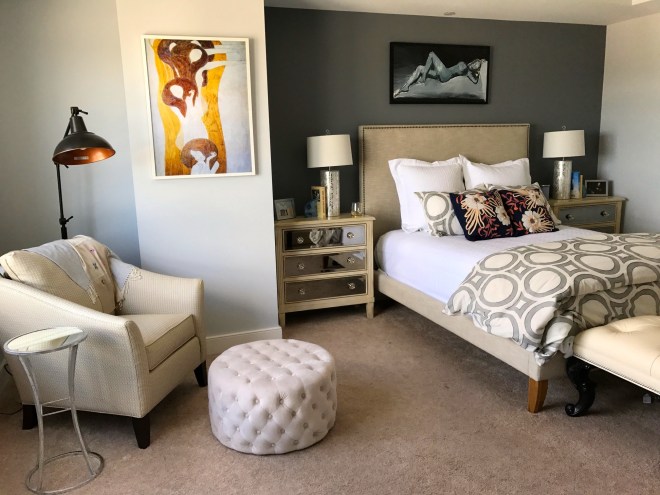
 We opted for a half-day excursion to one of the elephant sanctuaries for $50 US per person that included transportation and lunch. The domesticated elephants have been purchased and registered with a microchip to protect the wild elephant population. The sanctuary is about an hour and a half from the city, in jungle and sparsely populated countryside.
 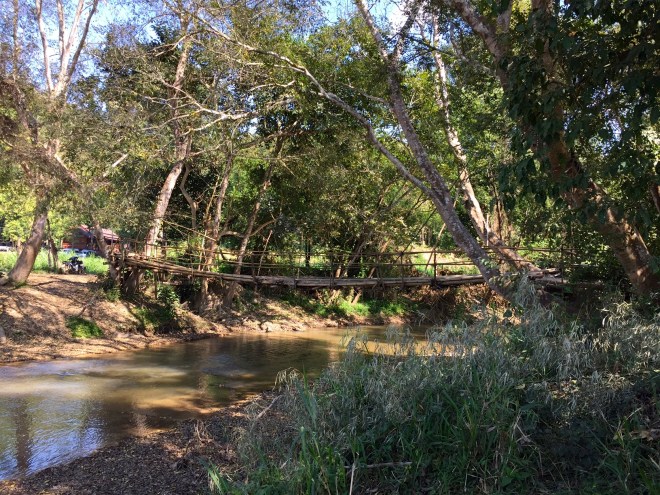 After an educational briefing, we fed the elephants bananas, sugar cane and grass. The bananas and sugar cane account for only 10% of their diet with the grass providing the balance. The night before, one of the elephants got into the banana storage bin and helped himself. No question, they loved the sweet apple bananas that we offered.
  We could hand the bananas to the elephant’s trunk or put it directly in his/her mouth. We were instructed to hide the bananas behind our backs and hand over just one at a time but the elephants clearly knew where to look for more.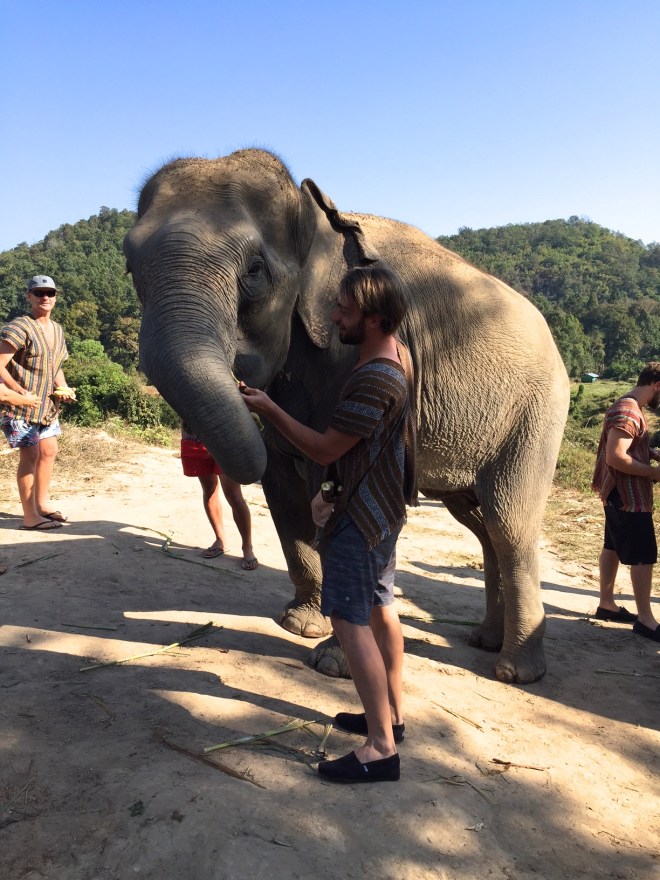
 After the snack, we went to a pond where we scrubbed mud on the elephants which is supposed to be healthy for their skin. They seemed to like it; some tilted their heads and looked us in the eye as if to ask us to continue. After the mud scrub, we walked down to the river for a bath in fresh, running water.
  Both the elephants and we loved playing together in the cool water. We had to be a bit careful when they rolled over as their legs are heavy and could cause minor injuries.
 What a great way to spend our last day in Thailand! Time for showers and one last delicious meal then we began the long flights home.
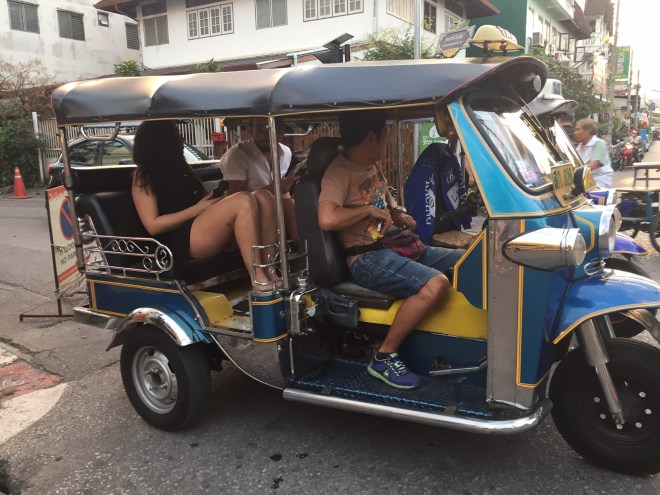
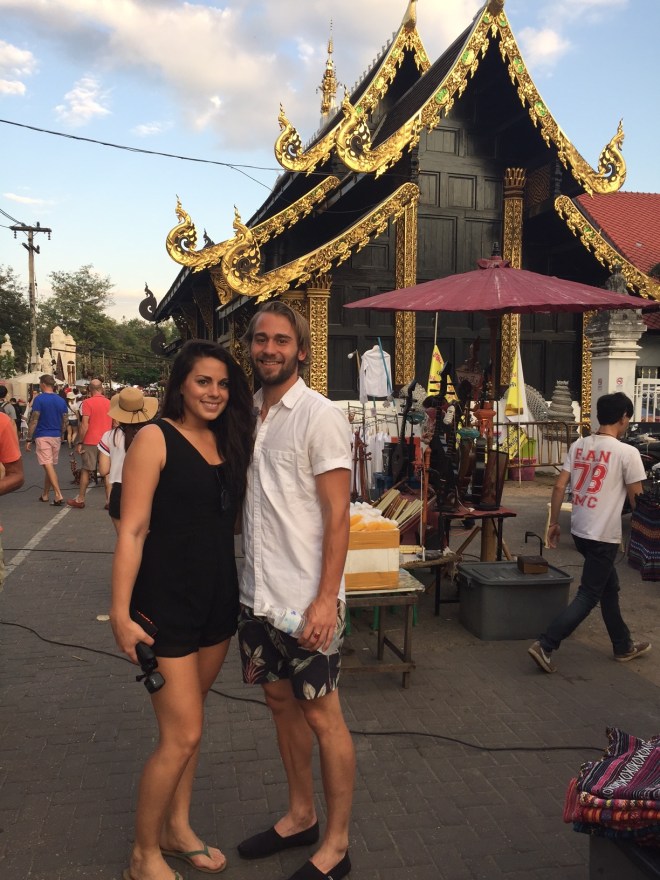 There was an open market set up and countless temples/monasteries in every direction. We paid a couple dollars for a ride back on a tuk-tuk, a three-wheeled motorcycle cab. These little tuk-tuks have replaced bicycle drawn rickshaws and are an easy alternative for a short distance ride. The little red trucks into which you jump in the back and sit on a bench are the most economical and easiest way to go more than a few blocks. We never paid more than 20 Thai Badt per person (about 55 cents).
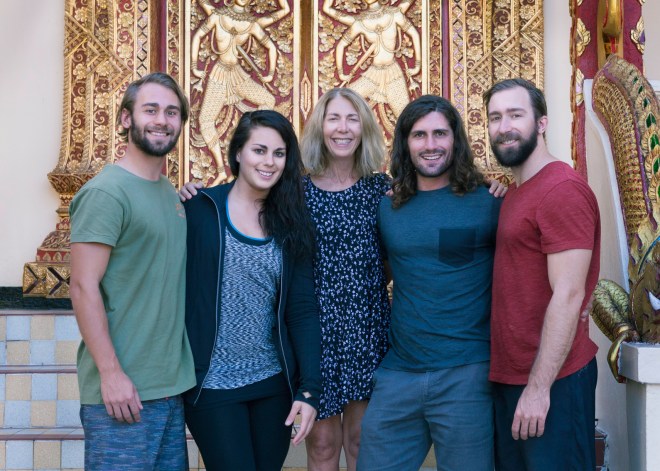
 My dear friend, Nee, picked us up for a traditional Christmas dinner with some of her nephews. The young men were raised and educated in the United States or England but, it’s clear, they respect their Asian culture as evidenced by the fact that they all came home to spend time with their 95-year old grandmother when her health began failing.
  Our host is Pauranee Chaisiri (Nee), whom I met in college in the 70’s. Although a very humble person, her family is well known due to her father, General Lee, who left Yuan (south of China) during the communist revolution, formed an army, walked through Burma to northern Thailand and liberated the land from communist hold. (
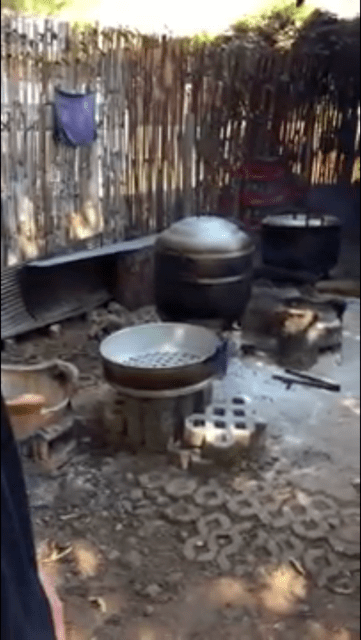
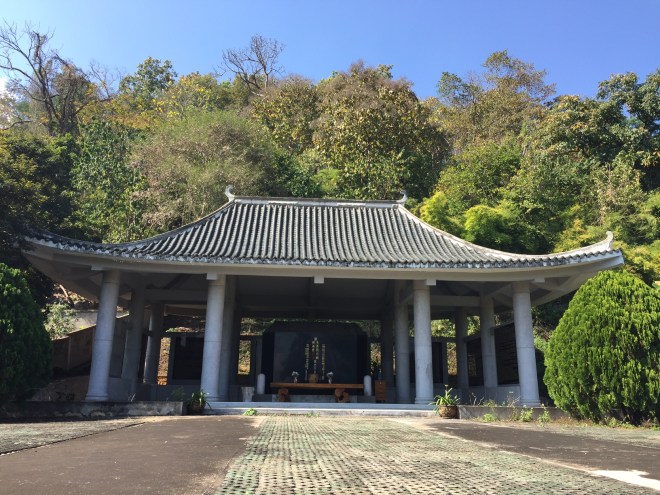 Nee now operates a restaurant on the site in Thom-Ngob where General Lee’s headquarters was and she lives in his old quarters when she’s in town. The restaurant serves delicious Yuanese-style food including puffy, rice buns and savory pork barbecue. The food is prepared by locals in giant pots on open fires in back of the dining area.
 This land was settled when her father purchased it (early 80’s) and gave small plots to approximately 600 soldiers and their families. Now many of Nee’s friends and employees are the soldiers’ children. He oversaw 36 villages but this area seems extra special since it was his headquarters and is on the highest elevation. The flat area at the compound was leveled by 100 soldiers with hand-shovels. Most all the rest of the land is steep with houses precariously balanced on the side of the road. The single road connecting villages is paved now but Nee remembers taking a six-hour ride on horseback to visit her father when she was younger.
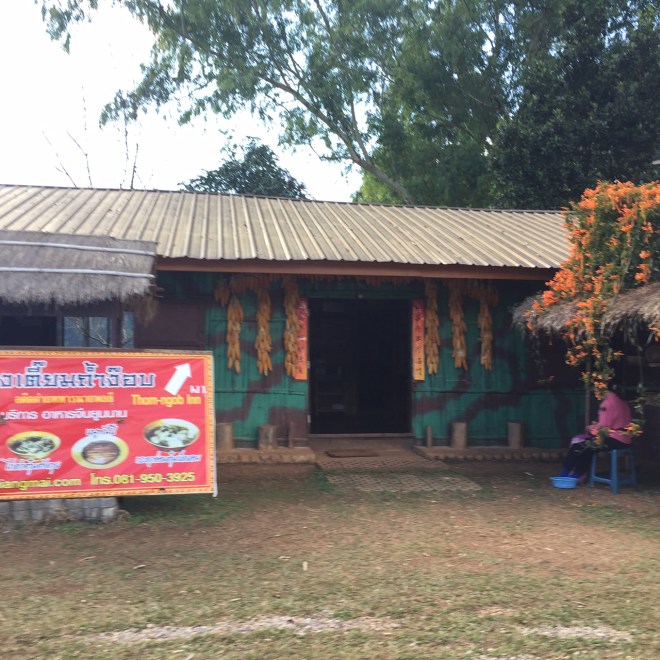 After lunch we drove farther north to the Royal Projects, an area of agricultural experimentation, botanical gardens, orchards, camp sites, cabins and cafe. This is part of the product of government efforts to close down the golden triangle opium trade among Thailand, Burma/Myanmar and Laos by providing locals with alternative crops and income.
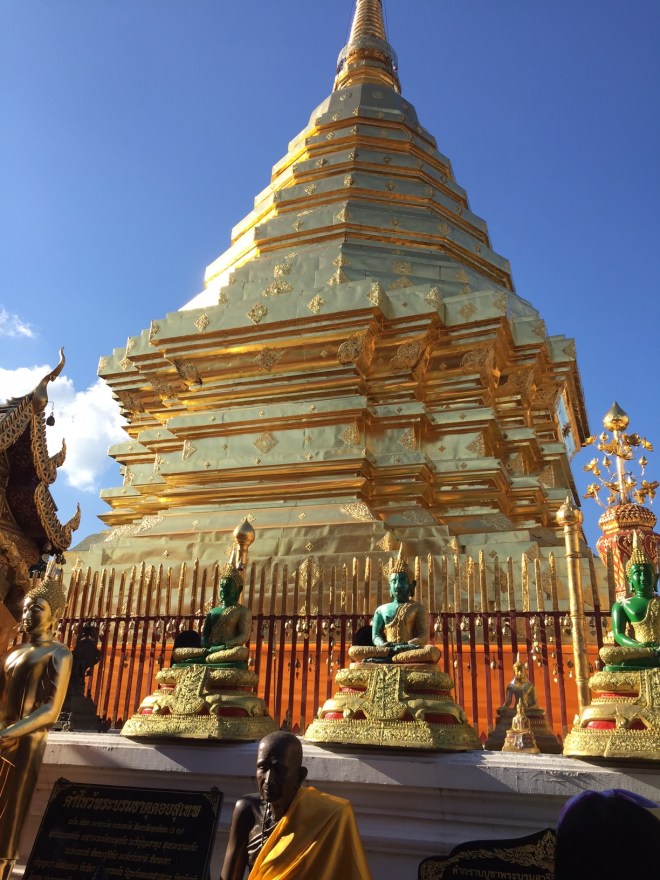
 Located way up at the top of a hill, it offers panoramic views of the city below. We went up by van; passing those hiking or bicycling up did not make me jealous. The huge staircase leading to the temple has long, dragon banisters of bright yellow with green and red. At the top, there’s so much gold everywhere that it’s practically blinding.
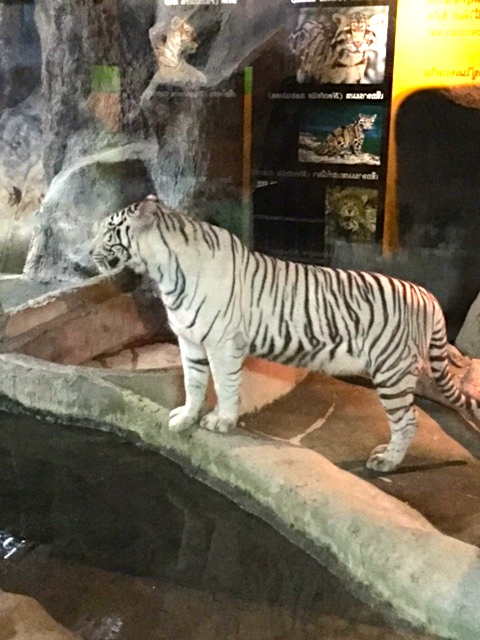
 Needing to get out of the van and do something a bit more physical, we headed to what’s known as the Grand Canyon of Chiang Mai. I’m not sure if it started as a natural crater or is the result of mining but it’s quite impressive and provided several hours of cliff jumping & diving, swimming, and fun for the tiny entrance fee of 50 Thai ($1.50 US)
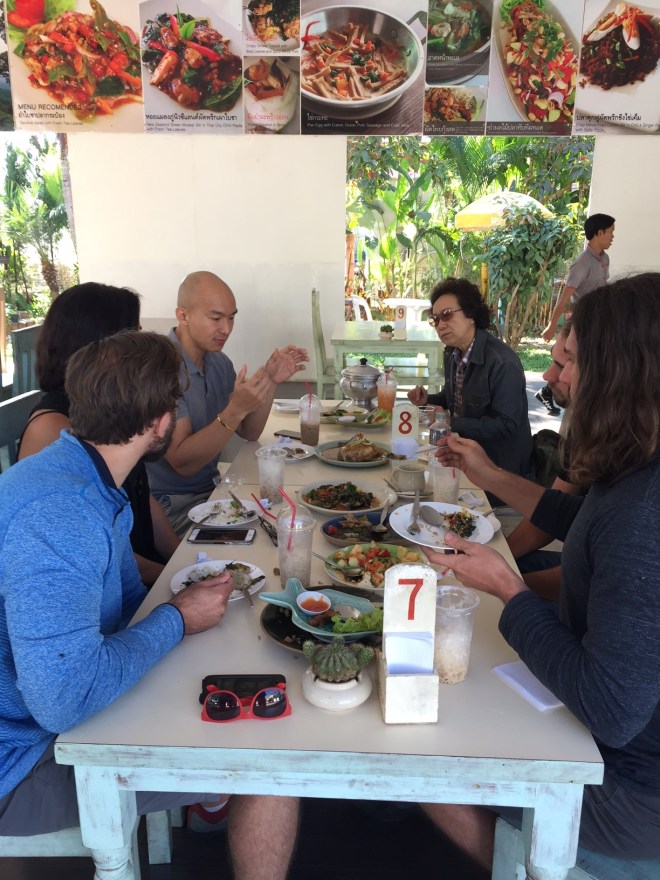 We often got take-out and relaxed at our Airbnb home playing games or watching a movie. Each morning we were up early to begin another day of exploration and good Thai food.
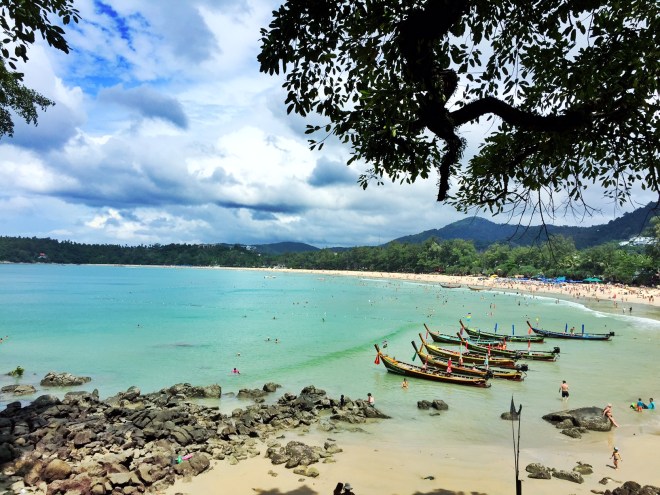 Phuket is in the south of Thailand, on the Indian Ocean, near the border to Malaysia. It’s definitely a tourist area and has a strong reputation for providing anything the tourists will pay for. We’re staying in a house a few miles away from the strip so we walked down the street to a market in the morning to buy coffee and fruit. Patrick cut up a big plate of mangoes, pineapple and bananas for our heathy breakfast. The fruit is at peak freshness and the merchants helped us with our selection. They laughingly insisted that Pat switch out bananas he picked up in favor of another bunch that looked the same to us. I haven’t seen any of the long, skinny bananas that we buy back home. These are smaller and much more flavorful. I think they’re called apple bananas.
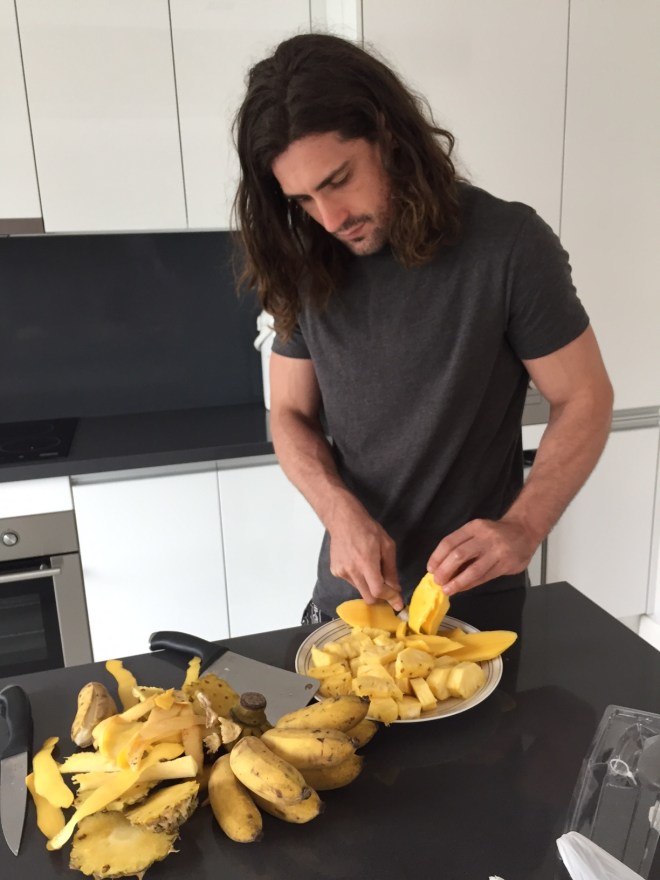 Freshness is definitely the main consideration when you’re shopping on the street…Straight from the tree or boat to the market.
  The electrical cables don’t seem to bother anyone except me but it looks so crazy seeing this big mess on virtually every street.
  At the beach, we walked along the shops and saw the typical touristy items such as T-shirts, sunglasses and souvenirs. There are a lot of personal service businesses like massage, nails, tattoos and hair salons.
 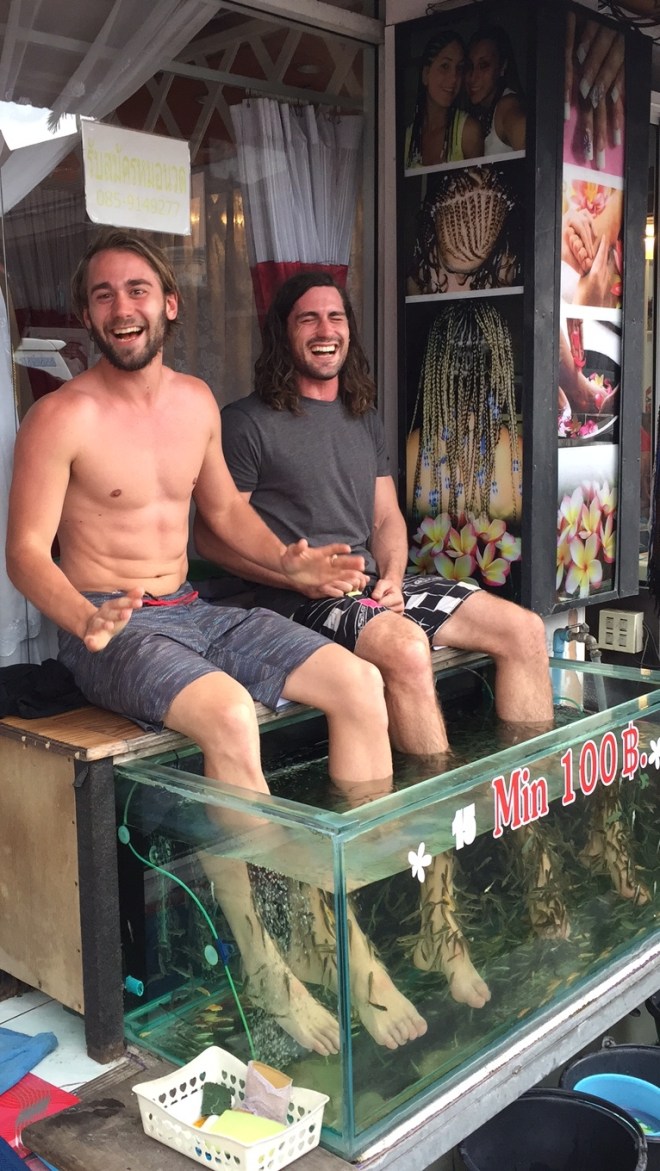 Daniel and Patrick laughed and laughed at this foot massage provided by little fish. The exchange rate is 35 Thai Baht per $1 U.S. dollar so this 15-minute treatment cost $3 USD.
 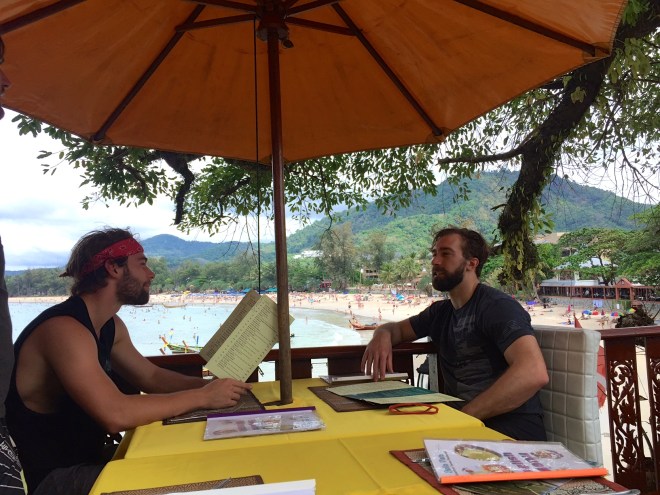 The views are so picturesque. And there’s no end to Thai food at very affordable prices (about $3 for a big plate of pad thai or curry with chicken).
 We spent Christmas Eve on the water. The Indian Ocean has warm, clear, blue water–perfect for snorkeling, diving, swimming and fishing and that’s just what we did. Although most of us are licensed SCUBA divers, we opted for snorkeling which was a good call because the water was shallow enough to see everything without going deeper.
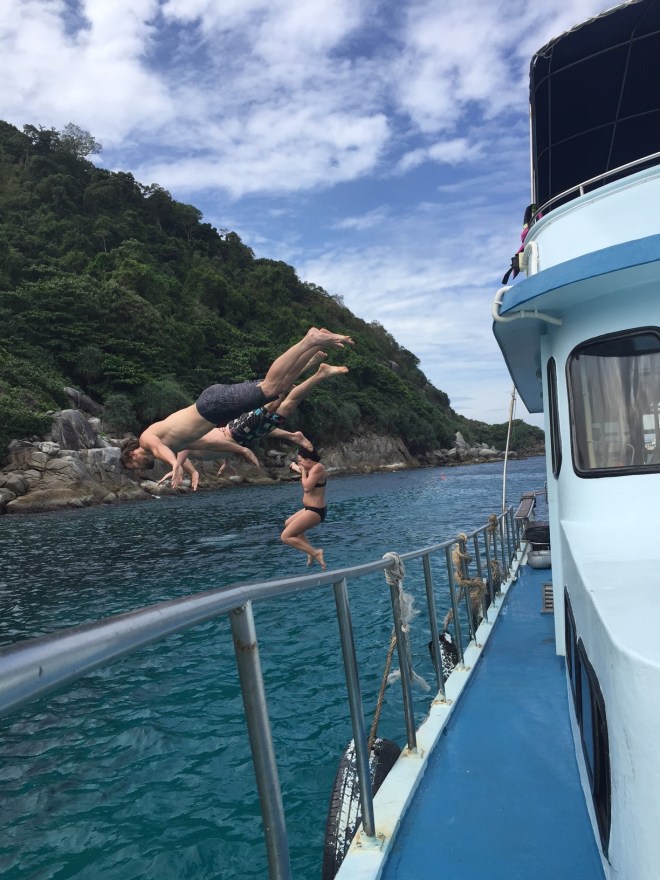
  The weather is so pleasant that we all got a bit more sun than we probably should have. Here’s a picture of Andrew, Patrick and Kristina jumping off the top of the boat into about 30 ft of water.
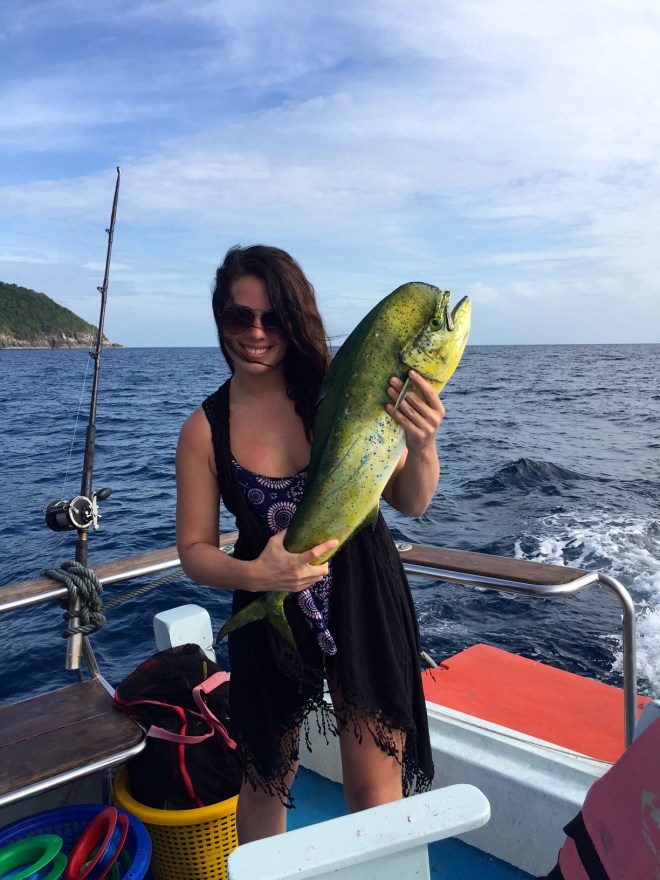
 We trolled most of the time we were out and caught about a dozen tuna plus this big mahi that Kristina brought in. Our guides cut up some of the tuna and made delicious sashimi with soy wasabi sauce.
 To get from the parking area down to the end of the dock where the boats are, there’s a little shuttle trolley that holds about 20 people but more like 50 get on it each time. Here are all four kids crammed into the trolley. Fortunately, it’s a short ride. Kind of funny how we stand out among the Asians who are smaller. There’s no way we could pass as locals but we could easily be thought Europeans until we start talking.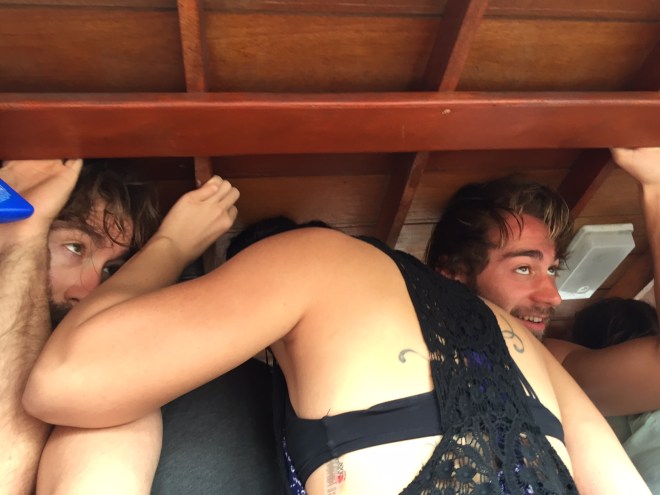
 First things first–delicious iced coffee for all five of us. It seemed so odd that we couldn’t find any cafe open until 10 AM so we used the time to walk around the streets and watch the merchants set up their wares including raw meats, aromatic cooking, fruits and vegetables. There’s something fun about sitting outside in shorts while it’s freezing back home in Virginia.
  I was aware of the recent passing of the king and the customary year of mourning but I was surprised to see the depth of the show of sympathy including black bunting draping walls and buildings, memorials set up all over the place, and black attire or ribbons on the locals. This memorial display is typical of what we saw at least once every block.
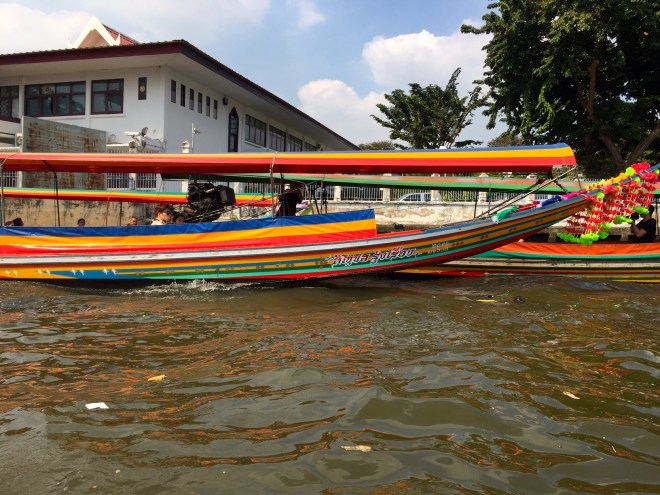
  With just one day to spend in Bangkok, we opted for a two-hour boat ride on the river and up the canals.
 The water was filthy including floating dead goat but it was surrounded by life. The big floating markets are set up on weekends but we passed a few boats selling things. Children were swimming and busy households were cooking, washing, and making noise. We saw many of these large amphibians sunning on the banks — I think they’re monitors. They’re much bigger than an iguana and almost as large as an alligator.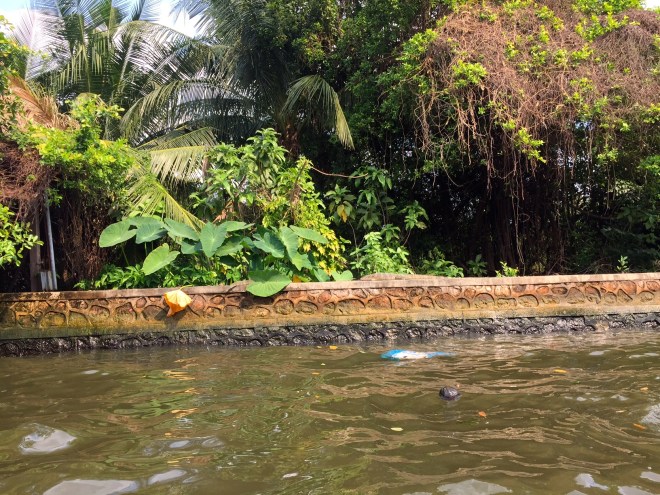
 Going into and out of the side canals, we had to pass through a lock to adjust to the water level.
 Before heading back to port, we stopped by one of the many temples and walked around. These gardeners are balanced on bamboo scaffolding as they trim ornate trees.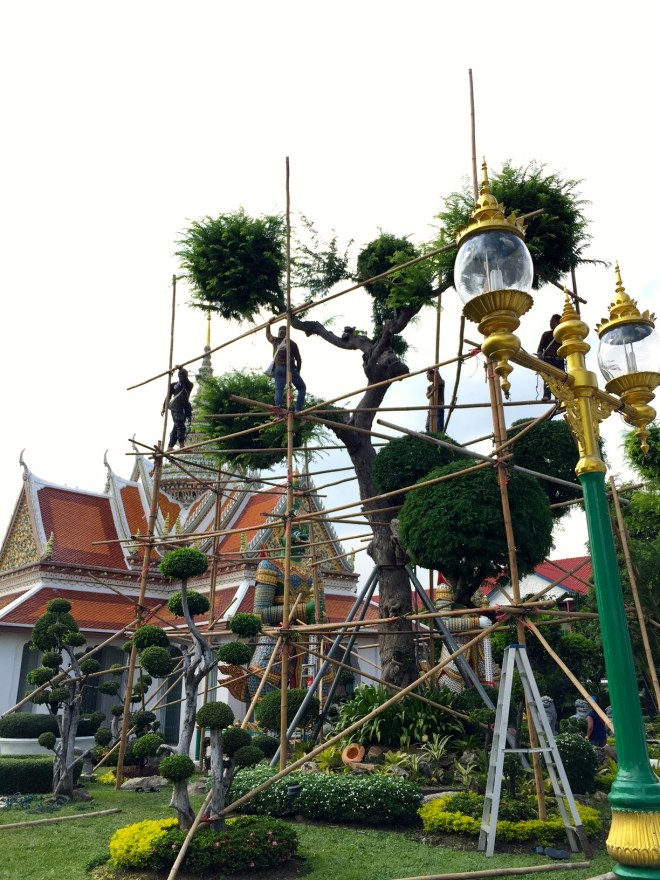

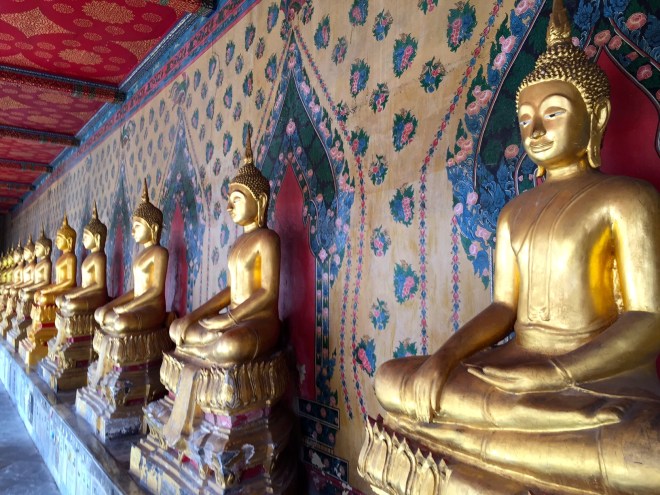
 These pictures were taken of smaller temples but some are huge compounds with multiple buildings and gardens. Temples are all over the city. We walked by the grand temple where the king’s body lays in state and saw thousands of people dressed in black, lined up for blocks, to pay respect. The memorial crowds add to the already grid-locked traffic. At one point, we got out of an Uber car and jumped on the train. It’s really the fastest and easiest way to get around the city.

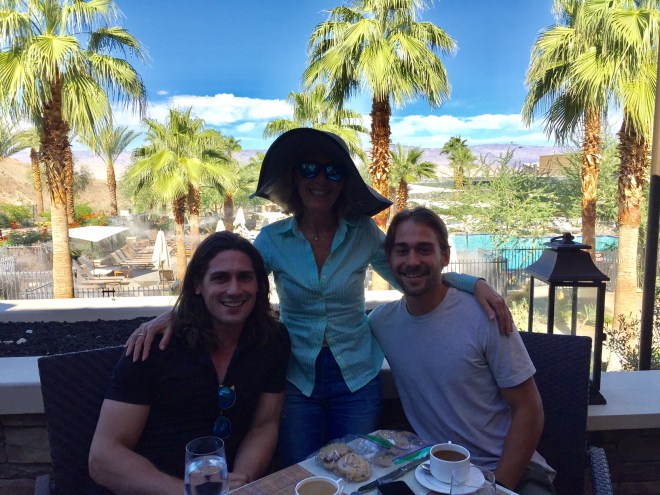




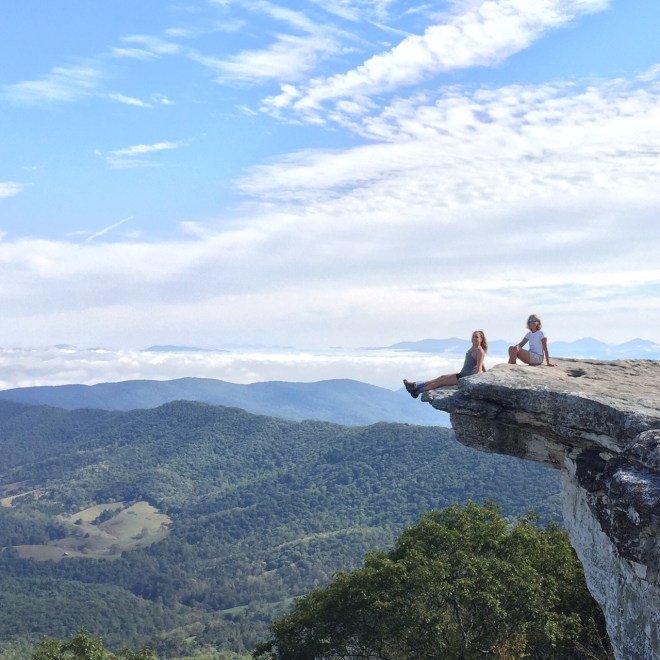 Yesterday my daughter, Kristina, plus three friends and I hiked to McAfee Knob. Yes, she made me very nervous getting so close to the edge.
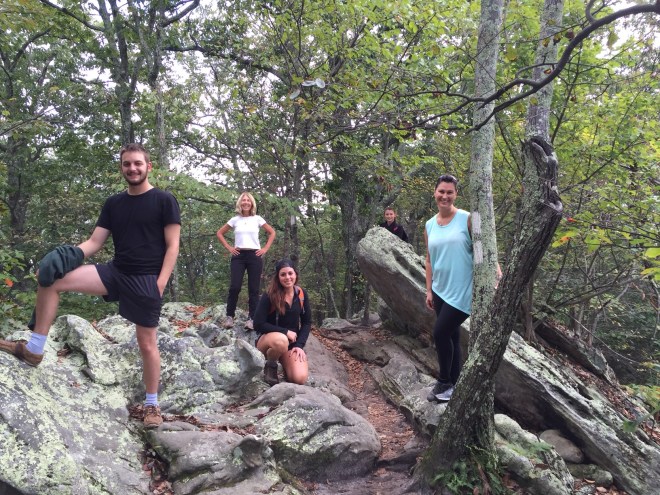 The weather was perfect–about 70 degrees. We were just a little early to see colored foliage but a few of the trees had orange leaves. We passed about a dozen rock climbers practicing their skills on the giant boulders as well as campers on their way down from spending the night wilderness camping (there is no proper campsite and access is strictly by foot). Everyone had a smile on his/her face and a lot of the hikers wore VA Tech shirts and hats reminding me that Blacksburg is only about 30 miles away. How long it takes start to finish depends, in part, on how long you stay at the destination point taking pictures and soaking in the majestic views, but we spent about 4 1/2 hours total.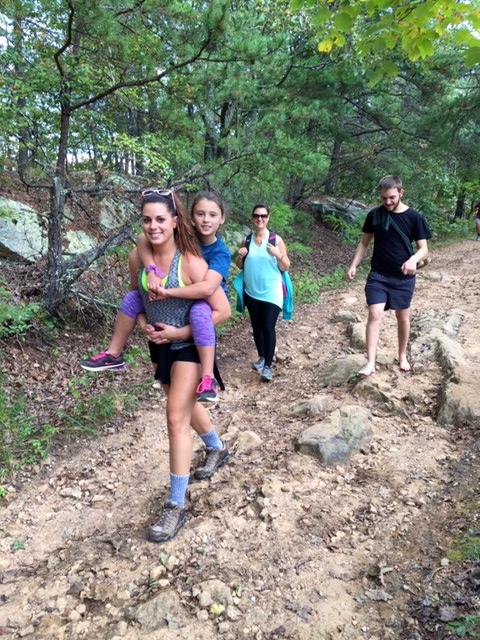

 Kathryn Byler, blog