- It seems I’ve taken a water tour of deserts. I’ve been in the Mediterranean Sea, Dead Sea, Red Sea, Sea of Galilee, Jordan River and several smaller bodies of water including a waterfall at Wadi Boqeq and springs at Tel Dan. Wherever there is water, there is green growth and life. Just a few yards away the brown, dry, sandy desert returns. (The Dead Sea is the only exception since the salt content in the water is too high to support life.)

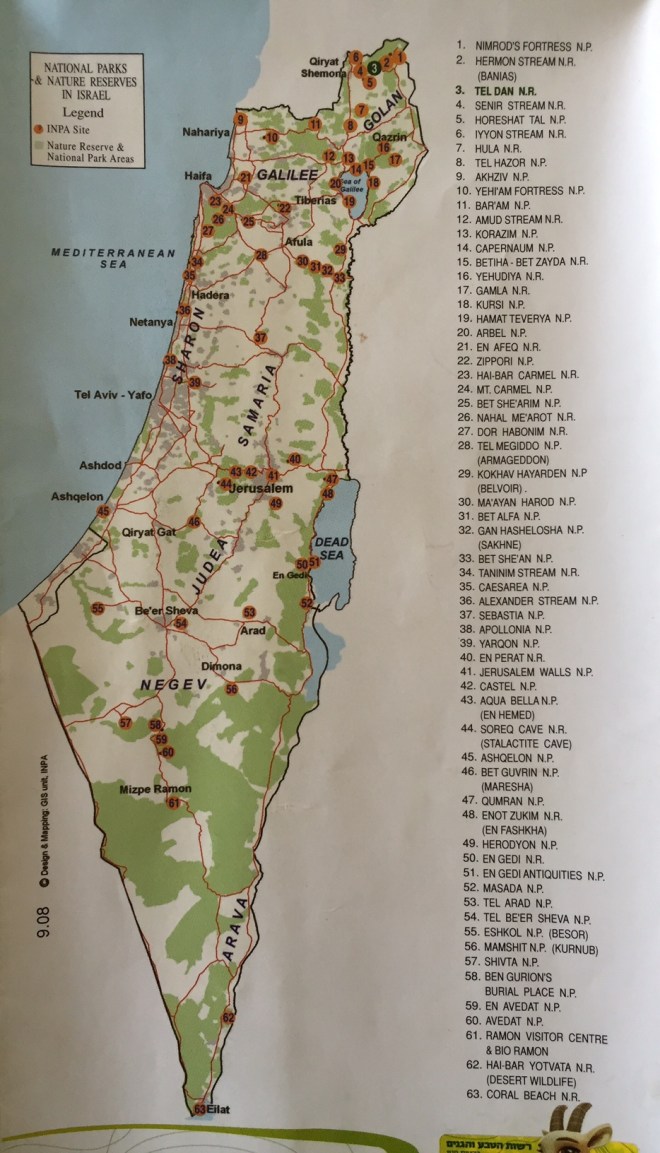
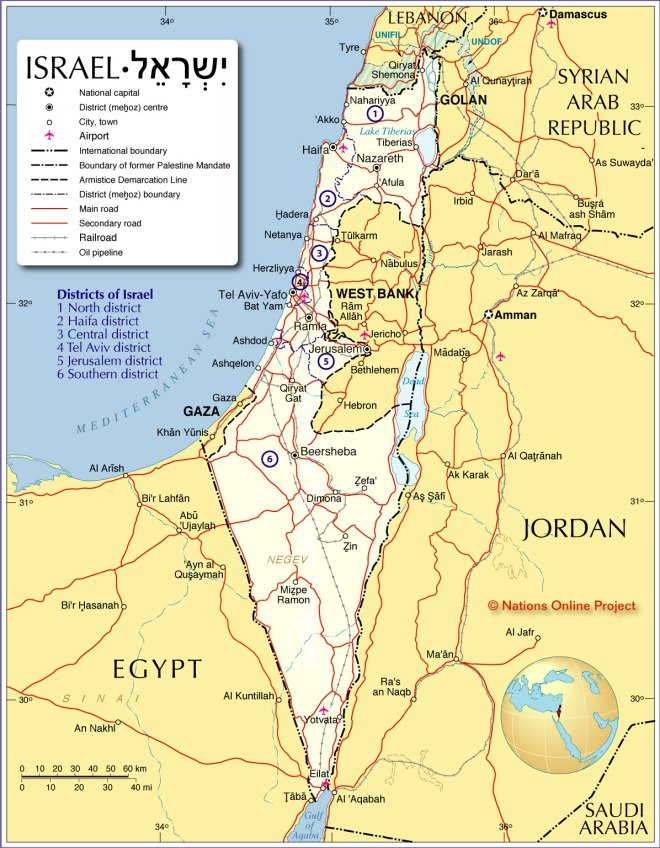
- I’ve been at every border of Israel — Lebanon, Syria, Palestine/West Bank, Jordan, and Egypt. The country is the perfect size for a two-week trip. Clearly, I need much more time to explore with depth but I made it to all extremes without feeling hurried and I stayed fascinated by my surroundings without getting bored.
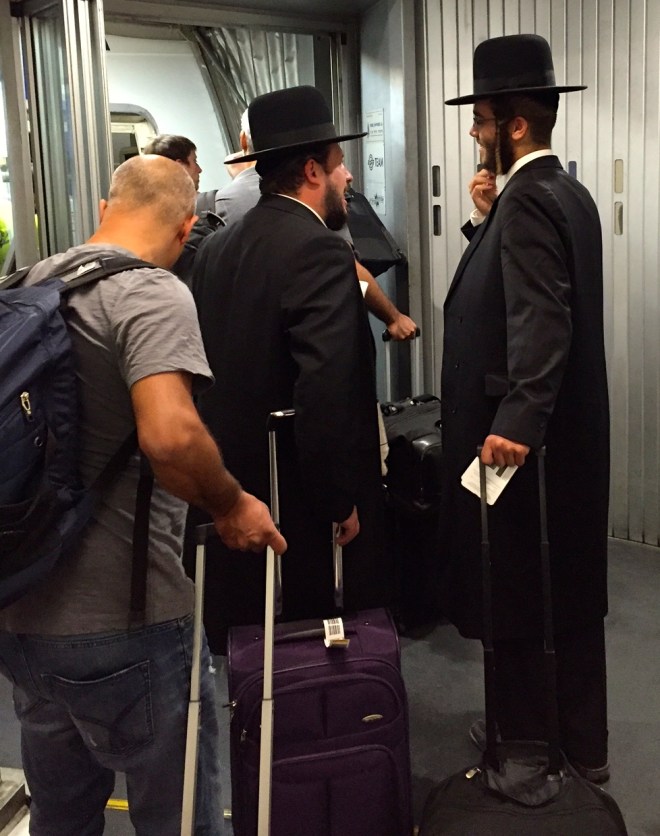
- At first blush, Israel seems to be a country of Jews and Arabs (75% Jews, 20% Arabs with 5% other) but it’s actually much more complex than that. The Jews are segmented into many groups. Historically, place of heritage (Ashkenazic light-skinned Europeans, Sephardic dark-skinned Spanish and Middle Eastern) divided the population with the Ashkenazic receiving preferential placement within the country allowing them access to better jobs, education and housing. The new influx of a million Russians added to the division based on country of origin. I also noticed a divide between the religious and secular Jews. While the secular population serves in the military and protects the freedom of the country, the religious block has huge political power and attempts to impose its beliefs on everyone. A small example of this is the mandatory closing of stores on the sabbath. This causes some discontent among those who prefer freedom of choice. Since Israel is a Democratic country built on Judaism, this can be a difficult balance.
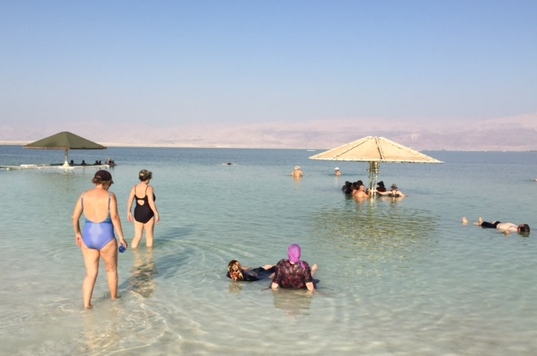
- Although essentially all are Muslim, the Arabs are also not homogenous. Some consider themselves Palestinians with Israeli citizenship, others are Bedouins and some are Druze. The Bedouins are traditionally nomads but I saw some setting up villages with primitive but permanent structures. It surprised me to see several bedouin campsites in the middle of nowhere with a car. It seems change comes eventually to even ancient traditions. The Druze are generally loyal to whatever country they occupy. The Arabs and Jews often share workplaces, streets, restaurants and entertainment venues. At the beach I’ve seen women in long dresses and head coverings (Muslim or religious Jews) and others in bikinis (non-religious Jews) sharing the water. I didn’t see them personally but I heard there are topless women sunbathers (Europeans).
 Working, playing together and even friendship is one thing but I understand there is no intermarriage. Under Muslim Sharia law, intermarriage is punishable by death of both the man and woman. (http://www.billionbibles.org/sharia/sharia-law.html) The Christian population of about 200,000 is much smaller but its members are also committed to their beliefs and feel called to live in the Holy Land. The balance of the population is a mixture of Samaritans, Assyrians, Circassians, Vietnamese, Baha’is, and others. That’s a lot of diversity, each group hugely committed to its own values, trying to live peacefully in a small country.
 - Several times I heard Israelis comment on how far they’ve come in 70 years. It’s true. What was largely uninhabited desert is now a vibrant economy with commerce, arts & culture, universities, outstanding facilities for medicine, scientific and anthropological research, and respect for the rule of law. Importantly, all people are free to practice the religion of their choice and the holy sites are open to all faiths. The architecture everywhere is formidable. I especially love Jerusalem where all structures are built in limestone so there’s uniformity and a Zen-like feel that everything blends in with the beautiful hills and rocks. Here are just a few of the new buildings in Tel Aviv.
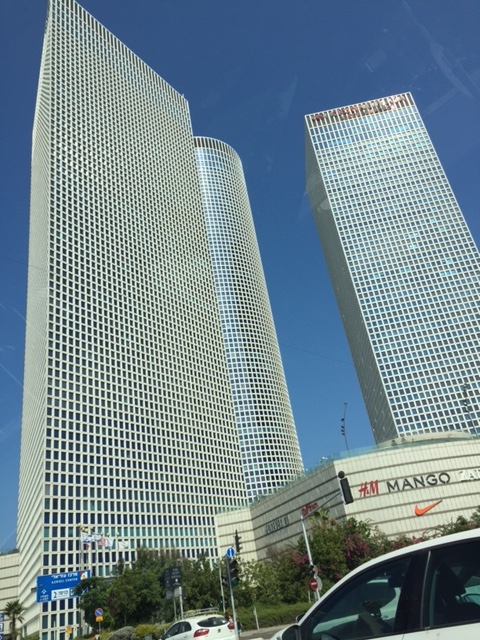
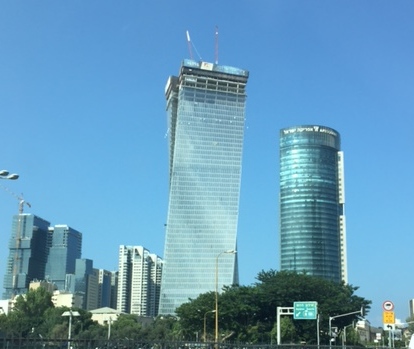 Far from desolate, Israel is a major exporter of fruits, vegetables and flowers. Impressive gains in sustainable agriculture and energy are helping the entire world. “The desert and the parched land will be glad; the wilderness will rejoice and blossom.” Isaiah 35:1 While I appreciate all that, a Sponge Bob water park near the Sea of Galilee is too much for me. Where are the zoning and permit inspectors when you need them?
 - One quickly becomes acquainted with a kosher diet when visiting Israel. Basically, dairy and meat must be kept separate. One should wait four hours after eating dairy to have meat and eight hours after meat to consume dairy. Vegetables, fruits, breads and most fish are neutral so they go with either. Pork, crabs, and shell fish are never eaten. Breakfast ends up being full of cheeses, yogurts and dairy products but no meat.
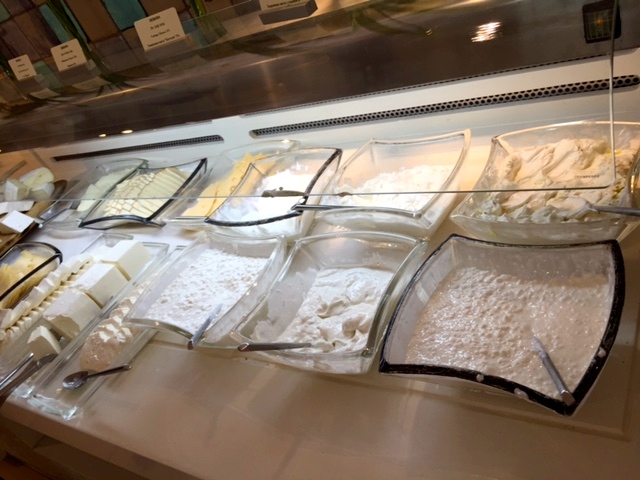 Lunch and dinner are meat meals with no cheese, milk or cream. Most of my friends eat only kosher foods but don’t keep kosher kitchens or worry about details such as timing. A law prohibiting non-kosher meats from being imported means that thousands of inspectors (and their families) are paid to live all over the world monitoring the farming, slaughter and packaging of meat. That amounts to a cost of about $770 million U.S. or 3 billion shekels annually. The cost of meat is then more than double what it would be otherwise which is a concern for Arabs and others who don’t choose to keep kosher. This is another example of forcing others to comply with Jewish religious laws. (http://failedmessiah.typepad.com/failed_messiahcom/2016/01/israel-spends-about-770-million-annually-on-kosher-food-supervision-driving-up-the-cost-of-food-by-5-percent-234.html)
 - Whenever I travel I notice small differences that may be inconvenient to some Americans. One such difference is toilets. Since Israel has a severe shortage of water, toilets have two flush options–a small one for liquid waste and a larger one for solid waste. Paper is put in a trash can, not in the toilet, as the water treatment plants are not equipped to handle paper. Entering into Jordan, public toilets are essentially a hole in the floor. I suggest you take your own paper and, generally, avoid them, if possible. Restrooms in hotels and restaurants are nicer.
- A close Israeli friend and I were talking one night and he made an insightful observation. All four of our parents started with nothing. His parents walked out of Iraq, refugees leaving their home, business and possessions except for one suitcase to begin life in a country where they didn’t speak the language. Neither of my parents had a high school education and were raised in the depression. That generation sacrificed and took risks, working hard to give their children better lives than they had. We’ve done quite well, thanks in large part to what they provided, but what’s more impressive is our children who are competing on an equal level with anyone in the world.

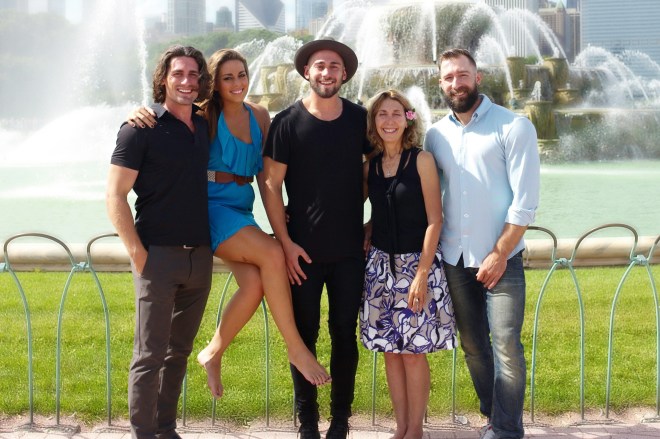 I have no idea what another generation will bring but we’ve come a long way from the 1920’s to 2016.
 - I am not a historian or politician. I am not Jewish or Muslim. I make no claim of understanding the politics of the Middle East. In my opinion, war is horrible. Having said that, some things are worth fighting for. Regardless how unavoidable or necessary, deadly fights over freedom, over land, over anything are tragic. My own beloved country, the United States of America, was “stolen” or “won” from those who previously occupied it through a series of battles and wars. One of my friends/readers challenged me on my statement that what is now Israel was “largely uninhabited desert” 70 years ago. I know no answers to the problems that continue today but I found an interesting article on a blog written by someone who shares my surname. Although I’ve never met the writer and have no personal knowledge of the veracity, I share it in hopes of shedding light on a very different aspect of what life in Israel is like today for some. (https://cindydarylbyler.wordpress.com) Through my travels in Israel and Jordan, I found only beauty and good people everywhere I went. But I saw the memorials, the bomb shelters, the discrepancies between the cultures and I heard the comments and fears of my friends. When my 18-year old, Israeli friend left to begin his army service, he proudly showed me his uniform and talked excitedly about the experience. I shared his joy with the certain knowledge that this is not a game. Living under a shadow is not healthy and, even worse, when war breaks out each country sacrifices its strong, courageous, young people. I told my friend I will pray for his safety. And I am.
Author: kbyler2015
I'm a real estate broker, attorney, and adjunct professor of law; mother of 4; grandmother of 2.
Northern Israel
After crossing back into Eilat at the southern tip of Israel, we drove northwest to Rishon LeZion near Tel Aviv-Yafo. The highways are new and big but there’s not much to look at except gorgeous Arava and Negev Desert. The few towns, Dimona, Be’er Sheva and Qiryat Gat, are relatively small and not very exciting. I wish I had time for camping and hiking because I understand there are some really nice places. After a quick change of clothes and change of attitude, I headed to Kibbutz Glil Yam near Herzliya for Shabbat dinner with our Hasidic friends.
Shabbat dinner is full of ritual, scripture reading, prayers (all in Hebrew, of course), and protocol. The meal was long, plentiful, beautiful and delicious. I was told by the father of the home that in America good things come easy but in Israel and throughout the Bible, good things come hard. Therefore, one must ask God for what one needs, thank God when it’s delivered and appreciate that God is the source of all goodness. There are so many rules, I thought it best to sit quietly except to follow the other women when it was time to wash our hands three times. From sundown Friday to sundown Saturday, no work may be done, including cooking, turning on light switches, pushing elevator buttons, or driving. Shabbat elevators open and close automatically on a timer and stop at every floor so there’s no need to push buttons. The actual Shabbat meal is essentially the same each Friday night but it’s prepared on Thursday with salads and last minute items made on Friday. All day Thursday and Friday the house is cleaned, food is prepared and the family gets ready for Shabbat. Enough food is prepared to eat on Saturday also. The dishwasher isn’t started until after sunset on Saturday when the sabbath ends. Thursday, Friday and Saturday, three days each week, are devoted to Shabbat preparation and celebration.
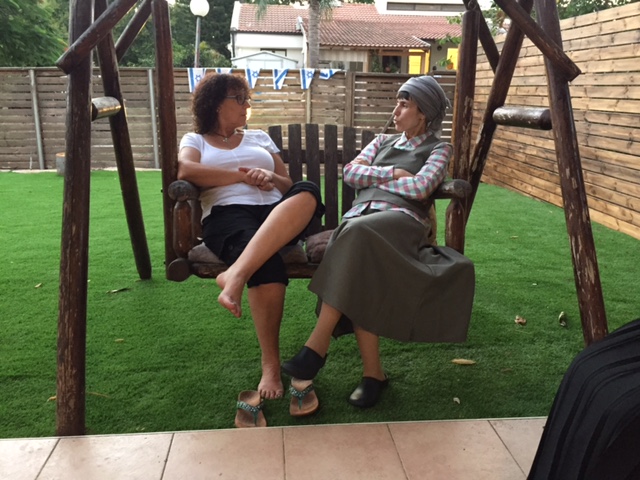
Saturday we went to the beach in Herzilya (Mediterranean Sea) then north to Hadera for the night. Dinner in Yikhron Ya’akov was like visiting a magic village. It’s 35 km south of Haifa at the southern end of the Carmel mountain range on the Mediterranean and has pedestrian streets lined with small cafes. Once again, I need more time to stay in these wonderful places. A couple hours is horribly insufficient.
Sunday morning we drove to the extreme northern point of Qiryat Shemona. The land in the north is much greener than the south and is full of hills with beautiful vistas below. In Qiryat Shomona we visited one of the many memorial sites to soldiers lost. Standing there looking into Lebanon and listening to the story of a young Israeli man who died in the 2006 Israel-Hezbolla War (aka Second Lebanon War), I was overcome with grief. This young man could have been one of my sons. My heart breaks for his brother and parents. I realize wars are sometimes necessary to protect freedom but I hope the governing politicians are prepared to send their own sons and daughters before they send others.
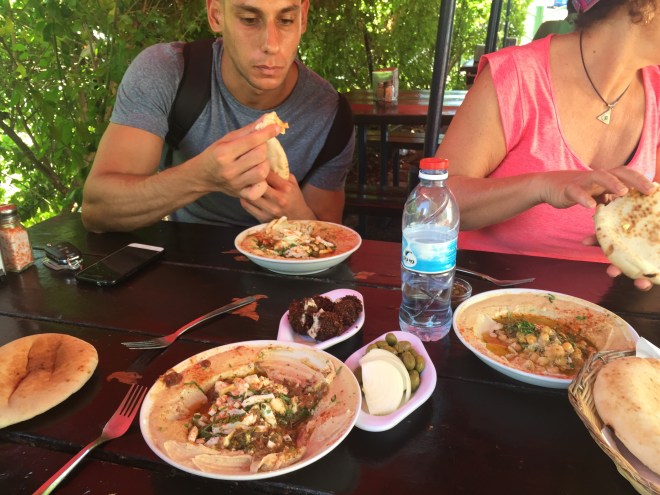
Stopping for possibly the world’s best hummus at a local spot, we feasted! It’s so easy being vegetarian in Israel. And with most places offering outdoor dining, it’s a complete delight to stop a while for good food and to soak up the local culture.
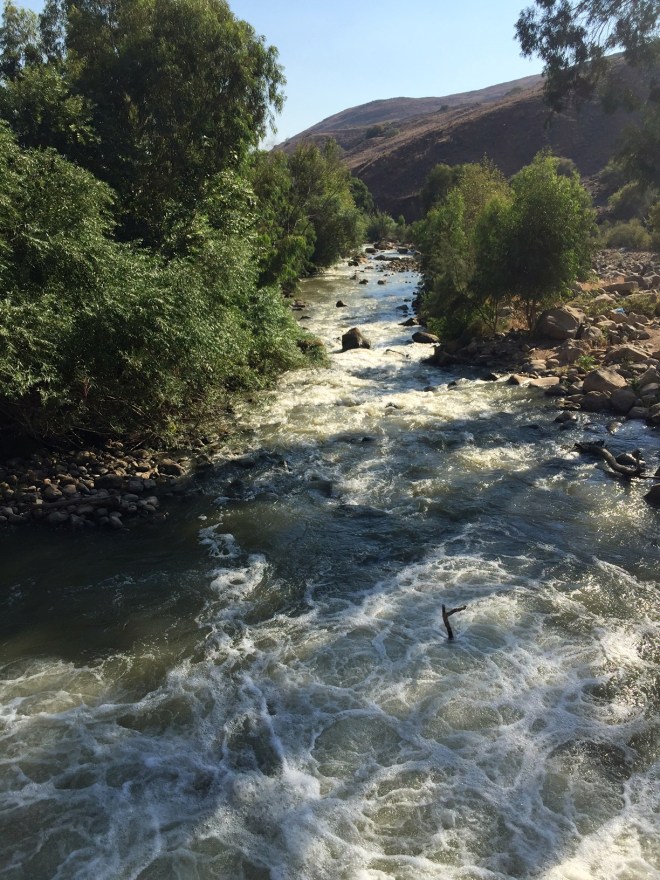
Our next stop, Tel Dan Nature Reserve, is a beautiful park on a hill above natural springs. The Dan River is an important water supply — one of the three sources of the Jordan River. While the forest and ponds are lovely, I really got excited when we arrived at Tel Dan, an archaeological excavation from 2700-2400 BCE. Like so many places in Israel, the history is documented in the Bible. “They proceeded to Laish, a people tranquil and unsuspecting, and they put them to the sword and burned down the town. There was none to come to the rescue, for it was distant from Sidon…They rebuilt the town and settled there, and they named the town Dan, after their ancestor Dan who was Israel’s son. Originally, however, the name of the town was Laish.” Judges 18:27-29. It’s very cool walking among ruins from almost 5,000 years ago but it reminds me that this land, like so many others, has had wars for as long as history records and probably longer.

And, if the day could get any better, we then headed to a dirt path, far off-road overlooking the Jordan River. The only things up there were an occasional army vehicle on patrol and dozens of boxes with bee hives at various intervals that are maintained by a nearby kibbutz. “Hear therefore, O Israel, and observe to do it; that it may be well with thee, and that ye may increase mightily, as the Lord God of thy fathers hath promised thee, in the land that floweth with milk and honey.” Deuteronomy 6:3
We dropped a friend off at his cute apartment in Qiryat Shmona where he’s a personal trainer and nutrition major at Tel Hai Academic College. Like most young people, his English is very good. The bomb shelter near his front door is a reminder of the nearby Lebanese border occupied by Hezbolla. I will never again hear of conflicts at the Israeli-Lebanese border without thinking about Avi and his lovely girlfriend.
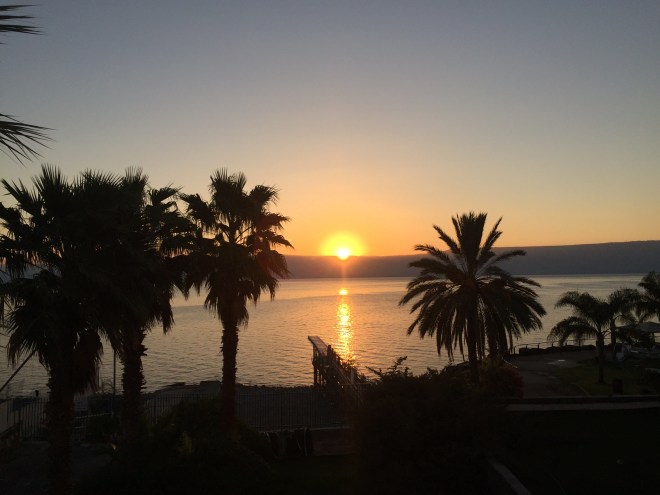
Next we drove the short distance to Tiberias on the Sea of Galilee (aka Lake Kinneret). At 700 ft below sea level, it’s the lowest fresh water lake and the second lowest lake on earth, second only to the Dead Sea. It’s about 33 miles in circumference so smaller than you might expect for something called a sea. This is the place where Jesus performed the miracles of walking on water, calming the water and feeding the multitudes. “And when he was entered into a ship, his disciples followed him. And, behold, there arose a great tempest in the sea, insomuch that the ship was covered with the waves: but he was asleep. And his disciples came to him, and awoke him, saying, Lord, save us: we perish. And he saith unto them, Why are ye fearful, O ye of little faith? Then he arose, and rebuked the winds and the sea; and there was a great calm. But the men marveled, saying, What manner of man is this, that even the winds and the sea obey him!” Matthew 8:23-27
Watching the sun rise over the Sea of Galilee and the Golan Heights the next morning was another of the magically beautiful and calm moments in this land of contrasts.
After a lovely morning on and around the lake, we drove up to the top of the Golan. On one side (west) there is the Sea of Galilee and on the other there is Syria.
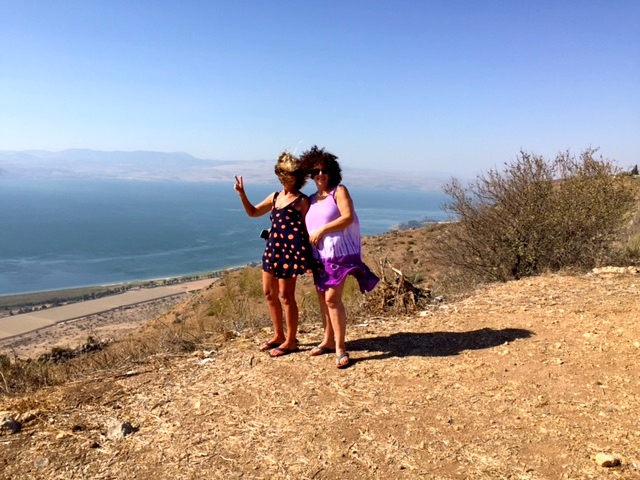
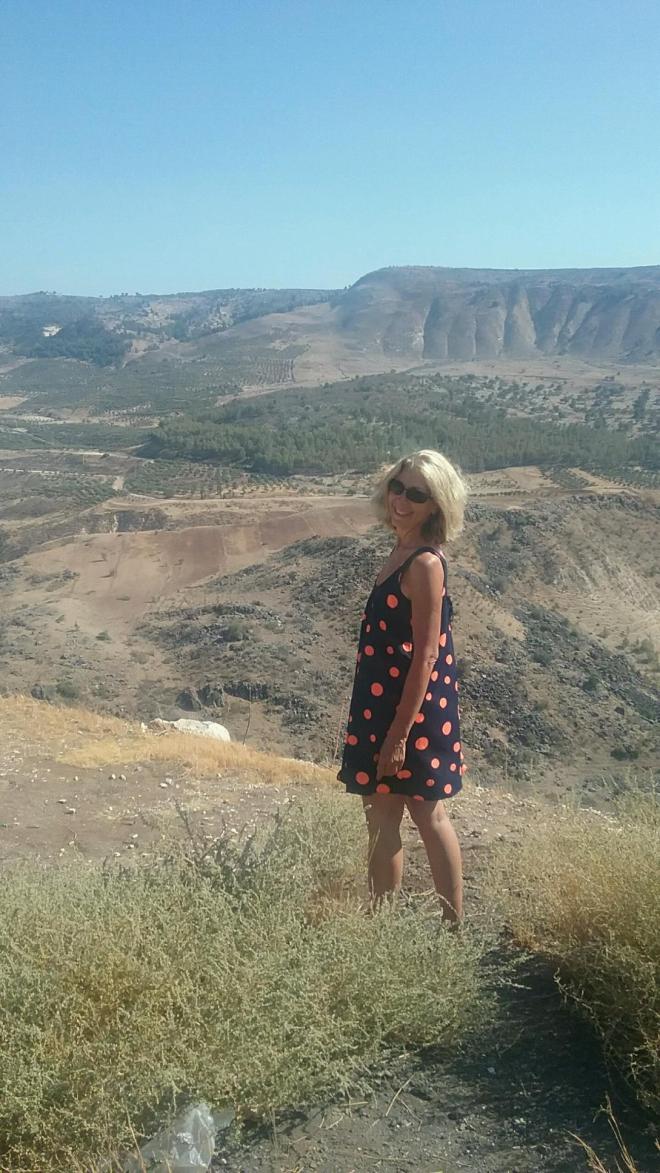
The double fence separating Israel from Syria reminds me of my own country and political promises/threats to build a huge wall separating Mexico. In this day of technology and powerful economic incentives, I feel like there are better ways to control immigration and maintain American borders.

Time for another falafel stop before returning to Tel Aviv and the midnight flight that will take me home. This time I ordered only a half and it was still all I could eat.
Saying goodbye to dear friends is never easy and it’s made more difficult not knowing when we’ll see each other again. Leaving part of your heart behind is one of the dangers of travel. Still, one must travel.
“The world is a book and those who do not travel read only one page.” St. Augustine
Petra, Jordan
All my Israeli friends warned me not to go to Jordan. Even young people stated flatly, “They are our enemy and we are their enemy.” When I mentioned the Jordanian-Israeli agreement to support each other, I was told it’s not real. But I was convicted that I should go to Petra and so I was going. While short of encouraging, my Israeli friend, Yehezkel, graciously insisted that I should not go alone. We decided to drive his car instead of taking one of the tours. From Jerusalem, we drove south to Mizpe Ramon and spent the night in a very cool ecolodge right on the ridge of the crater. A nearly-full moon rising over the sculpture garden gave the night a surreal element. 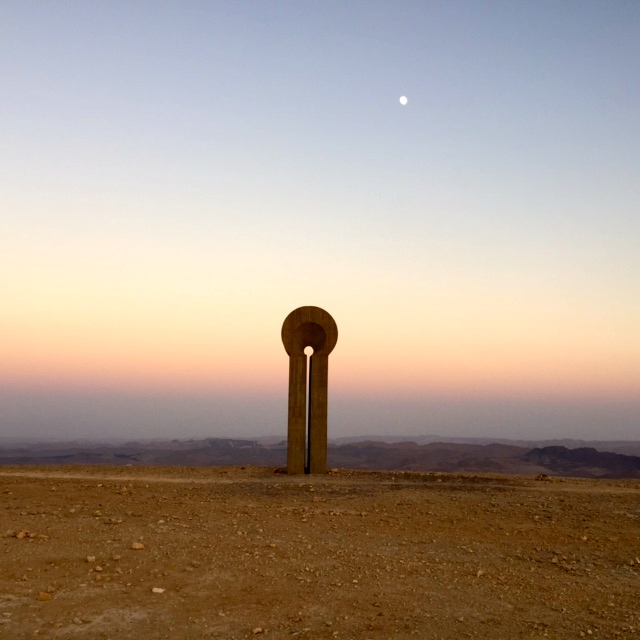
As an American, I automatically compare all craters to the Grand Canyon. Ramon is not as big or as beautiful as the Grand Canyon but it’s really big and very beautiful plus it has the added feature of a road across the canyon floor that we traveled at sunrise watching the light hit the walls of the canyon.
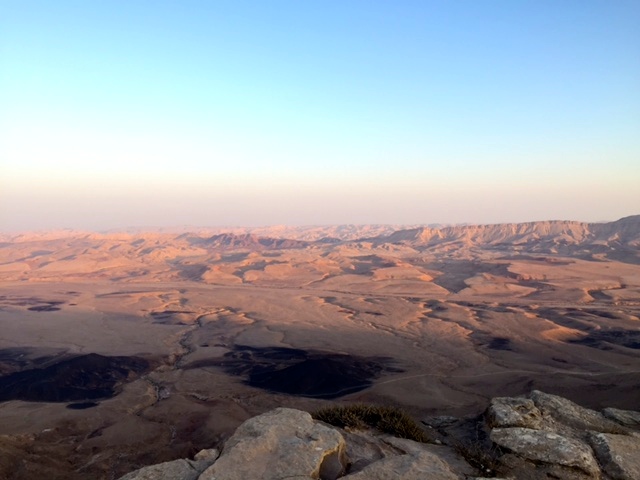
En route to Eilat, we passed the construction site of the new airport that will serve both Israel and Jordan. That’s one more step towards cooperation and reason in a region that desperately needs both. Leaving Israel at the border crossing by Eilat was quick and painless. Entering Jordan was different. I had been warned to expect to up to two hours. There were very few people crossing and virtually no lines but the process was sadly incompetent. Go to door 4, go to window 10, go to window 8, go to door 6, pay a fee for entering, pay a fee for the vehicle, back and forth for 90 minutes. The car had to be registered, then insured, Israeli license plates were removed and placed in our trunk with Jordanian plates replacing them. We were cleared to enter but I had my doubts. Sure enough, turn around and go back to window 9 for another stamp. Once we finally entered Jordan, there was no doubt that we had entered an underdeveloped country quite apart from the southern European feel of Israel. Beware of camels on the road!

We drove through Aqaba, a big city on the Red Sea, but the traffic was horrible and in a short time we were ready to head to Petra. The drive took about two hours. Once in the town by the entrance to Petra, we stopped for a delicious, very affordable lunch, and asked for a recommendation for accommodations. Perhaps, I shouldn’t compare, but hospitality, quality, service and prices were 100% better than Israel. We spent the closing hours of sunlight and the rising moon at Little Petra. Words and pictures are insufficient but I’ll give you a taste and, hopefully, a desire to go see it for yourself. Imagine a town carved into beautiful, rose-colored cliffs thousands of years ago, deep in a canyon.

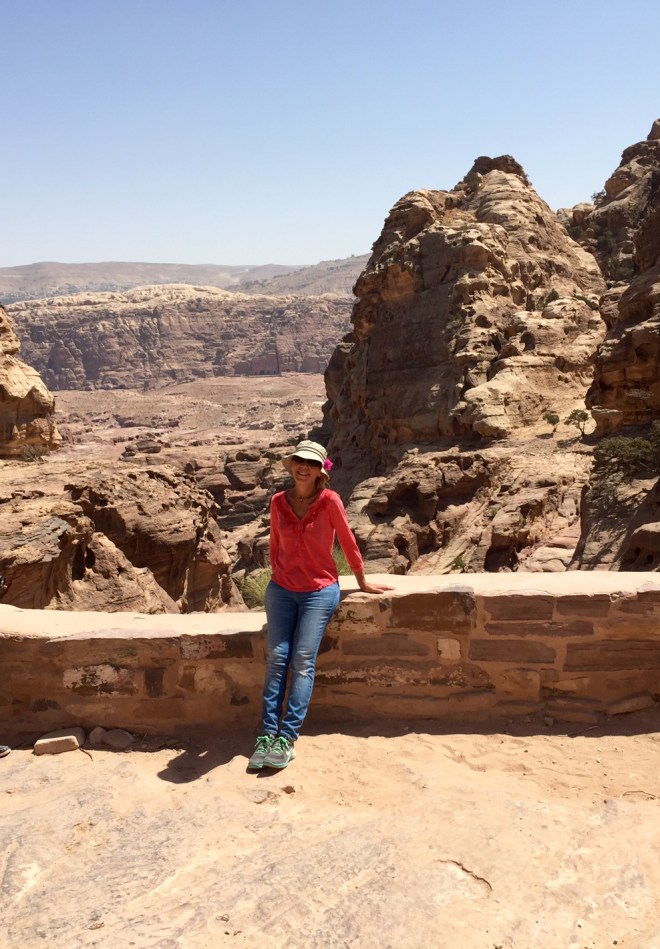
Early the next morning we each paid the 40 Jordanian denar (JD) fee ($50 US) to enter Petra. Locals pay only 1 JD but I’m fine with that. After all, it’s their country. Plus, they earn so little. The clerk at our hotel earns 160 JD per month. The temperature was reported to be 40 degrees Celsius (104 Fahrenheit) or a little higher which made the hike a bit challenging. It reminds me why I must make these treks now and not wait until I’m older. In respect for the Muslim culture, I wore long pants and long-sleeved shirt the entire time I was in Jordan. But no amount of hiking or heat could dampen my spirits. Turning a corner and seeing Petra exceeded my highest expectations.
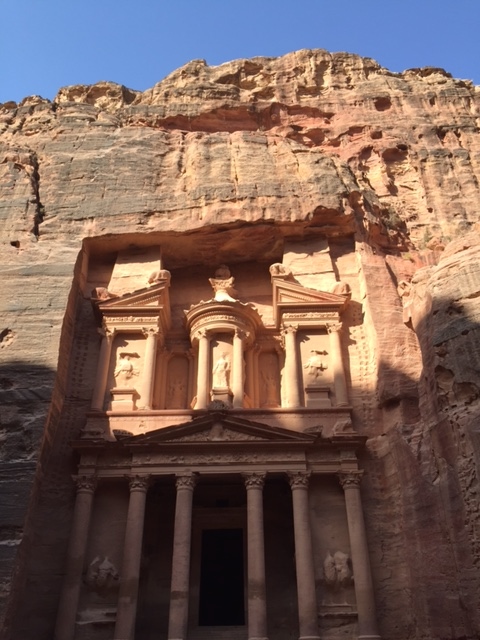
Frequently, we came to small stands selling water or souvenirs. Passing a child of two or three years old sitting alone selling rocks in the heat was hard to accept. Yes, all children are created equal in the sight of God and under the law (at least under American law) but how fair is it that this child must work in these hard conditions while American children are showered in comfort?

It’s hard to understand how huge Petra must have been. Viewing it at any one spot is misleading. We estimated that the amphitheater seated about 5,000 people. Only by standing way far back and seeing a larger portion can you appreciate how there was such a complex town with multi-levels of residences mixed with massive buildings that served as public offices such as the treasury office. This picture shows how the buildings were continuous and carved into the canyon walls but, even as big as it is, this is just a small portion of Petra.
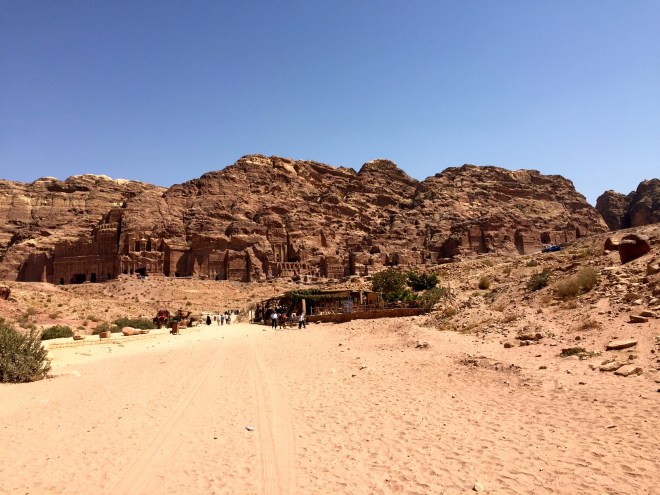
The last building in the old city is the monastery, set apart from the others. It’s high up in the mountains and takes quite a hike but it’s so worth the effort. Even the inside is well-preserved.
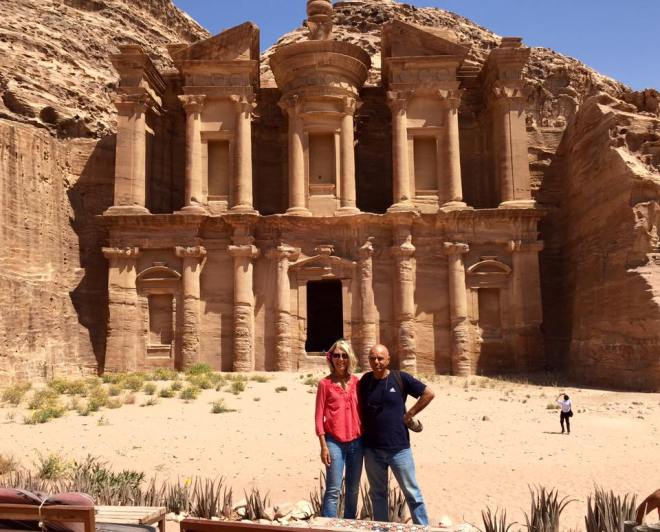 We got asked often where we were from. When Yehezkel said Israel, he was asked how he knows Arabic. And when he said his parents are from Baghdad, Iraq, the response was consistently, “COUSIN!” Almost everyone was warm and welcoming with minor exception.
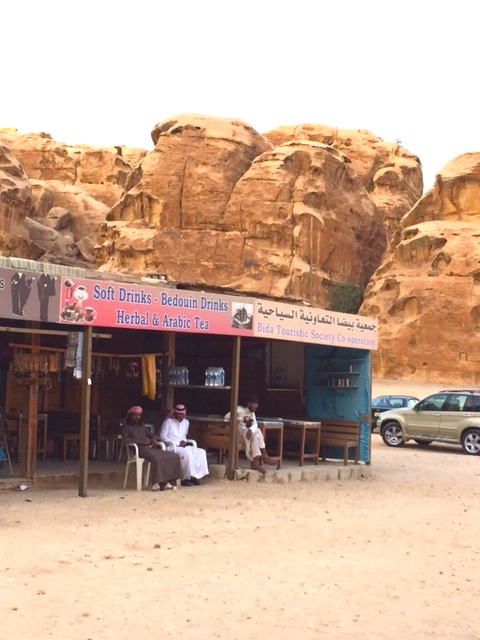

I wish I had another week to spend in Jordan but I need to get back to Tel Aviv for Shabbat dinner with our friends who are Hasidic Jews. So much to do and so little time…
Jerusalem–the Old City

As I walked up to and through Damascus Gate I was overcome by emotion. Jerusalem is one of the most sacred places for Christians, Jews and Muslims. Now that it is under Israeli control all people of every faith have access to the holy sites. Walking down Via Delorosa, the path that Jesus walked on the way to his crucifixion, was so powerful that I felt each step deep inside my soul. Being in the old city brings biblical history to life…like a massive Sunday School field trip.
This was my fourth visit to Jerusalem so I skipped some of the more popular places in favor of new experiences. Slipping through narrow alleys, we passed countless schools filled with Orthodox Jews studying the Torah. Then, thanks to our friend who lives in Jerusalem, we took a wonderful walk on rooftops that gave us a unique vantage of the shops and buildings below including the beautiful Dome of the Rock mosque built on the spot from which Muslims believe Mohamed ascended to heaven plus a myriad of churches with steeples marking sacred places such as the tomb where Jesus was laid.

Next, we went deep underground to tour the tunnels and foundation under the temple walls. The architectural feat alone is hugely impressive.
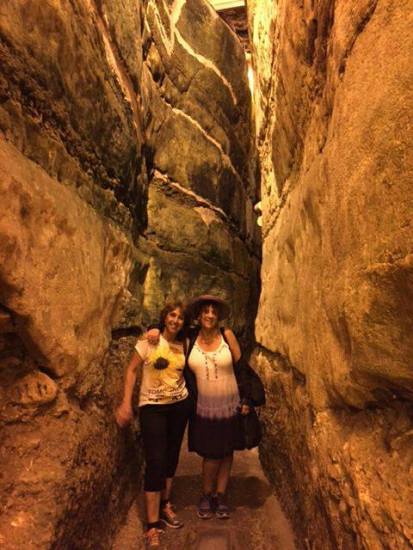
Regardless of when I visit, I stop at the Western Wall (aka the Wailing Wall). Built around 19 BC by Herod the Great as part of the second Jewish temple, the limestone walls encased the steep hill known as the Temple Mount. It stands 62 feet tall. Men and women are segregated to separate areas.
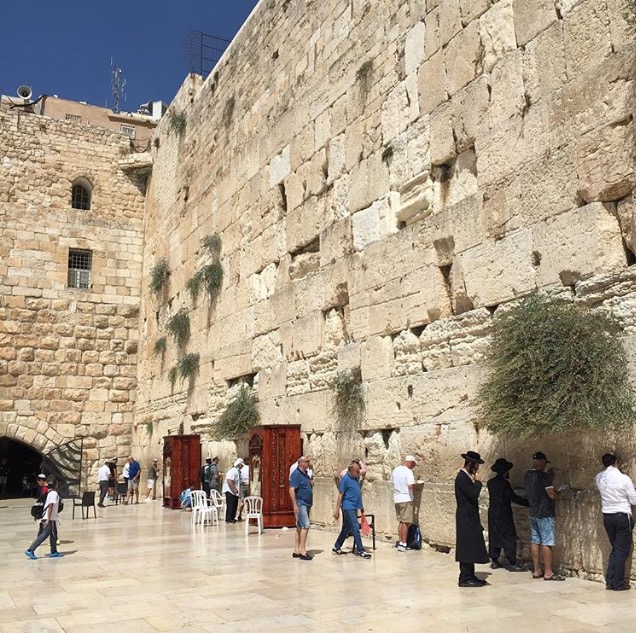
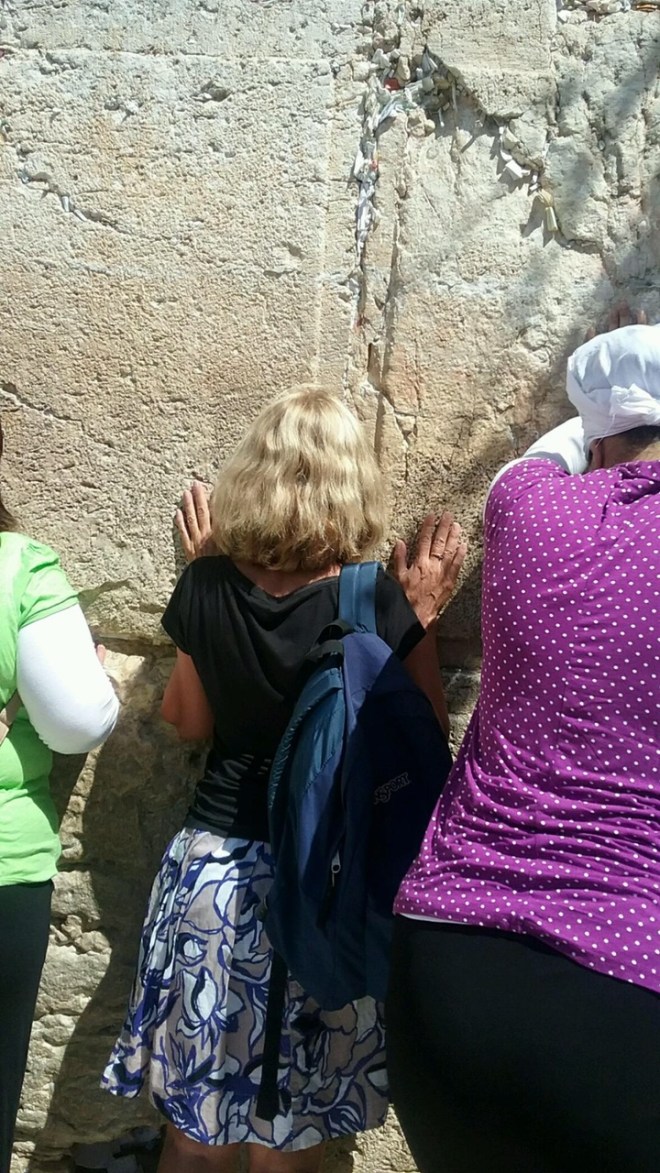
Praying for peace on earth seems to be more direct, somehow closer to God, when standing at the wall. Little pieces of paper with prayer requests are stuffed in the cracks.
The small alleys are filled with stands selling souvenirs to tourists. About 80% of the shops are owned by Arabs. Haggling over prices is standard. I’m not big on buying stuff but I was enticed by the shiny coins to pay $5 for the headband worn in the rooftop picture above.
It would be easy to spend a week in the old city of Jerusalem but my schedule limited me to a day and a half. It’s beautiful both by day and night. During the day the shops and people provide a busy, loud environment. At night the shops are closed and there are very few people around. For that reason, I prefer nighttime walks but most of the churches and many of the holy sites are closed after dark so you still need to endure crowds if you want to see it all.
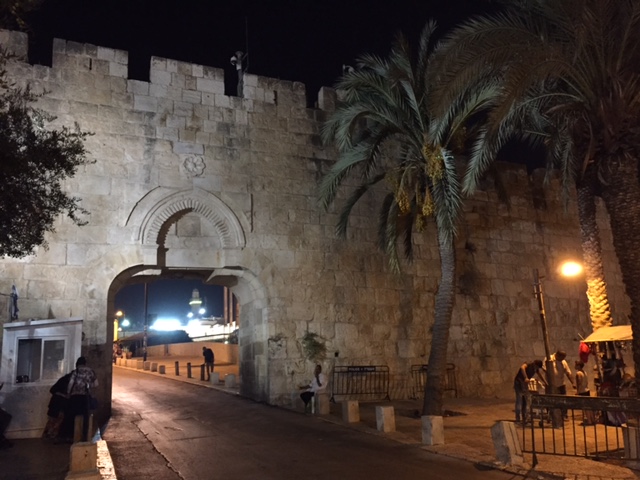
Local police and Israeli soldiers are quite visible and never far away. I never felt threatened or endangered. Having said that, three days after I passed through Damascus Gate, at the same spot, a young Jordanian who had entered the country the day before and just prayed on the Temple Mount shouted “Allah Akbar” and attempted to stab police. He was quickly shot dead. Terrorist attacks of small and large scale are always a possibility.
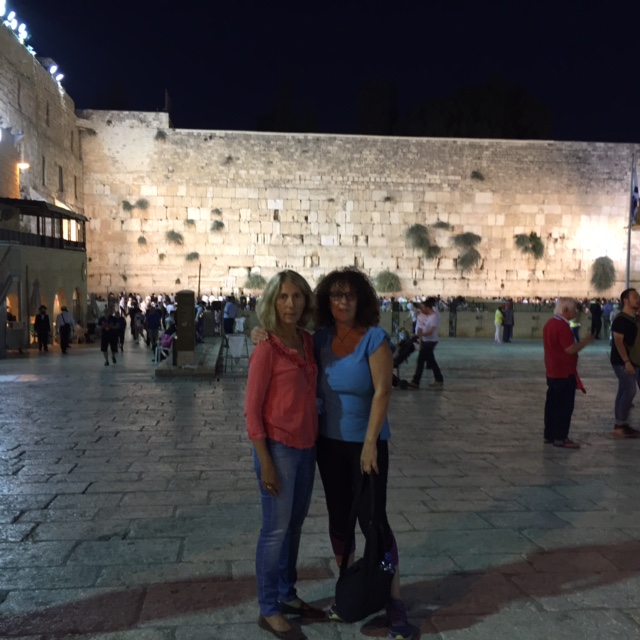
The spiritual strength of Jerusalem reminds me that what my Israeli sister, Naomi, and I share is far greater than what makes us different. War based on differences in faith just makes no sense to me. While there is hope, worldwide it doesn’t seem that earth in 2016 is more civilized or advanced in regard to tolerance and respect for different religions than any time before. Still, I pray for peace on earth and try to do my part to show respect for people of all faiths.
“Pray for the peace of Jerusalem: they shall prosper that love thee.” Psalm 122:6
Tel Aviv
Tel Aviv is a big city with a lot of life. The beautiful Mediterranean Sea sets the mood. The beach has many big hotels but it’s still open compared to Miami, Virginia Beach or any resort beach in the United States. There’s an effort to restore older buildings so you sense a positive energy of a community that is strong and progressive. The regentrification of old neighborhoods creates trendy new places to dine, shop and live. Dizengoff Street is famous for cafes and clubs but I found them all around downtown.
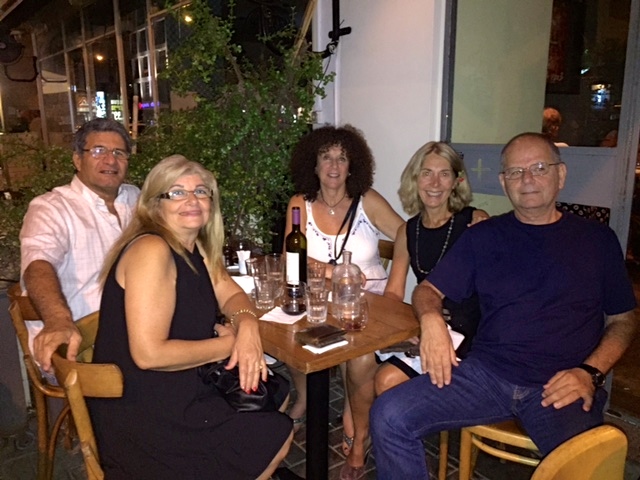
We checked into a beachfront hotel near the marina then dashed out to meet friends of friends. In typical Israeli style, they go out late, stay out way late and are extremely hospitable. So many times this trip we’ve laughed that we’ll sleep when we get old because there’s too much to do now. I feel like a child who needs to sleep but doesn’t want to go to bed in fear that he’ll miss something.
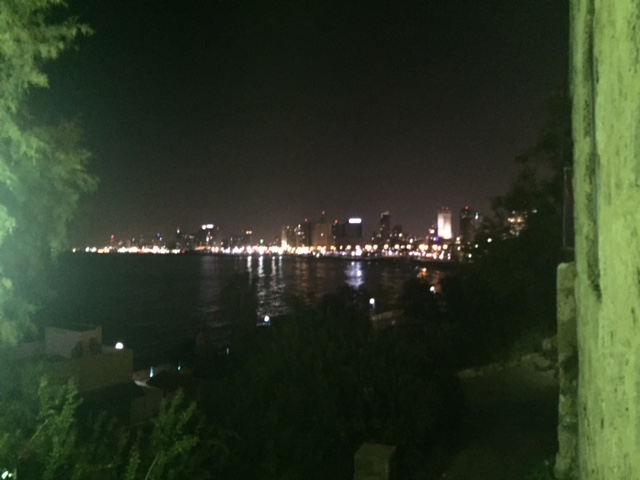
After dinner and drinks, we visited Jaffa, one of my favorite spots. Below is a picture of Tel Aviv taken from the old buildings in Jaffa.
In the morning we enjoyed delicious Arabic coffee and breakfast sitting by the beach followed by several hours of swimming and sunbathing. After checking out of the hotel we headed for the shuk that is only a block or two away from the beach. The open market is a sensory overload of colors, aromas and sounds.

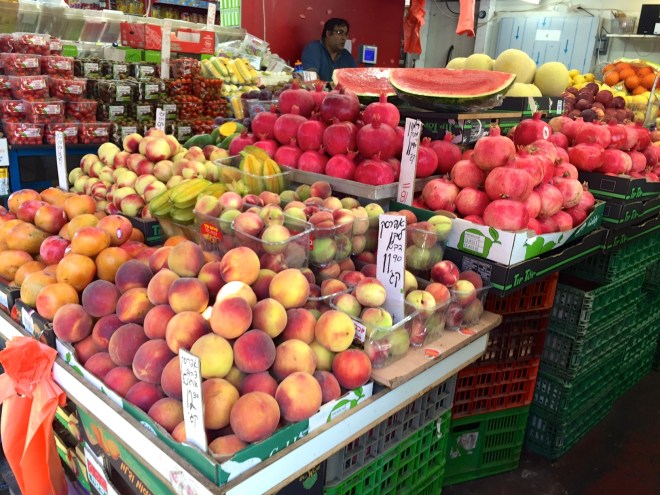
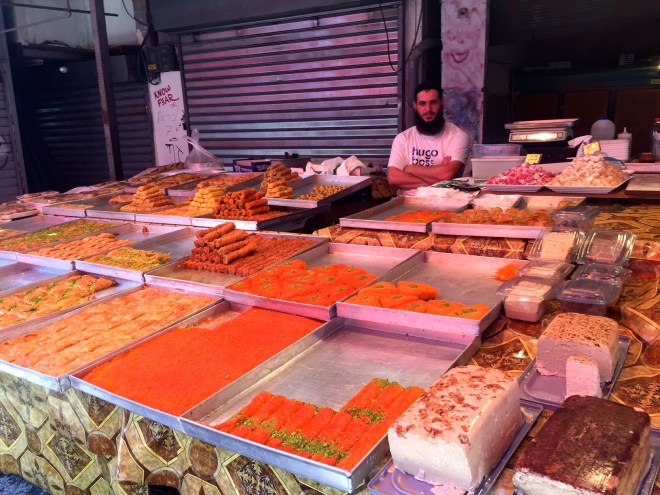
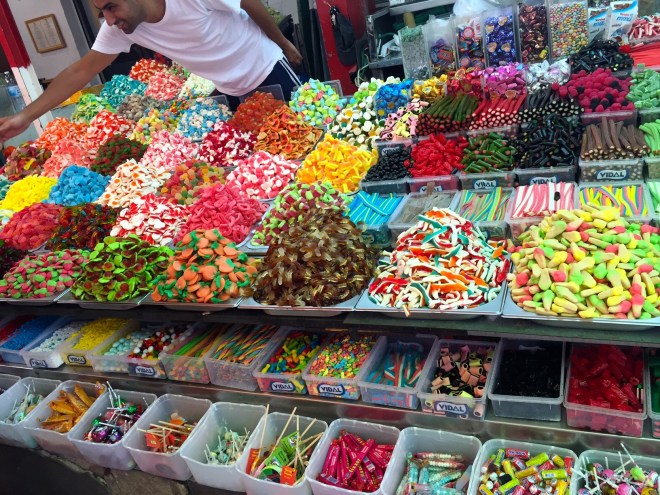
Below is a picture of an army group walking through the market. Everywhere we see them, they’re greeted by smiles. I love the idea of service to the country for a couple years after high school. I suspect these young people do a lot of growing up and are better prepared for life after their service.
 I’d love to spend another few days in Tel Aviv but we need to move on to Jerusalem. We took to the busy highway and began the short trip out of the city. The 67 kilometers took us closer to two hours rather than the estimated one hour which is common for our driving but we frequently take the wrong turn and get confused by the signs that are not as helpful as they could be.
The population of Israel was 3.575 million in 1976 when I first came here and now it’s 8.522 million; almost tripled. No wonder there are so many more buildings and roads. Approaching the beautiful hills surrounding Jerusalem, I see that the city has grown a lot.
Kibbutz Bet Nir
At 22 years old, I was backpacking around the world after graduating from college on a $20/day budget when I got to Israel and heard volunteers could live and eat for free in exchange for working 6 days a week. Sign me up! That’s how I came to Kibbutz Bet Nir. Looking back 40 years, my heart is full of affection and respect for the people I was fortunate enough to come in contact with at Kibbutz Bet Nir. The positives are more numerous than I probably know, but among them…
- Respect for the people of a country that I knew little to nothing about
- Real exchange of ideas with people from very diverse cultures
- Lifelong friends
Driving back to Bet Nir today, I was absolutely amazed at the 4-lane highways where small, dirt roads used to be and communities, warehouses, and commercial centers where there was nothing but open, farm lands.
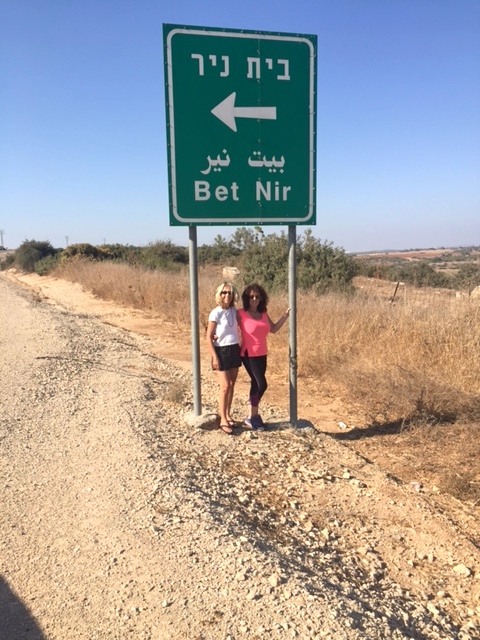
I remember trying to get to Bet Nir from Tel Aviv the first time. The bus took me to the highway 5 km away. I hitch hiked the rest of the way, as did everyone wanting to go there. Cars were few and far between. My various travels to/from the kibbutz blur but on at least one occasion, I got a ride on a mail truck and another time with an army jeep. Farm trucks were also a possibility. Today there was a fairly steady stream of cars and the road was paved so it made the long trip look simple.
My first shock was that there are now roads on Bet Nir. There was no need for roads before because there were only a couple cars that were owned by the kibbutz. If you needed one, you reserved it in advance. We had only foot-paths and we walked everywhere. While the kibbutz still has members, there is expansion land on which a homesite can be purchased. The residents of the expansion land do not have to become members but they can register their children in the private school for a reasonable fee and take advantage of the peaceful life in the closed community. Priority is given to member’s children. A friend told me that when he was young on the kibbutz, he loved the peaceful life and thought he’d never want to live anywhere else. But by his mid-twenties, he couldn’t wait to get away from it and considered it very boring. After living for two decades in Tel Aviv and abroad, he is happy to be back raising children in what he now characterizes as a caring, safe community. Funny how the same thing appears so different depending on perspective. His parents are still kibbutz members so his children can safely walk to school then to their grandparents and back home while he and his wife work outside. There is a fence and security provided by outside professionals; a small change since the days when members took turns on guard duty. This is a picture of one of the new resident’s homes–a mansion compared to the modest members’ homes.
Every home I went in was tastefully decorated.

It was really nice to see my old friends with grown children and sometimes even grandchildren. Below is a picture of my dear friends, Edi and Etie. They are still kibbutz members but only one of their three sons has chosen to stay so far. It will be interesting to see how they feel 10 years from now when they’re likely to be married with small children.
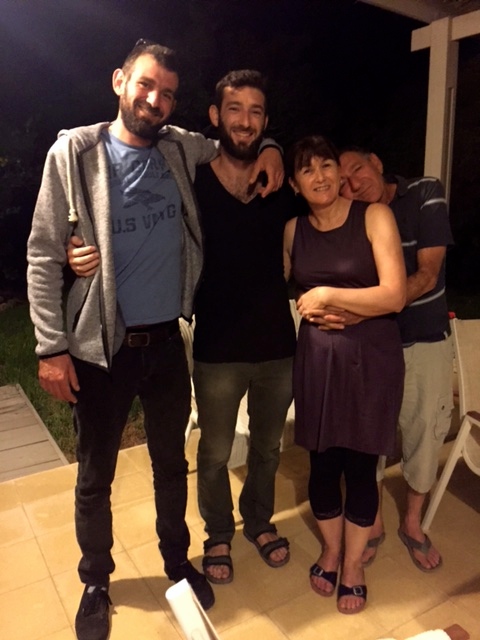
On Saturday I basked in the joy of good friends reunited after way too long. We’ve each had some hard days as well as great blessings but everyone seemed to be weathering life with a youthful spirit and a sense of humor. In my eyes, everyone still looks the same as they did back in the day. There’s something very special about old friends.
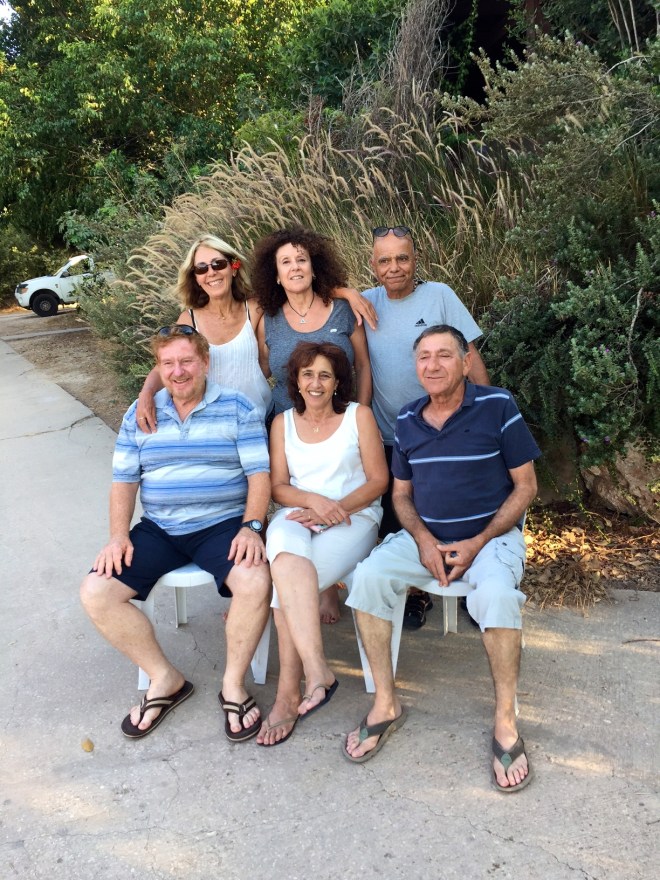
Here I am with Naomi, Yehezkel, Gingi, Malka and Edi. Each one has lived or traveled abroad but they keep coming back home to Israel.
The Dead Sea
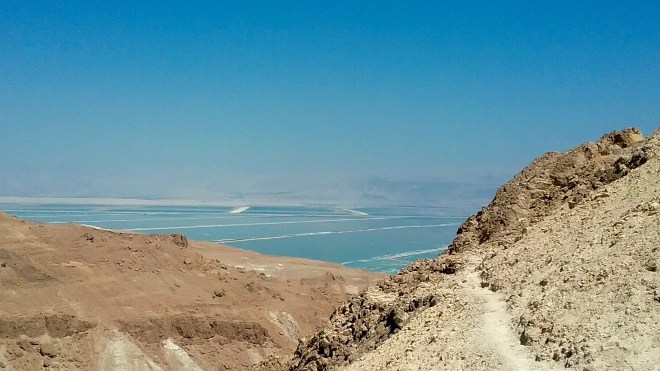 There are elevation markers every hundred meters as you descend from the mountains to the Dead Sea at 1,407 ft below sea level, the lowest point of land on earth. When I was here before, I slept under a full moon in a sleeping bag on the shore then hiked to the top of nearby Massada early in the morning. This time I’m staying in a resort that capitalizes on the natural beauty and healing powers of the water. There are mud baths, sulfur pools, and an array of spa treatments available. One is not inherently better than the other. Each has its own beauty and, as in all things in life, I try to appreciate the positive and not focus on the negative.
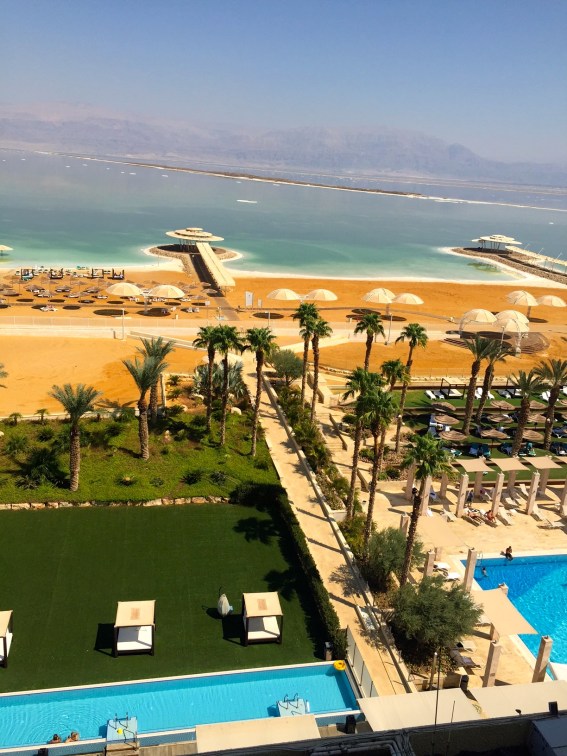
I’m up at dawn each day to watch the sun rise over Jordan then I spend the day in and around the water.
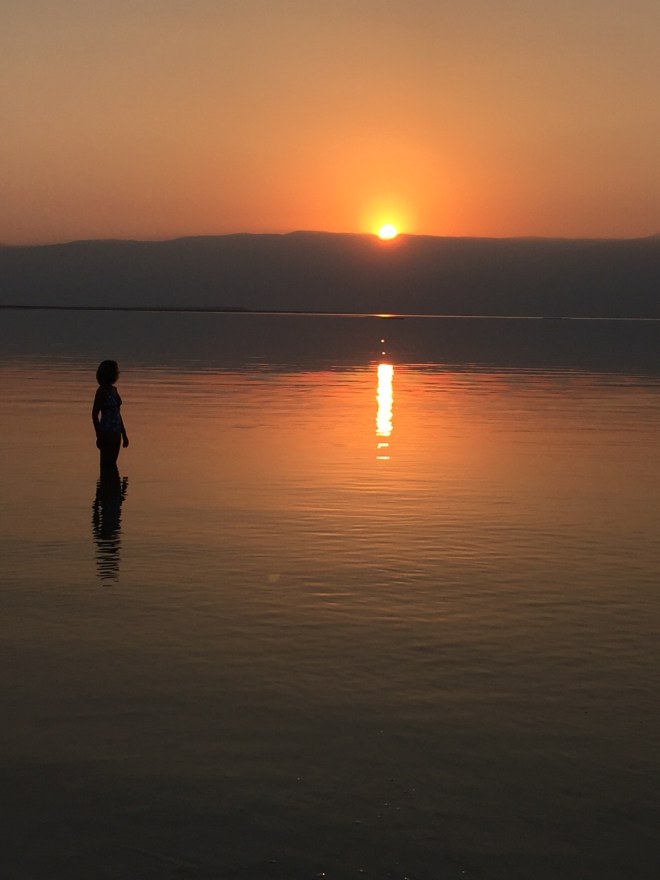
With salinity of about 34% or more than 8 times higher than the ocean, the buoyancy is quite comical. You float, if you want to or not. You could easily sit in an imaginary lounge chair and read a newspaper–no problem.
Nothing can live in the salty water, thus the name, the Dead Sea. If you have any cuts or abrasions, they sting. The salt sticks to everything. When you walk out of the water there are salt pellets between your toes and your skin is covered in a film of salt. I was curious to find Sodom and Gomorrah on a map of the holy lands and, sure enough, it is believed to have been just south of the Dead Sea on the East side that is now Jordan. “But his wife looked back from behind him, and she became a pillar of salt.” Genesis 19:26
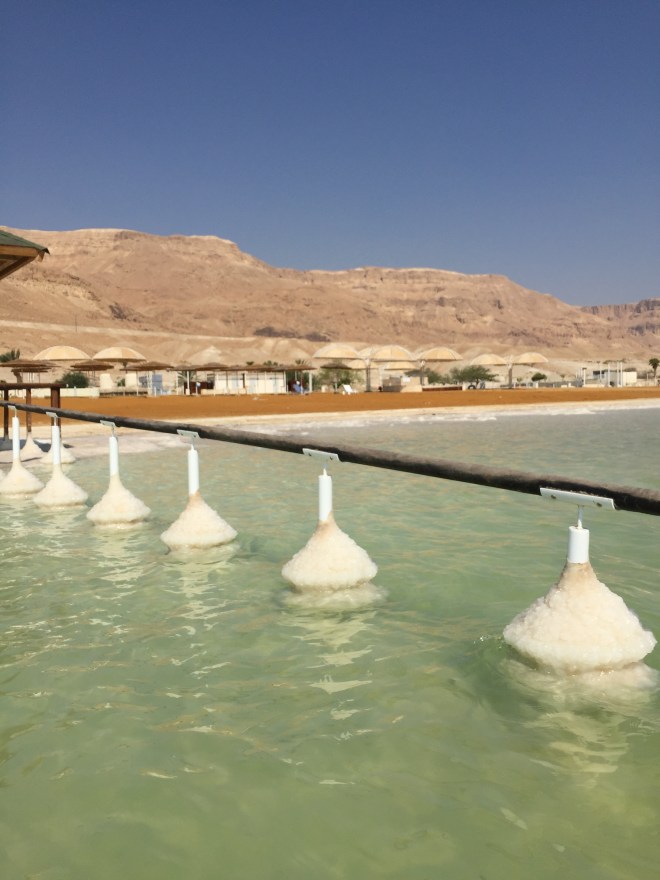
The air temperature has been about 100 degrees each day with low 80’s at night. The water temperature is currently 92 degrees. Yes, it’s hot out but, actually, you don’t sunburn as quickly as you would at high elevations like in Colorado.
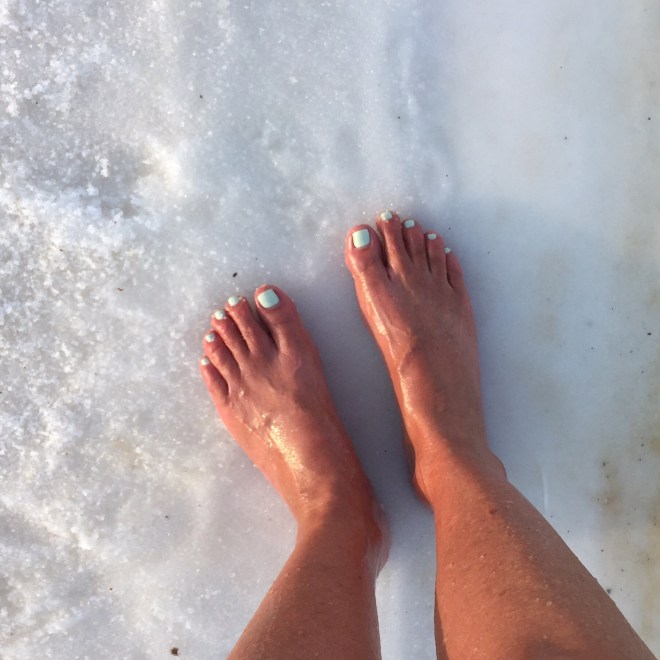
I took this picture of my feet at the edge of the clear water where the beach is covered in salt. You have to be careful not to splash or you’ll get salt in your eyes. It’s so crazy salty that when water barely touches your lips you need to rinse with clean water quickly.
We left the water for a short hike in Wadi Boqeq about 6:00 PM. All signs throughout the country are written in three languages–first Hebrew, then Arabic, then English. There was an initiative to add a fourth line of Russian but it was unsuccessful. 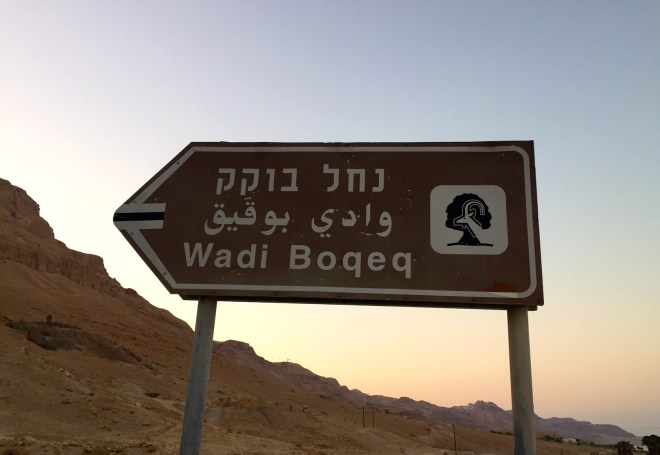
The hike led us down a stream, through gorgeous mountains, to a small pool and waterfall where we happily took off our shoes and everything extra then climbed the slippery rocks to cool off in a natural shower massage. This picture of Perla, Naomi, and me was taken halfway in to the falls.
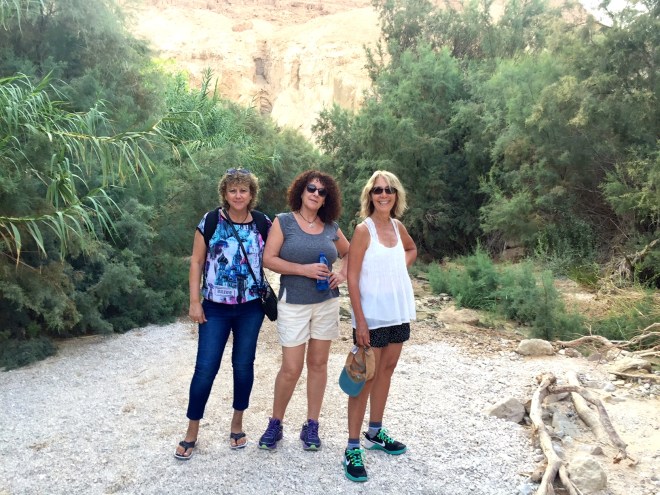 Nothing against Busch Gardens, but this is my kind of fun.
Shalom!
9/4/2016 It’s been 35 years since I was last in Israel; 40 years since the first time when I spent 3 months as a volunteer on Kibbutz Bet Nir. Now I’m headed back to visit friends and explore. The plan was to fly all night then meet my dear friend, Naomi, former kibbutznik, now naturalized American citizen, in Tel Aviv.
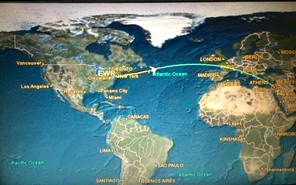
My first day was a bit of a blur due to jet lag and sleep deprivation but I was surrounded by loving friends and lots of Hebrew. Then came the night. Due to a 7-hour time difference from Virginia, I was awake until about 6:00 AM (11:00 PM at home) which gave me a total of an hour and a half sleep. Rise & Shine! So much to do…
After delicious Arabic coffee and breakfast, we drove to Kibbutz Glil Yam just north of Tel Aviv where Naomi’s sister, Mira, lives with her husband and children. They used to be typical Israelis (not very religious) but since one daughter converted and is now Hassidic, the parents and little sister have followed. It seems the main changes for them are the women’s attire (now plain with long skirts, long sleeves, high neck and head coverings very similar to Mennonite), stricter observance of the Sabbath (no driving or working from sundown Friday to sundown Saturday), no use of birth control, and more prayers. They prefer not to be photographed.
The kibbutz has also gone through a conversion of sorts and is no longer a kibbutz but rather privatized without joint ownership of the homes and property. The former members work outside the community and keep their earnings, contrary to the communal ownership of the kibbutz. I understand that a lot of the former kibbutzim have made similar conversions. There’s a political issue currently to begin taxing the kibbutzim. Formerly, they were not taxed as the concept was to settle the land. No taxation was one more way to encourage Israelis to move to certain areas where the government wanted Jewish settlements.
The food is all fresh and healthy–salad for every meal. People drink very little or no alcohol. Here’s a picture of my friend’s breakfast plate.

After leaving Mira’s we headed for the beach in Herzliya. Gorgeous white beaches with very fine sand join the Mediterranean Sea to the west coast of Israel. Near Tel Aviv, traffic was congested, parking was a problem and I was shocked by all the highways and tall buildings. Once at the beach, we found numerous restaurants right on the sand serving food and drinks. I was surprised to look up and see about a hundred young men and women in uniform running and walking by us; some carried Israeli flags and some carried rifles. People on the beach stood and applauded showing respect as they passed and many made comments of appreciation such as, “Keeping the peace.” Each Israeli citizen must complete mandatory service upon reaching 18 and graduating from high school; approximately 2 years for women and 3 years for men. When I met Naomi, she was 21 and had just completed her military service. She and her group mates were all sent to the Yom Kippur War at 18 and 19 years old. Our friend, Yehezkel, fought in the worst battles at 19 and today suffers from PTSD as a result of that experience.
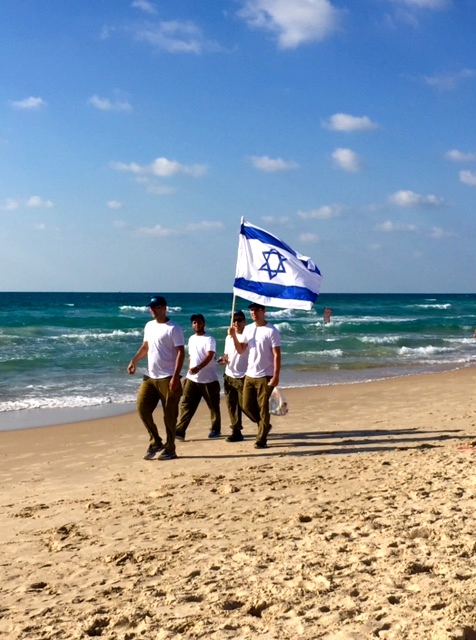
The water was amazing–so clear and warm; great for body surfing. The air temperature was about 85 and the water temperature was about 82.
Never forget that this is desert. It’s very common to see both residential and commercial properties with artificial grass and silk flowers, interior and exterior, so they don’t need watering.
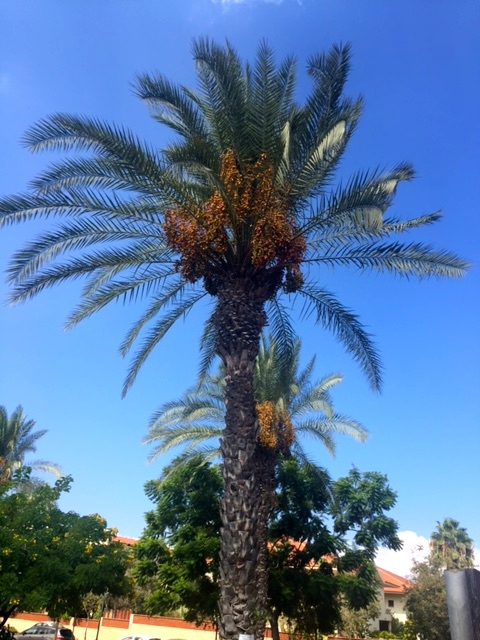
Beautiful palm trees are everywhere like these date palms. Olive, orange, and lemon trees are very common also. The orange blossoms put off such a sweet aroma; it’s like filling the neighborhood with perfume.
SoCal
For the next few days I moved among the people of Southern California. The weather was always lovely (75-85 degrees) and the streets were adorned with exotic, flowering trees unlike any I’ve ever seen.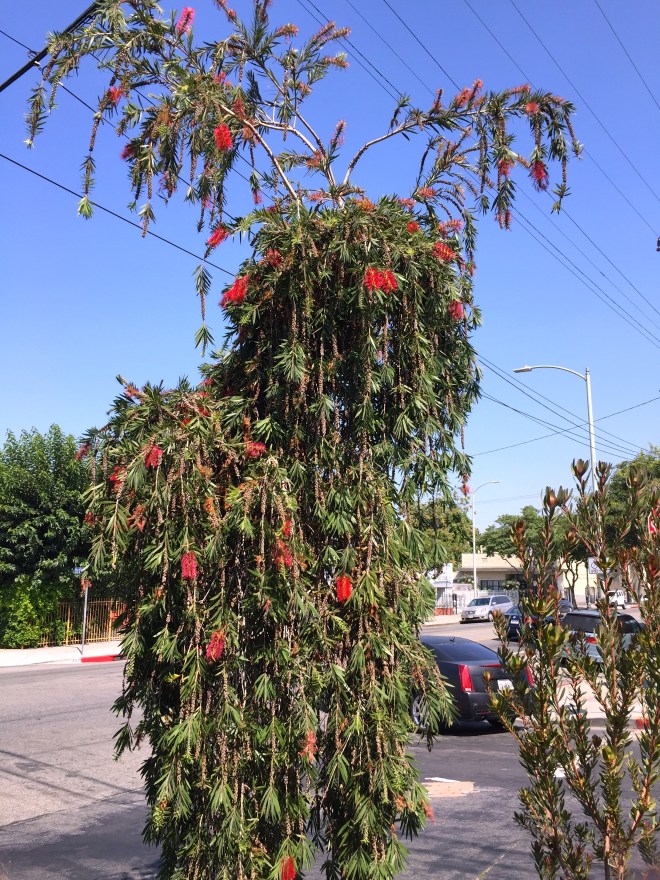
Driving was something I avoided as the traffic is congested and aggressive. The population is diverse in every regard. Rich and famous or homeless, are all on the same block. And, the food is excellent. Whatever you can imagine is available. You want Thai? No problem. You want vegan? No problem. You want Thai vegan? No problem!
It wasn’t uncommon for someone to comment that the person we just passed was a celebrity. Among the people we saw or they’ve seen around—Caitlin (Bruce) Jenner and Kendall Jenner, Ellen Degeneres, Jeff Goldblum, the guy from Mr. Robot, and various comics. I’m happy to say I didn’t embarrass myself when I saw Chris D’Elia at a cafe.
A lot of our time was spent in Santa Monica, in Western Los Angeles County. Somehow, SM feels younger and more upscale than most of L A. There’s absolutely a lot of style and a lot of money but it still has a community feel. 
Daniel starts work with Uber in a week. The Uber corporate office in Santa Monica has an amazing view of the ocean and pier but no sign or logo that might attract drivers or aspiring drivers. 
Searching for housing in Santa Monica is a tremendous challenge—even more difficult than Hollywood. It’s so limited that people rent every room, including dining rooms and garages for a lot of money. And, parking is even more scarce. Sadly, I left Cali with Daniel sleeping on the floor of his brother’s one-room apartment in Silver Lake and no solid prospects for a room. No doubt, he’ll figure it out.
I’ll be back at work in Virginia Beach tomorrow. The next adventure belongs to Daniel.
Across the Desert
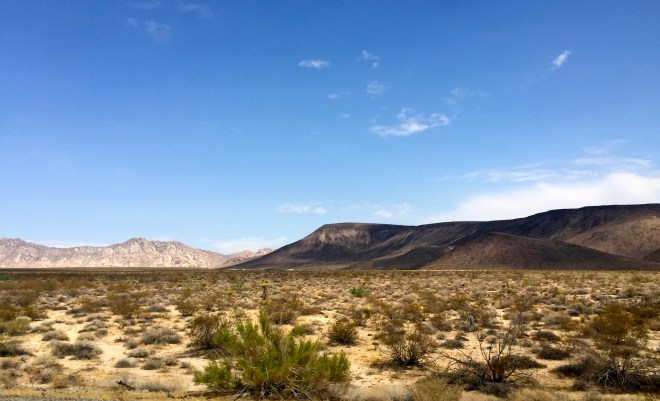 The last day of driving took us through wilderness land and the Mojave Desert. A few rest areas sell gas at more than double the price in Arizona and the signs warn of rattlesnakes.
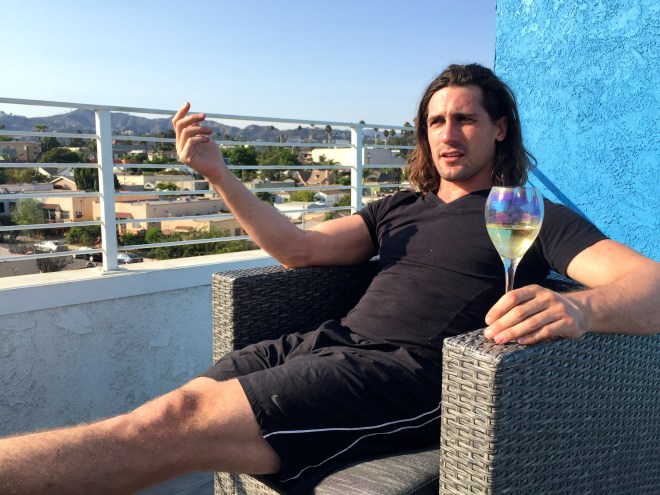
  First stop in Los Angeles … Patrick’s apartment on Santa Monica Boulevard! We relaxed on his rooftop patio for a while before heading out to Pasadena.
  Daniel found us some cheap tickets to the Coldplay concert at the Rose Bowl Stadium. We parked at a special event parking lot then walked two miles to the stadium. It’s definitely the largest venue I’ve ever been in with a capacity of 92,542. When we entered, we were handed a wrist band to put on. It had LED lights that were controlled by the band’s tech team so 92,542 bands turned yellow when Chris Martin sang “Yellow,” and a wide array of other colors to set the tone.
The fireworks at the end of the show were perfect to mark the end of the cross country trip. Welcome to California!
 Kathryn Byler, blog