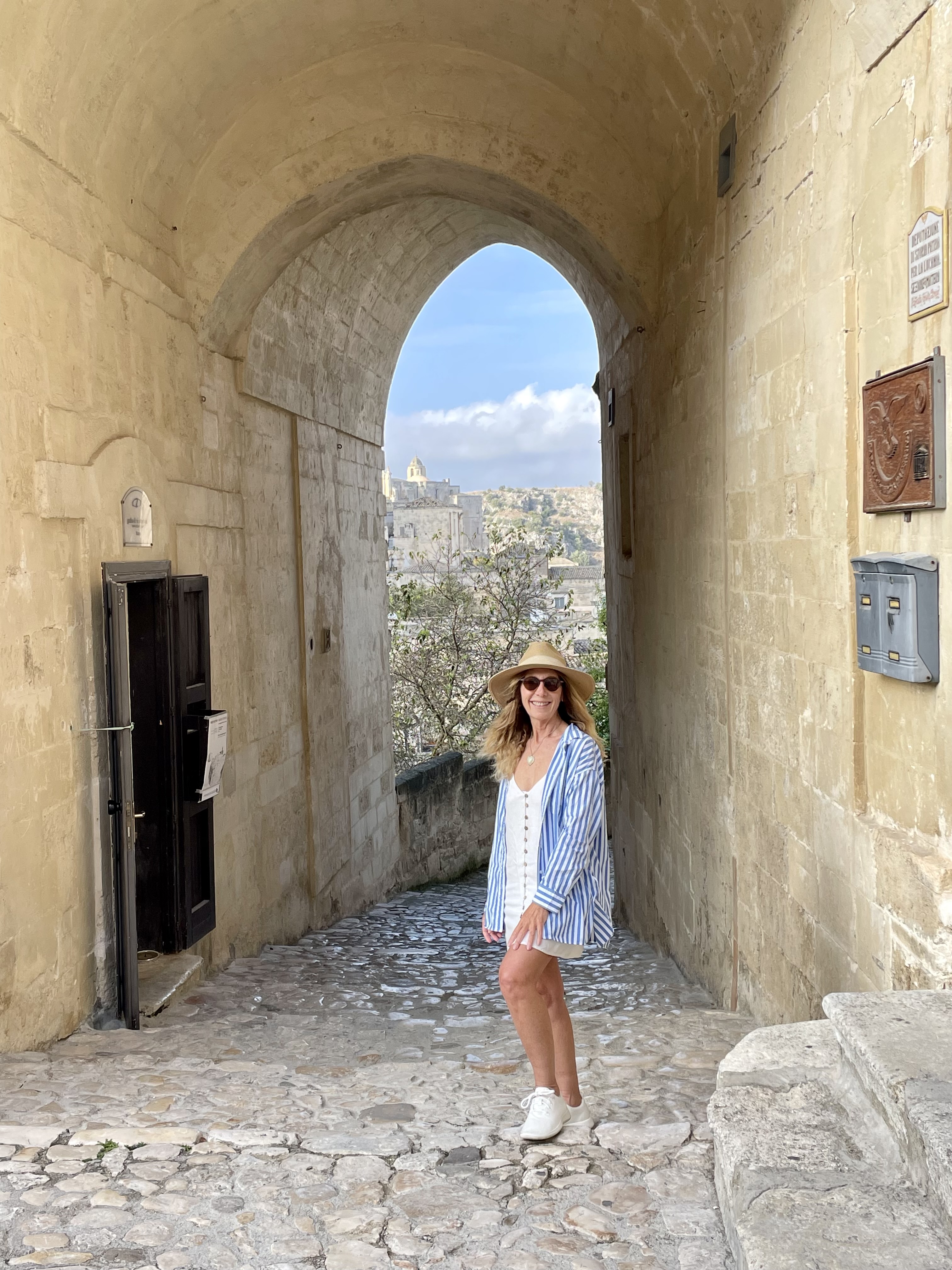
When I think of Italy, I think of delicious food, ancient villages, beautiful architecture, crazy drivers, and a lot of style. This 10-day trip delivered all that and more! Before I post pictures and thoughts, I want to list 4 rules of Italian culture that I learned …
- Never Order Cappuccino after 11:00 AM — The cappuccino machine has been turned off, cleaned, and is ready for the morning. You must switch to espresso or macchiato.
- Never Cut Pasta with a Knife — Twirl it. For giant noodles like lasagna, you may gently break with the side of your fork. Emily Post is wrong; you may never cut it with your knife.
- Never Go Outside with Wet Hair — People will legit look at you and comment as if you’re not properly clothed.
- Look Your Companion Straight in His/her Eyes When Toasting — Do not look at the glass. It’s all about sharing this moment with that special person.
Tuesday October 17, 2023 I arrived in Milan. My friends picked me up and we drove to their lovely home in La Spezia between Milan and Pisa. After dropping off my bags, we walked out for brunch at “Ciao, Baby,” an adorable cafe owned and managed by a local Italian chef and his American girlfriend. How refreshing to go out but not jump in a car. Walking places is great on so many levels. I was jet lagged but happy to be in this beautiful city with my dear friends.

Wednesday, we strolled through the streets of La Spezia and soaked up the beauty in the store windows with designer clothes and markets full of fresh produce and fish. People buy fresh food daily and eat it before it spoils. Home refrigerators are small and the vegetables & baked products have no preservatives. There are small markets all over so no need to go far for fresh food.
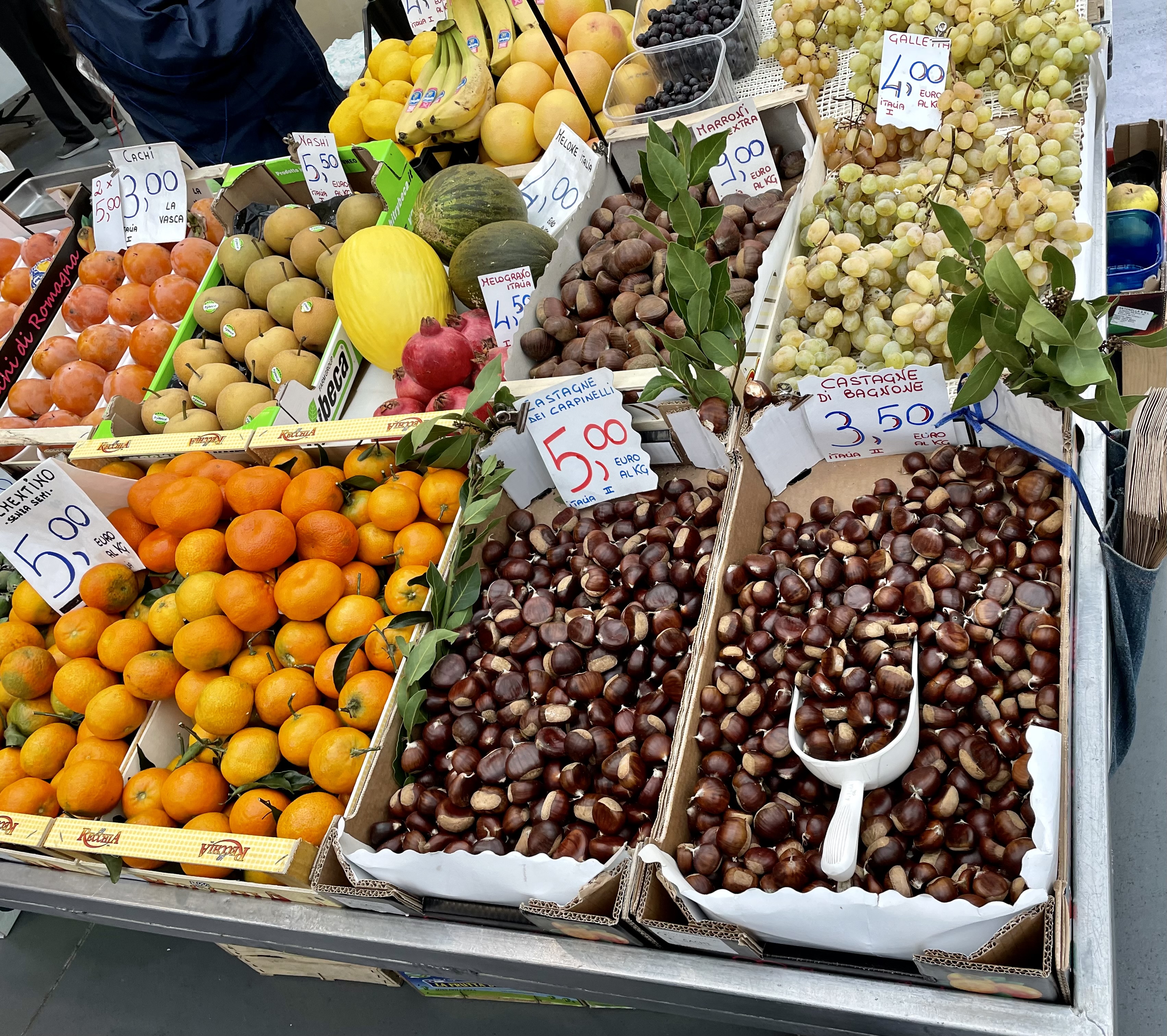
We enjoyed lunch with another ex-pat. As I’ve noticed in other places, the ex-pat community seems full of people with fascinating stories. I suppose it either takes or makes character to leave your home country and live abroad.
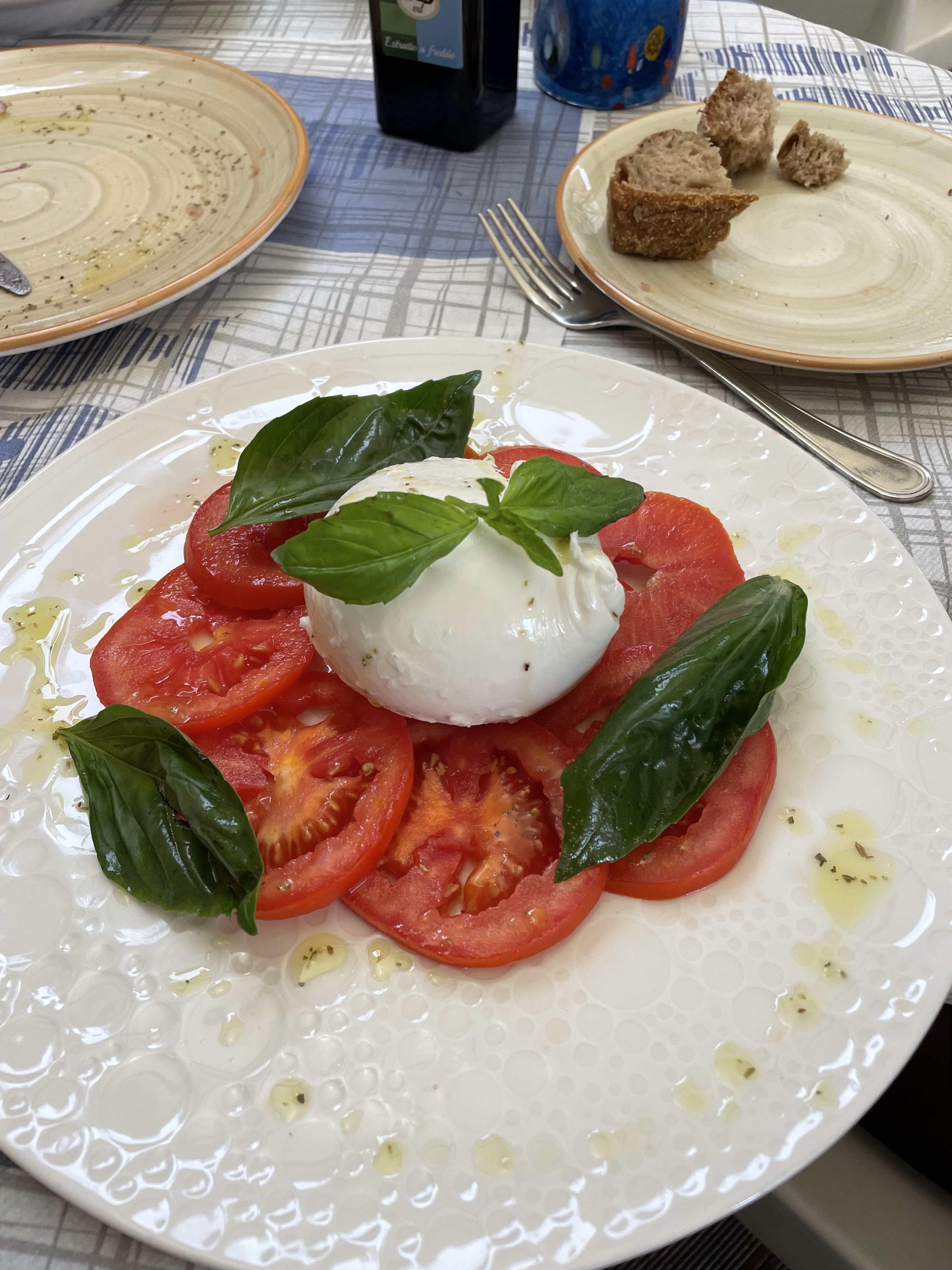
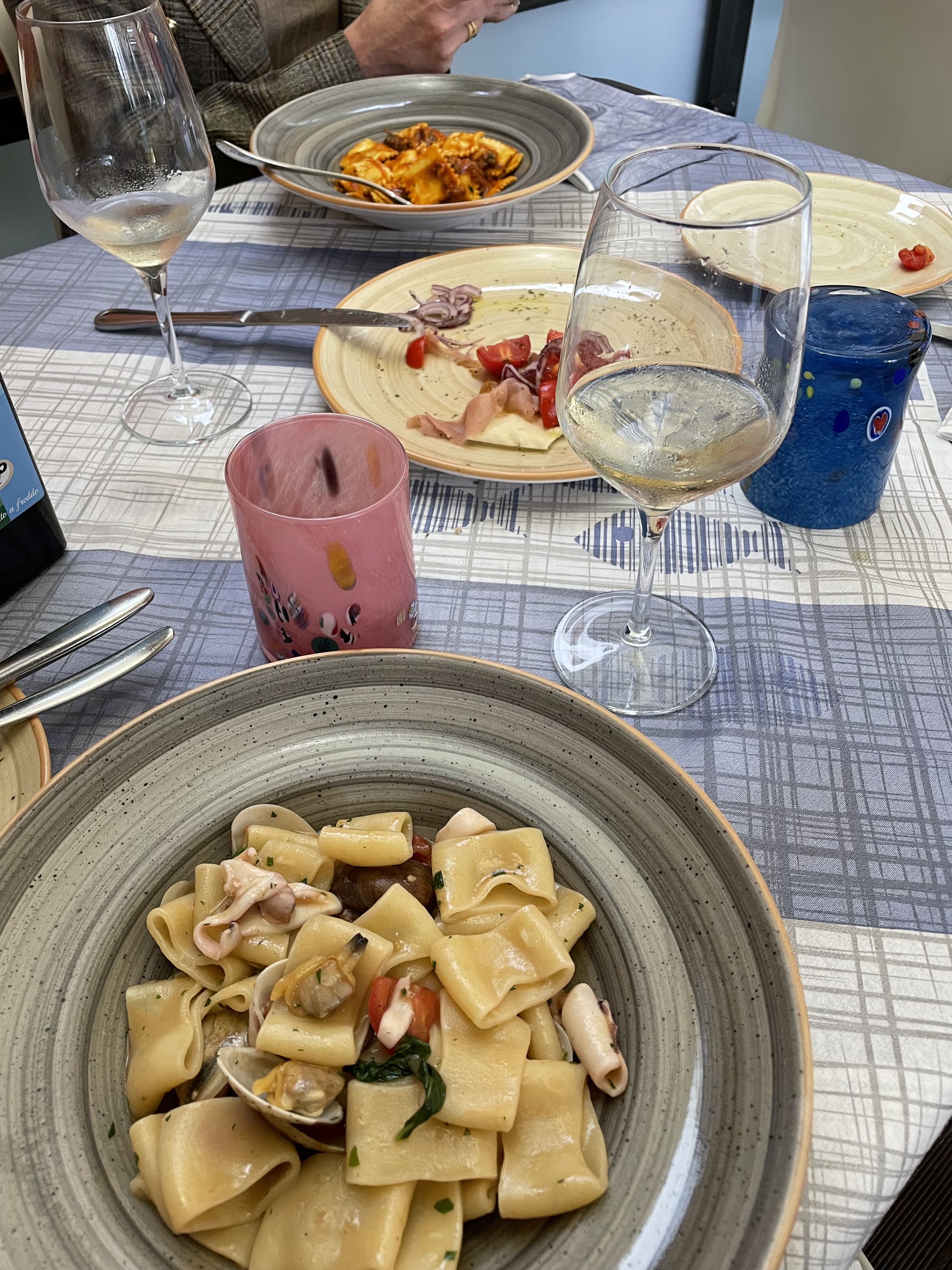
That’s right … wine, olive oil, and yummy bread with every meal. Lunch was almost too good; I ate so much! This is the time the stores close and people go home for a nap but I kept going; just too much to see.
Thursday morning we went multi-modal — planes, trains & automobiles. While it might sound difficult, it was super easy. And since I travel light, a small backpack was all I needed leaving my hands free to take pictures or sip coffee. We walked to the train station, took the train to Pisa, flew from Pisa to Bari, picked up a rental car and drove to Matera, city of “sassi” (stone). Italian drivers are aggressive and expressive. Thanks, Alessandra, for driving so Xandra and I could enjoy the ride (when we weren’t screaming or praying. Just kidding!)
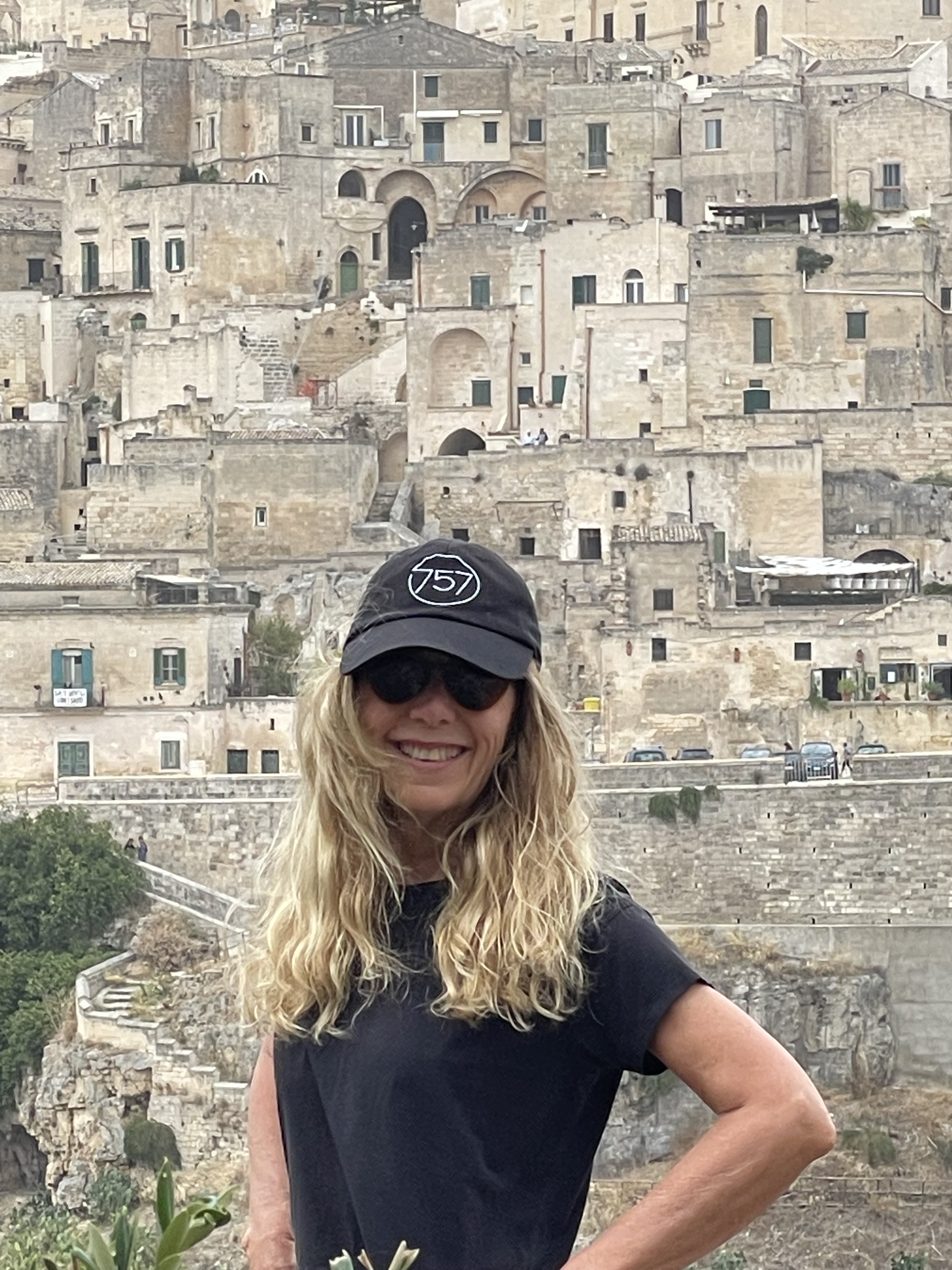
Matera is amazing! Dating back 10,000 years, it’s one of the oldest continually occupied communities in the world. Until the 1950s the cave dwellings were still in ancient conditions–basic and unsanitary. UNESCO stepped in and offered a lot of money to restore, preserve and partially modernize it. We opted to stay in the sassi and rented a cave apartment through AirBnB. It was lovely in every regard and our location was perfect. I didn’t wander very far alone because it was challenging to find my way back. The streets are many levels deep and seem to go in circles. The monochromatic structures are beautiful but make directions difficult. As awesome as it is in the day, Matera is even more magical at night.
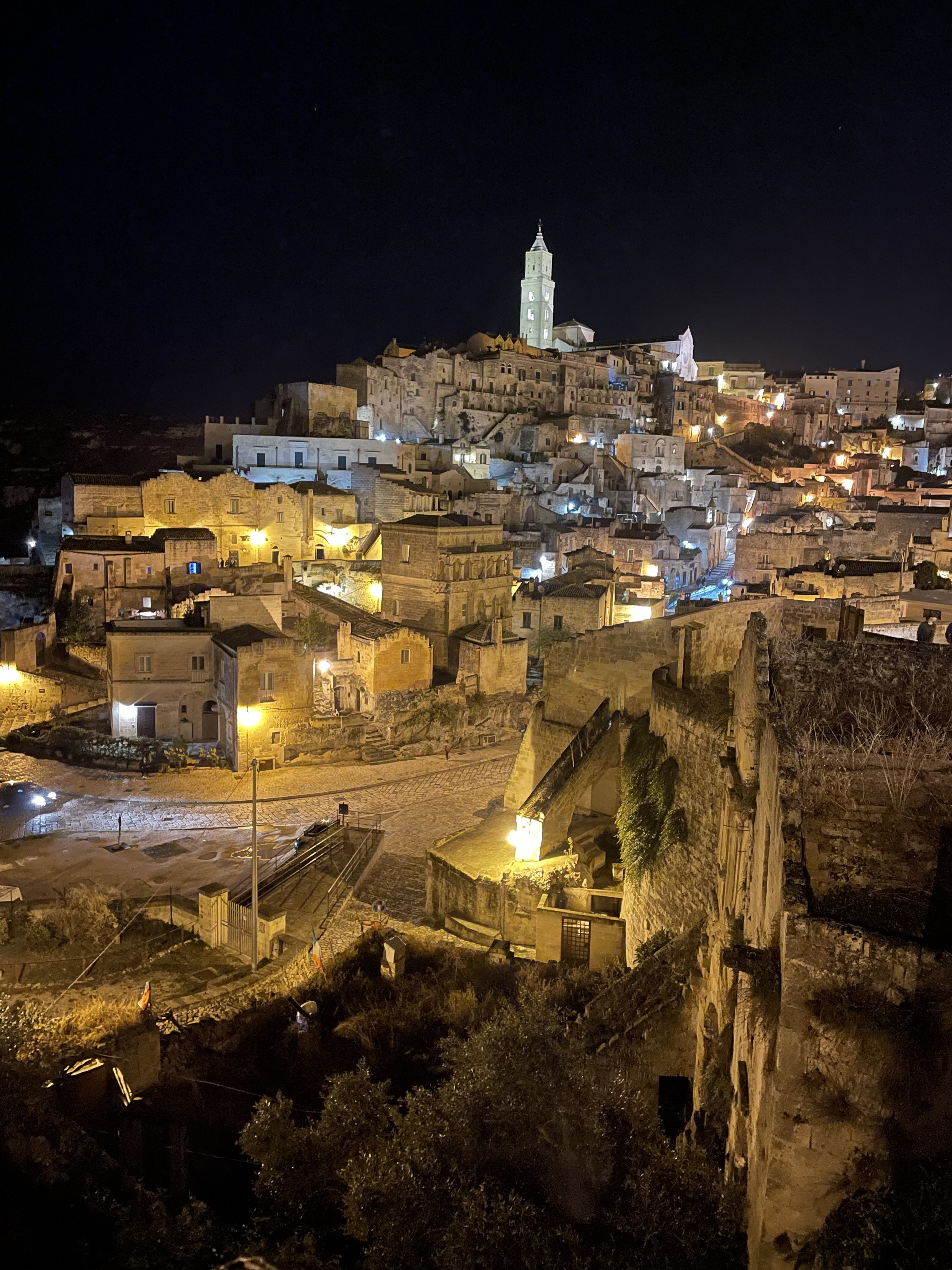
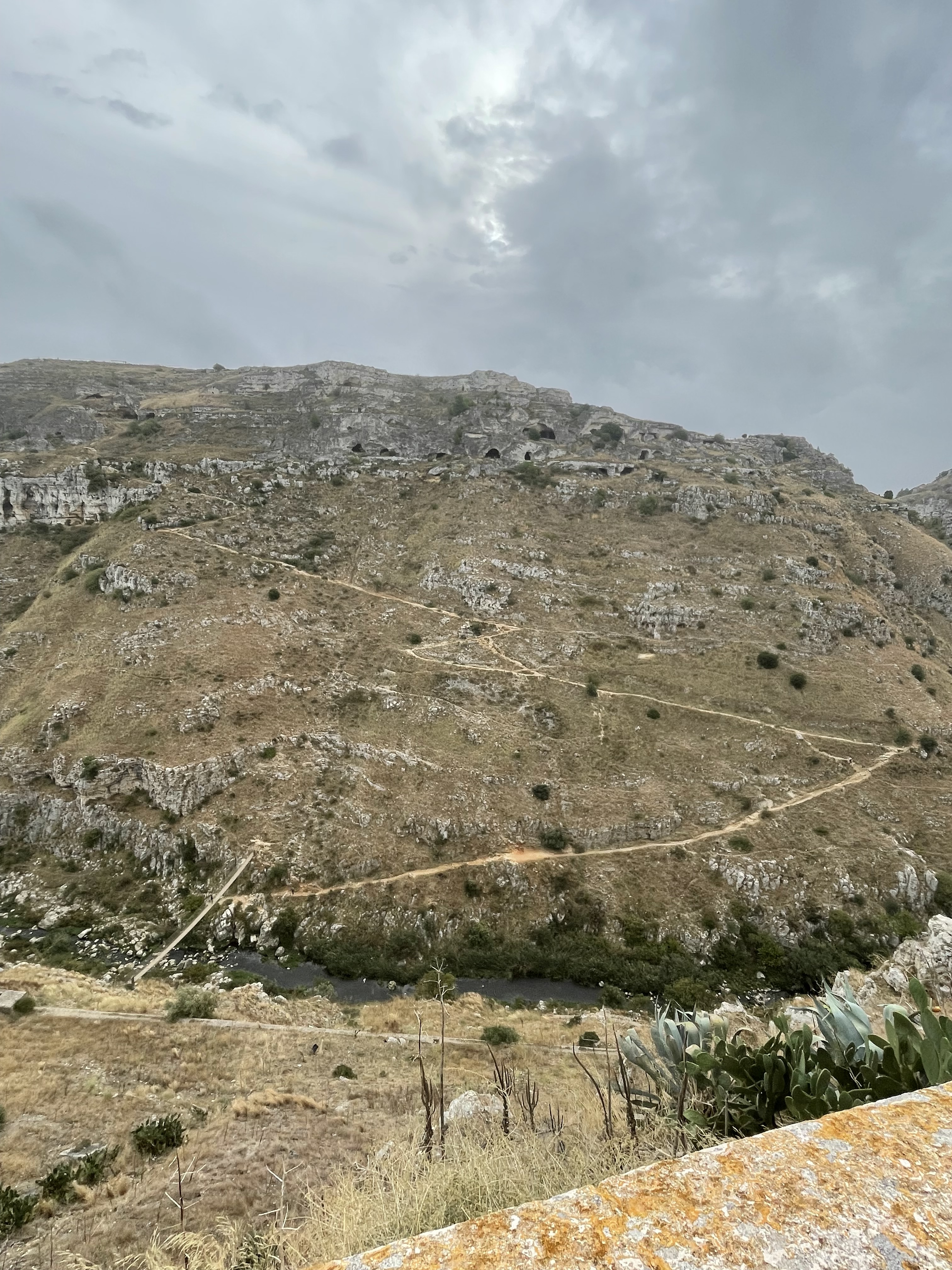
We were all excited about the Margia Materana hike. It was the key activity around which the whole trip was based. The hike was about 2 1/2 hours roundtrip and quite steep at some points –moderate difficulty but very high on satisfaction. The wobbly, suspension bridge at the start was a bit nerve-racking. You can see the bridge and much of the trail in the picture below.
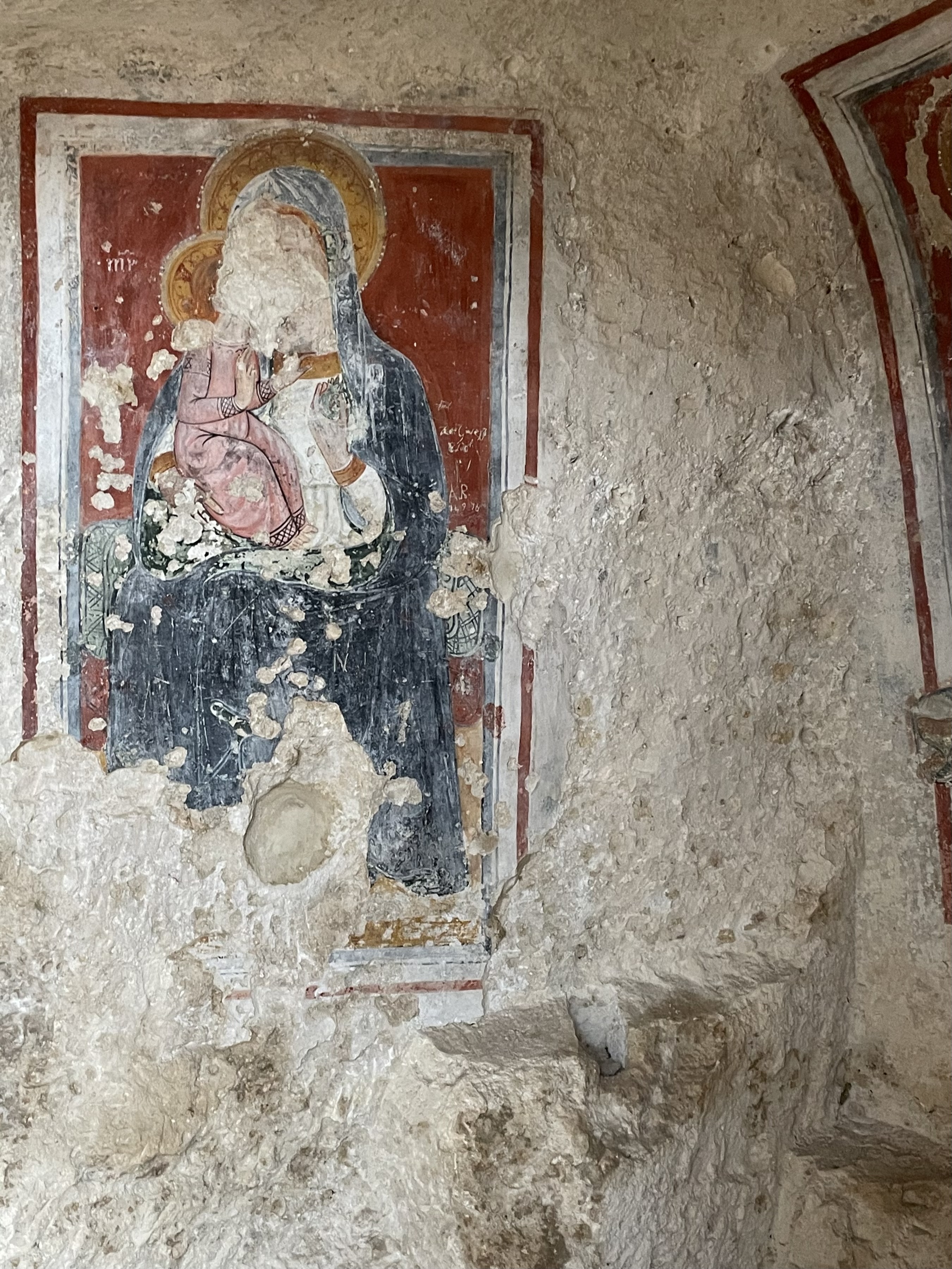
There were many caves at the top including one with three entrances that is believed to have been a church. The frescoes date back to the 8th century.
The wide-angle view from the top looking back on Matera is even better than seeing it up close. If you’re unable to hike, there’s a road on the back of the mountain and a parking lot near the top. Taking a bus might not give you the same feeling but it’s sure better than not going at all.
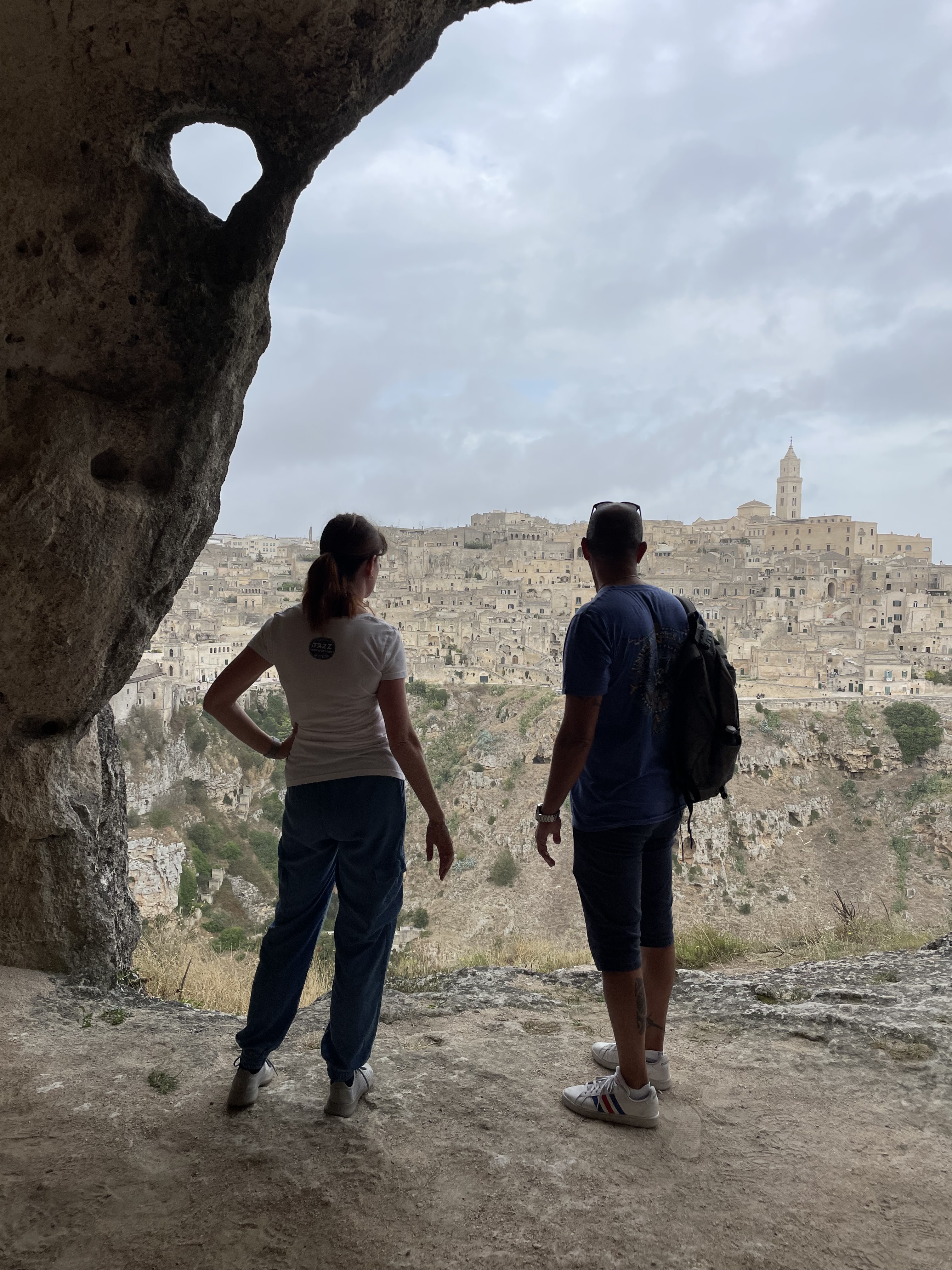
We had a gorgeous day to hike and take in ancient history. It filled me with a humbling sense of glory for my little place in this big world. If those structures could talk they would surely have endless stories of people with their dreams, struggles, and full lives over the centuries; the stories continue today. Matera is more than interesting — it makes you feel humanity.
After the hike we treated ourselves to a spritz, a popular cocktail that’s a mix of proseco, soda water, and one of three bitters. My preference is made with Select (Italian apertif created in the 1920s) which is less sweet than Aperol (orange, Italian apertif made from rhubarb and herbs) but sweeter than Compari (red, Italian apertif made from spices and herbs) and is supposed to be the original.

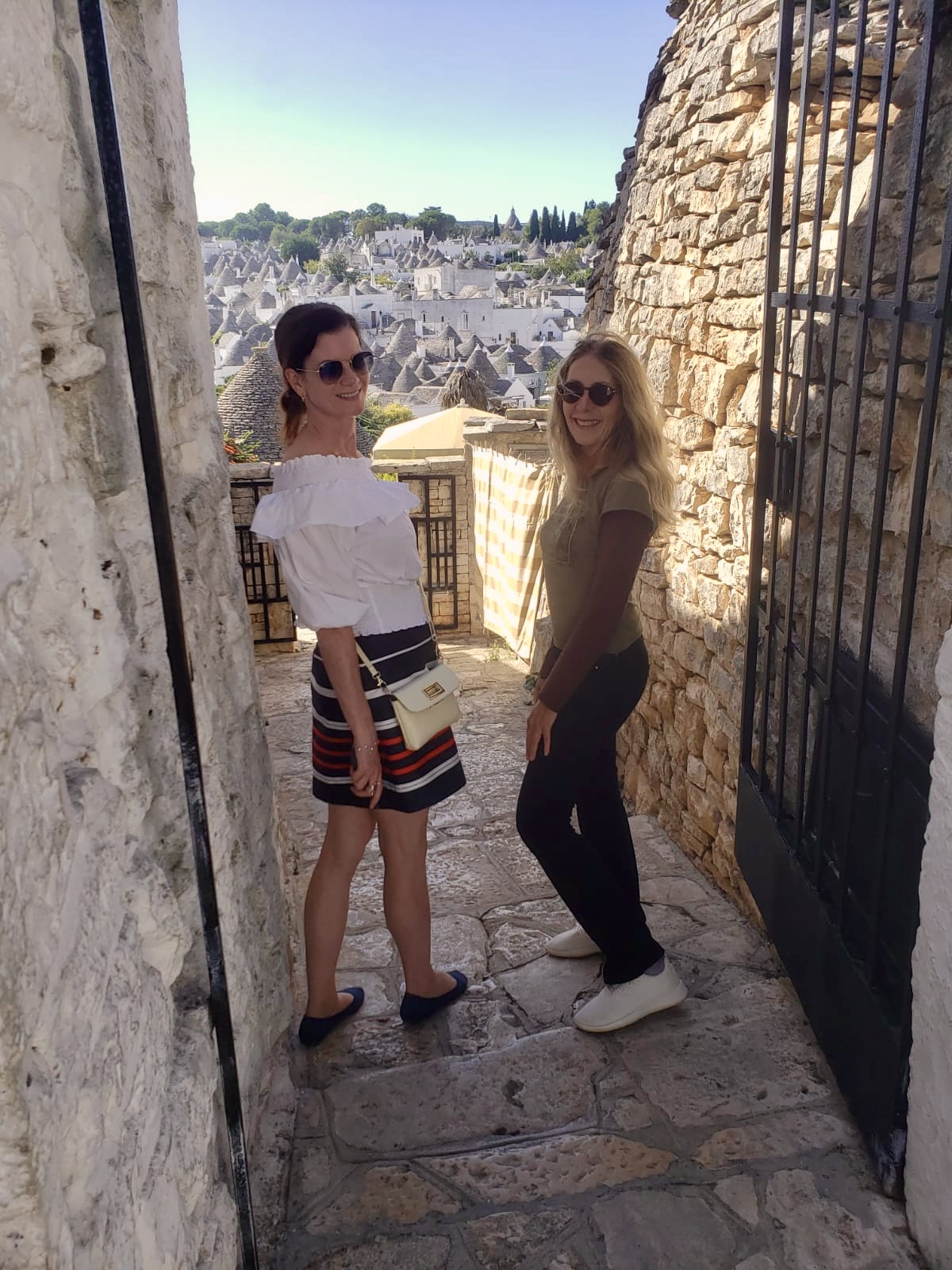
Leaving Matera, we drove about one hour to the scenic town of Alberobello (which means beautiful tree). Coming into the town, you see the typical “trulli” (plural of “trullo” which is a traditional stone hut in the Apulian region) homes.
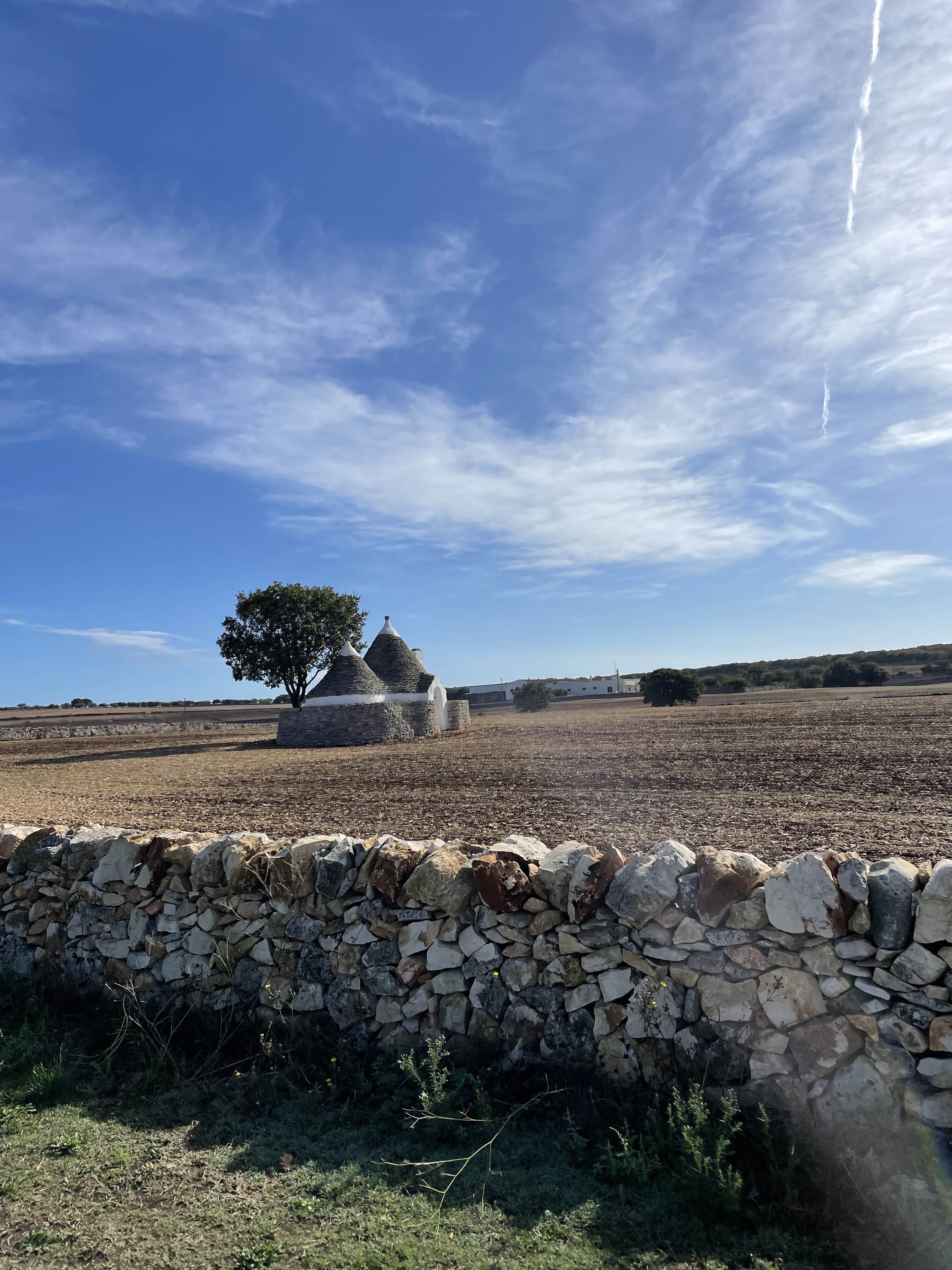
The town attracts tourists because it’s full of these picturesque buildings. I was told they became a popular building style because they use local materials and can be quickly disassembled when the tax assessor comes around then can be rebuilt after the fear of being taxed passes. No idea if that’s true but it fits with other things I’ve heard about the relationship between the people and the government.

Alberobello was just right for walking around for a couple hours and popping in to the stores selling things like hand-woven linens, roasted walnuts, and offering a friendly chat.
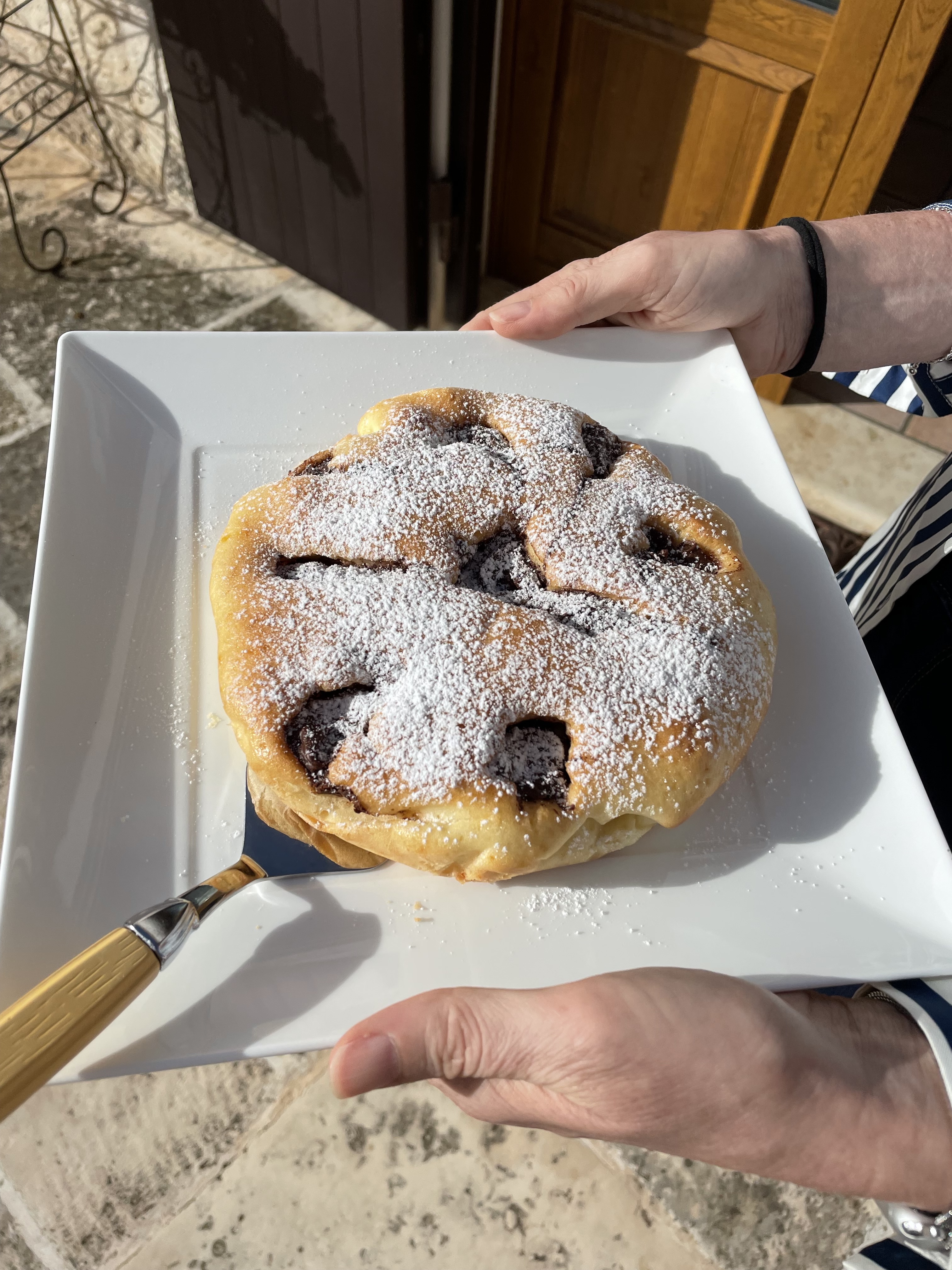
Our AirBnB for the night was a sweet, two-bedroom trullo in Martina Franca about 20 minutes away. The hosts couldn’t have been nicer. My Italian is limited to a few basic phrases but somehow we managed several pleasant exchanges. Our hostess brought over fresh baked goods when we arrived and again in the morning.
For the evening we went in to the nearby town of Ostuni. There was an open-air festival where we bought hats from an Italian woman who studied in NYC at Fashion Institute of Technology. Attire all over Italy is quite stylish. Even everyday clothing for both men & women is so much more interesting than jeans & T-shirts. I didn’t see even one Italian woman in leggings. And, skinny pants are on the way out while loose-fitting slacks and over-sized blazers are featured. Nice sneakers are worn with everything including dresses. The streets are not appropriate for heels. Closets are small so wardrobes are built on quality, not quantity.
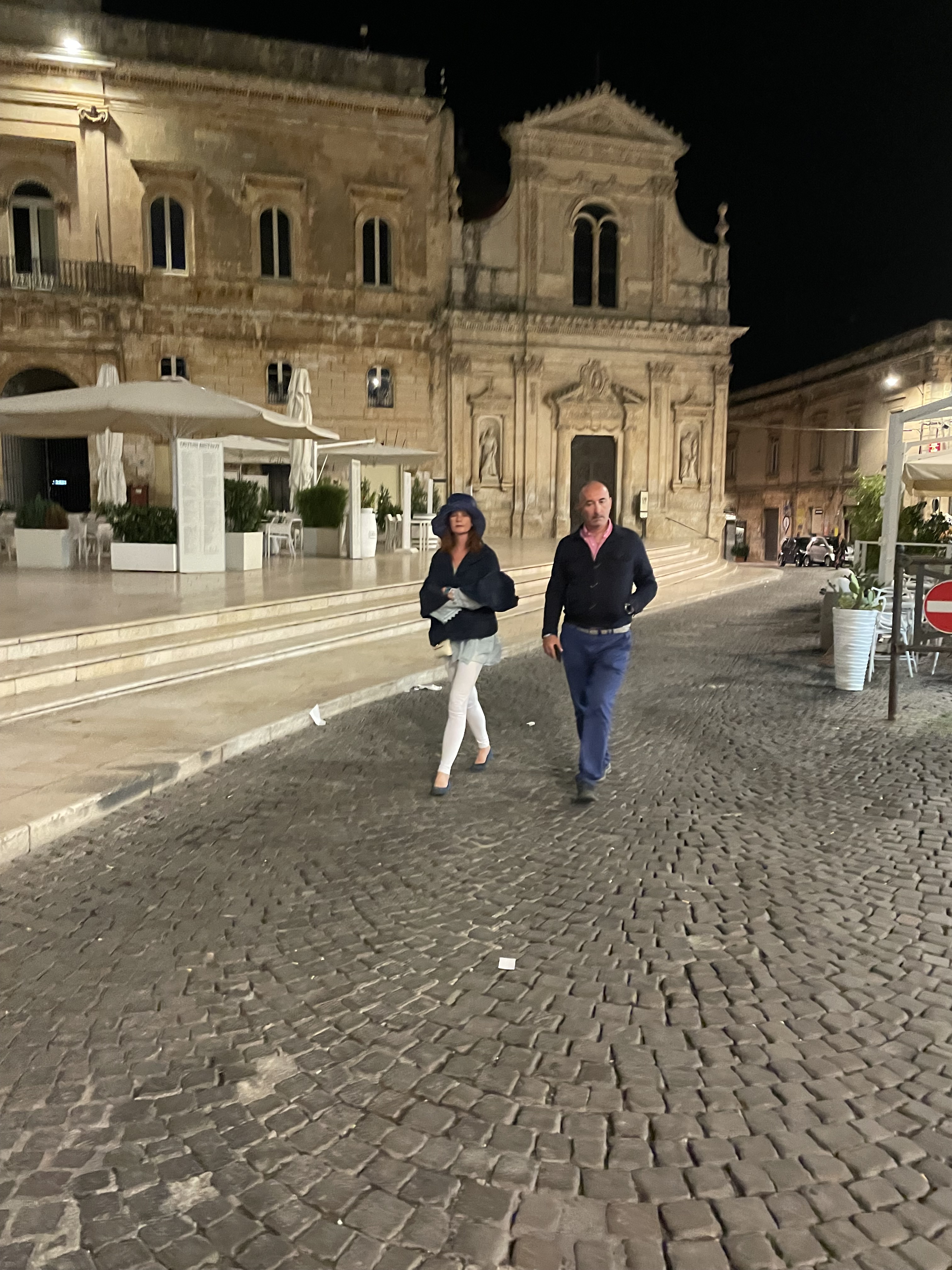
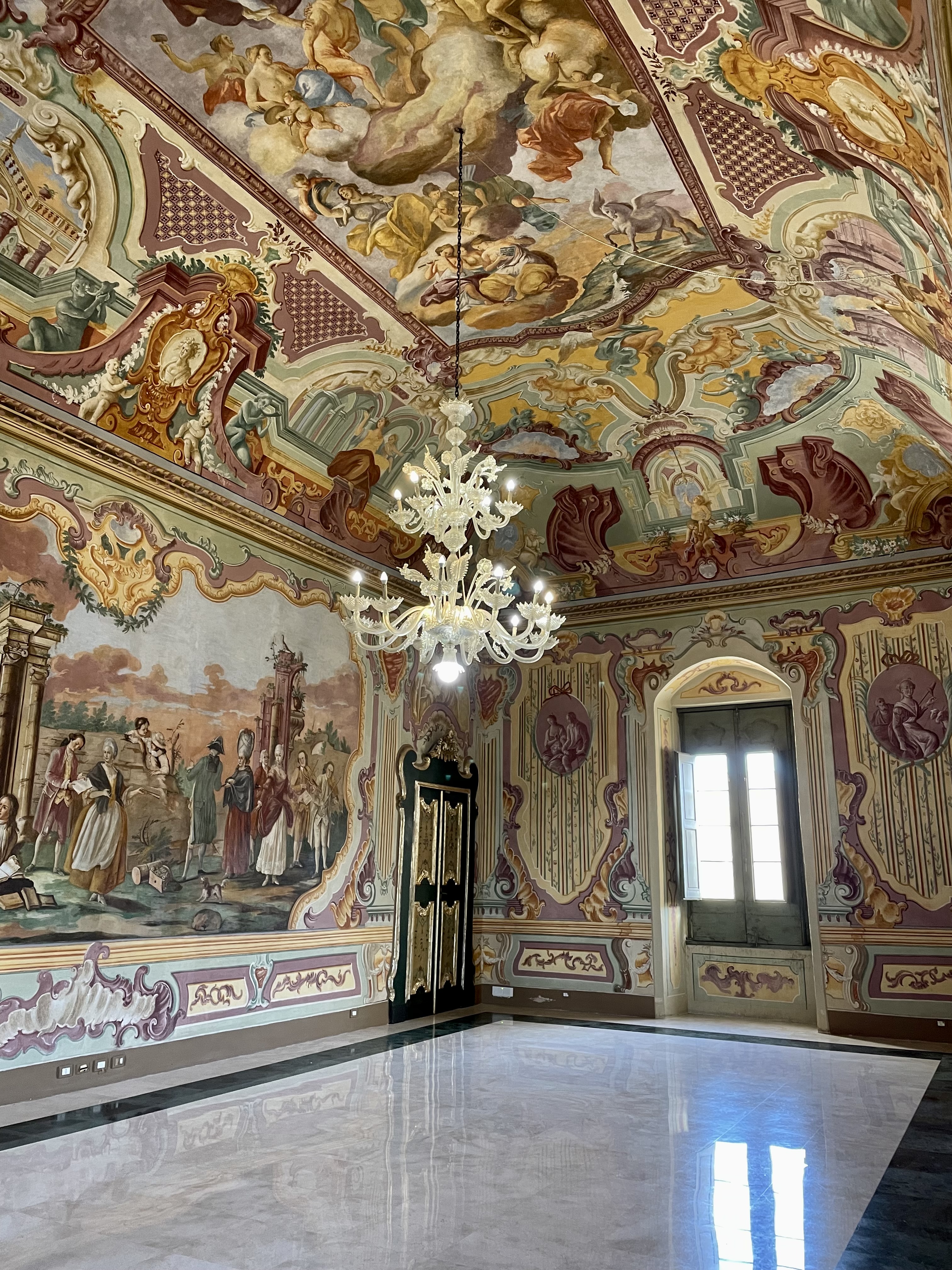
Before leaving Martina Franca the next morning, we toured the royal Martucci Palace in Piazza Roma that is being used for meetings and special events …
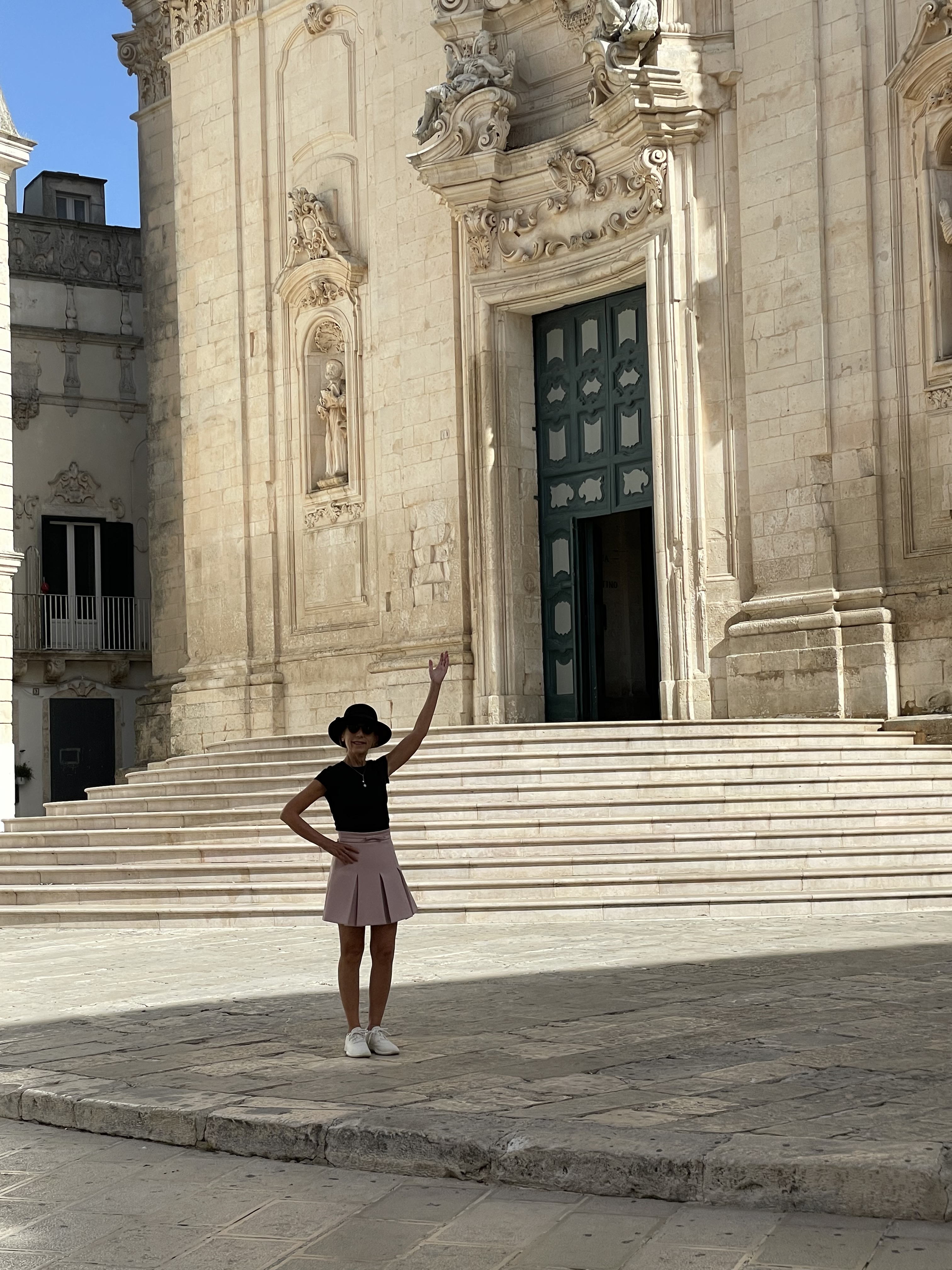
then strolled through Piazza Plebiscito with this gorgeous Cathedral. Not unusual, these grand buildings are in the middle of a relatively small town of less than 50,000 people.
Continuing our tour of the southeastern region of Puglia, we stopped in Monopoli for yet another delicious lunch. The restaurant owner/chef came by to check on us and said the tightened economic conditions have been hard on business. We were the only customers during the hour we were there. While American tourism seems to be big, I suppose most tourists stick to the big cities and well-known areas like Rome, Florence, Venice and the Amalfi Coast. After lunch we made the short drive (8 km) to Polignan a Mer.
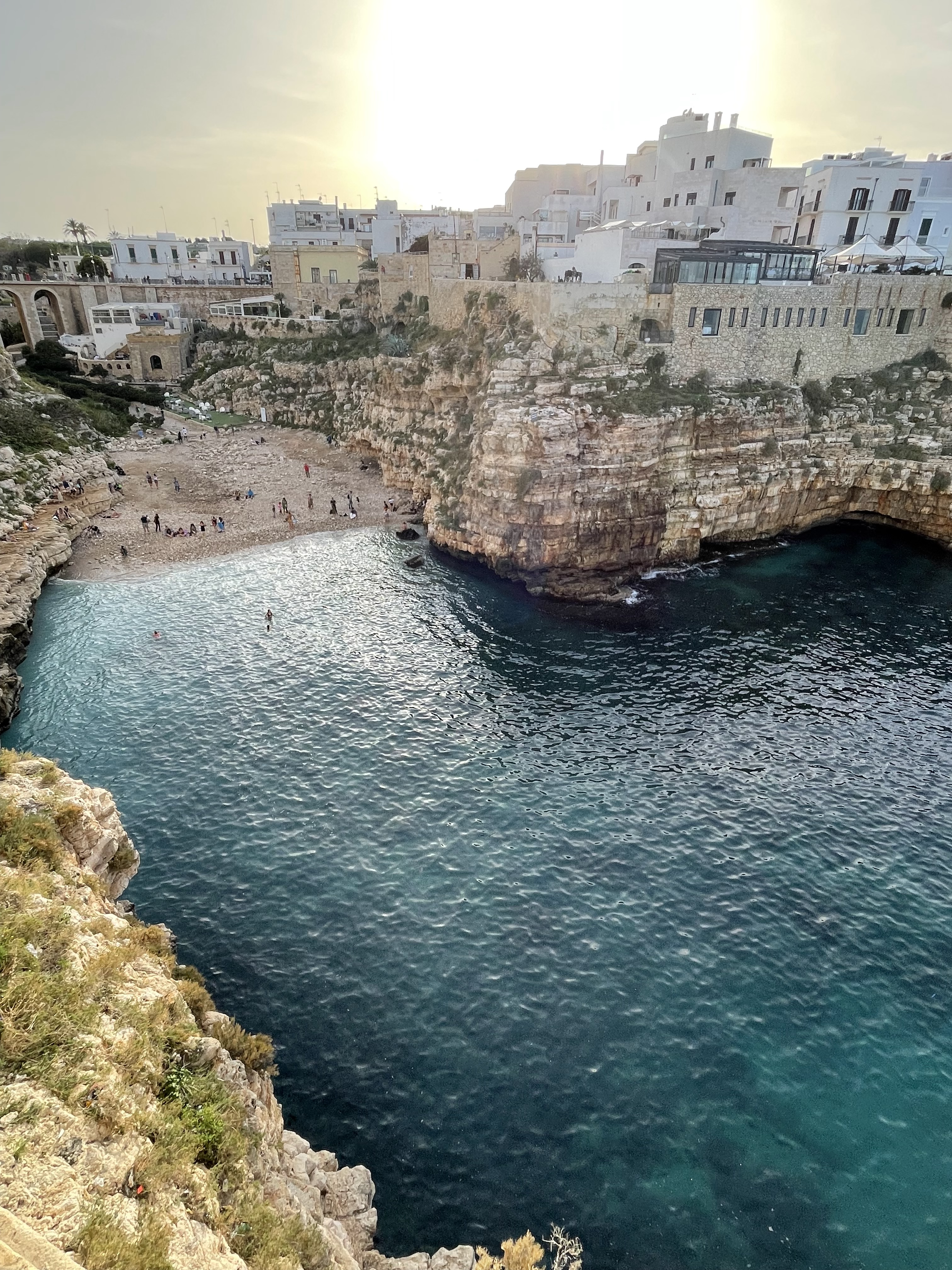
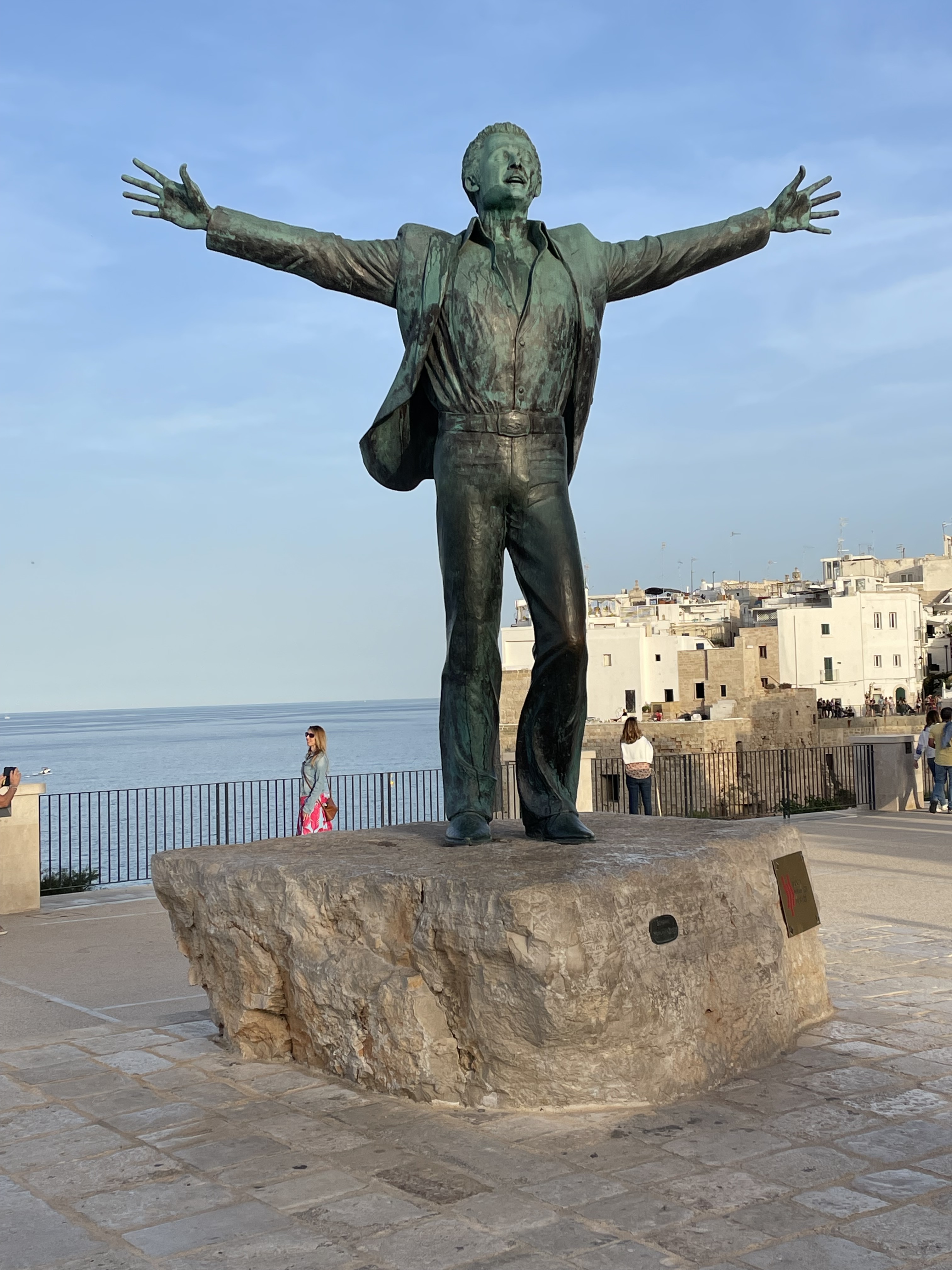
There’s a statute of Domenico Modugno, the Italian singer made famous by his popular song “Volare,” in a plaza by the beach. He was a native of Polignano a Mer. It’s fun to celebrate both the happy song and something that makes this town unique. Mermaids, dolphins and King Neptune are all fine in a seaside town, if a bit generic, but only this town can claim Domenico Modugno.
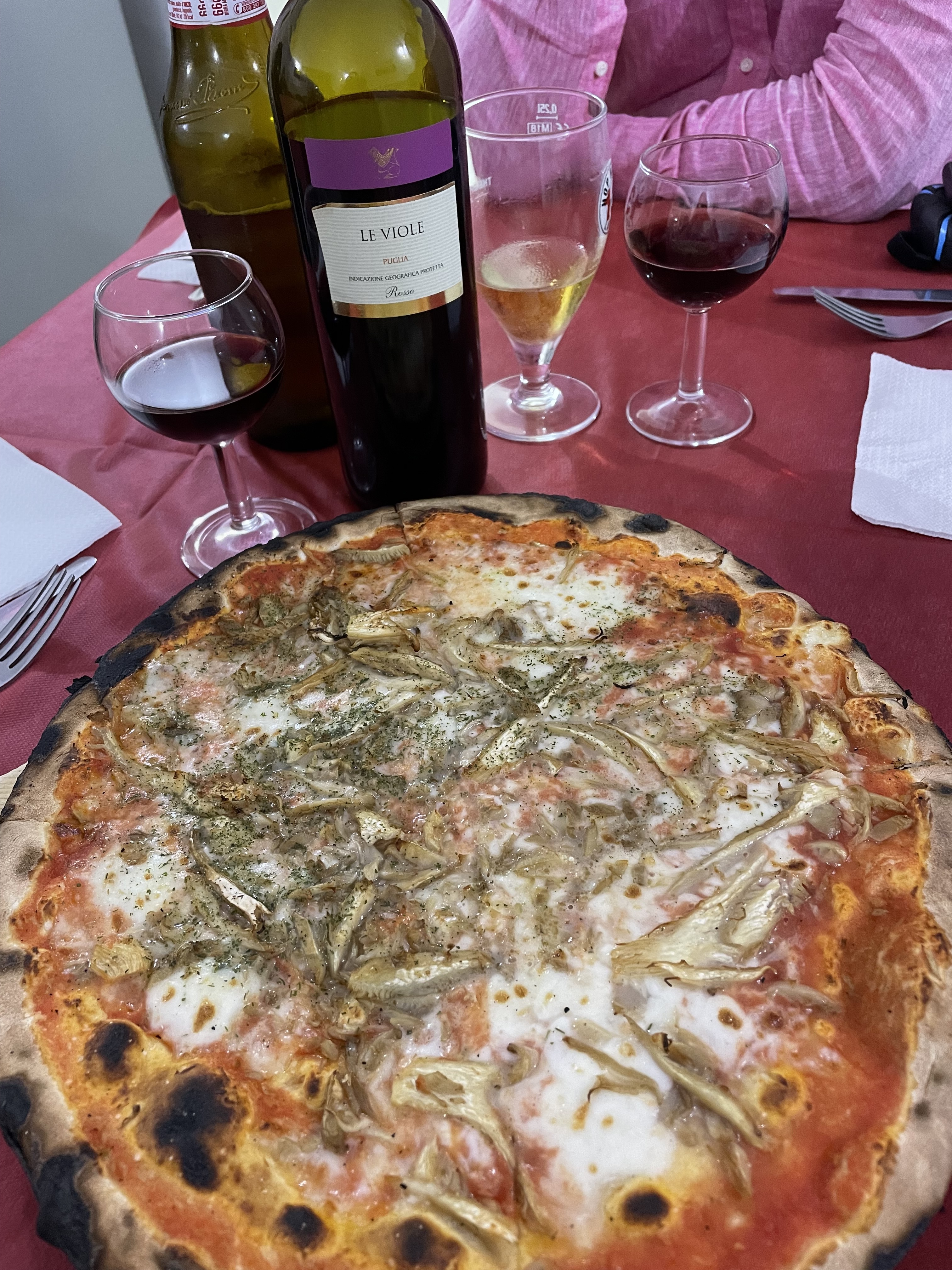
After a perfect afternoon by the beach and walking through the pedestrian-only streets, we continued to Bari for our final stop for the night. Time was limited so we didn’t see much of the city except a wonderful, little, pizza place full of locals and the airport the next morning. My pizza was thin crusted with mushrooms and I absolutely ate the whole thing! We joined in singing happy birthday to a 5-year old boy at the next table and I was pleased when they shared birthday cake with us. While this was a simple and inexpensive dinner, it was perfect. Wish I could repeat this dinner once a week.
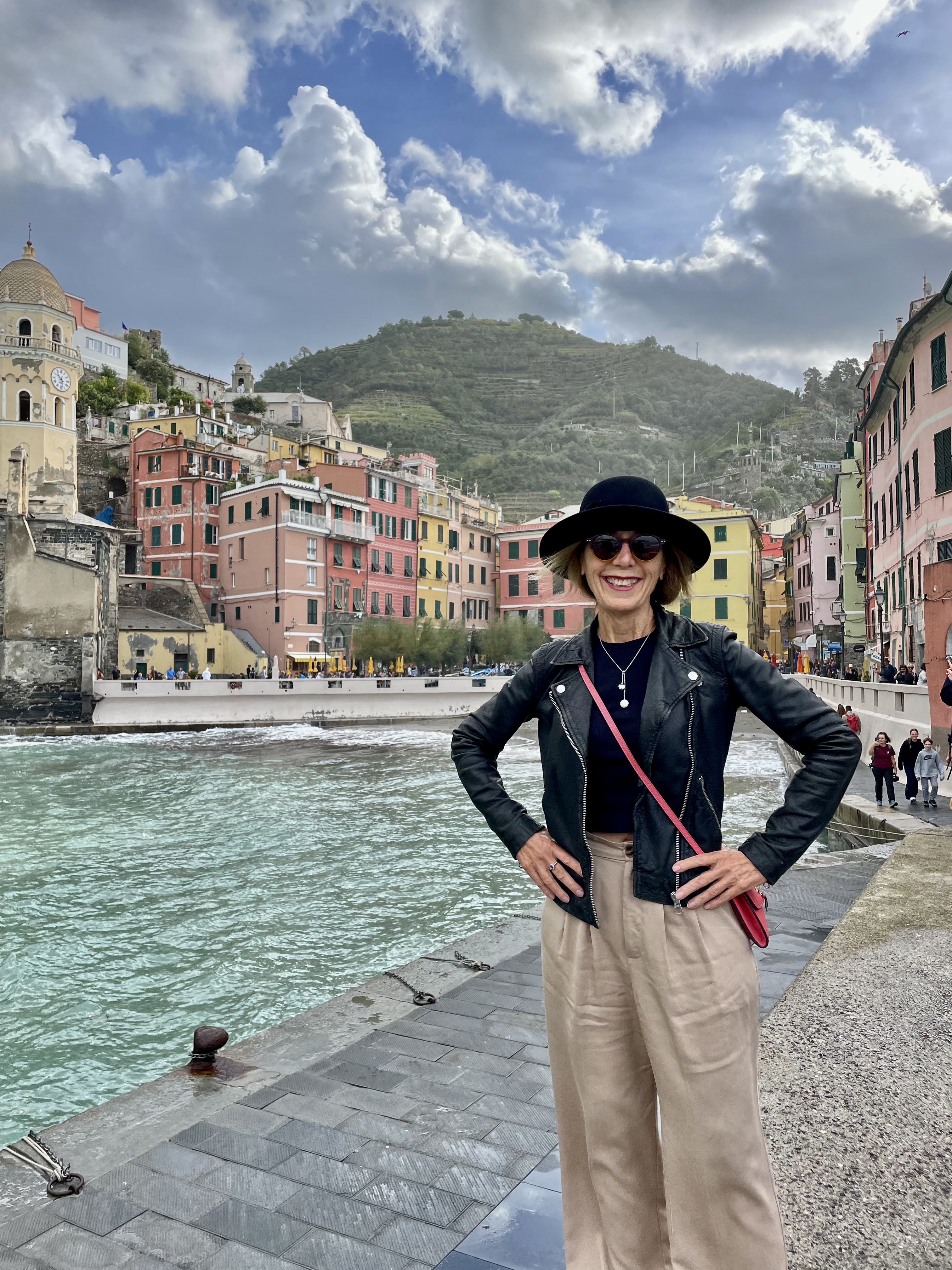
Back at La Spezia we embarked on seeing as much as possible of the Liguria region (northwest Italy) which is adjacent to Tuscany. I’ve seen Florence and Pisa twice before so, while they’re both wonderful, I skipped them and headed to Cinque Terre, meaning “five lands.” Another UNESCO World Heritage site, Cinque Terre is just west of La Spezia and comprises five villages — Monterosso al Mare, Vernazza, Corniglia, Manarola, and Riomaggiore. The footpath connecting them was closed due to mud slides earlier in the week but we took a train to Vernazza and Manarola. When/if I have the brilliant opportunity to return here, I’d love to walk the Azure Trail (Sentiero Azzurro) trail that connects all 5 towns; 7.5 miles (12 kilometers) long and a 2,000 ft (600 meter) elevation change. I can’t imagine living in one of these tiny towns balanced on the cliffs. On the way to Cinque Terre and traveling among the 5 towns, the train passes through tunnels and over rails perched on the edge that make you dizzy if you look down. I didn’t see any cars or roads that might accommodate them but I assume they’re inland and available when needed.
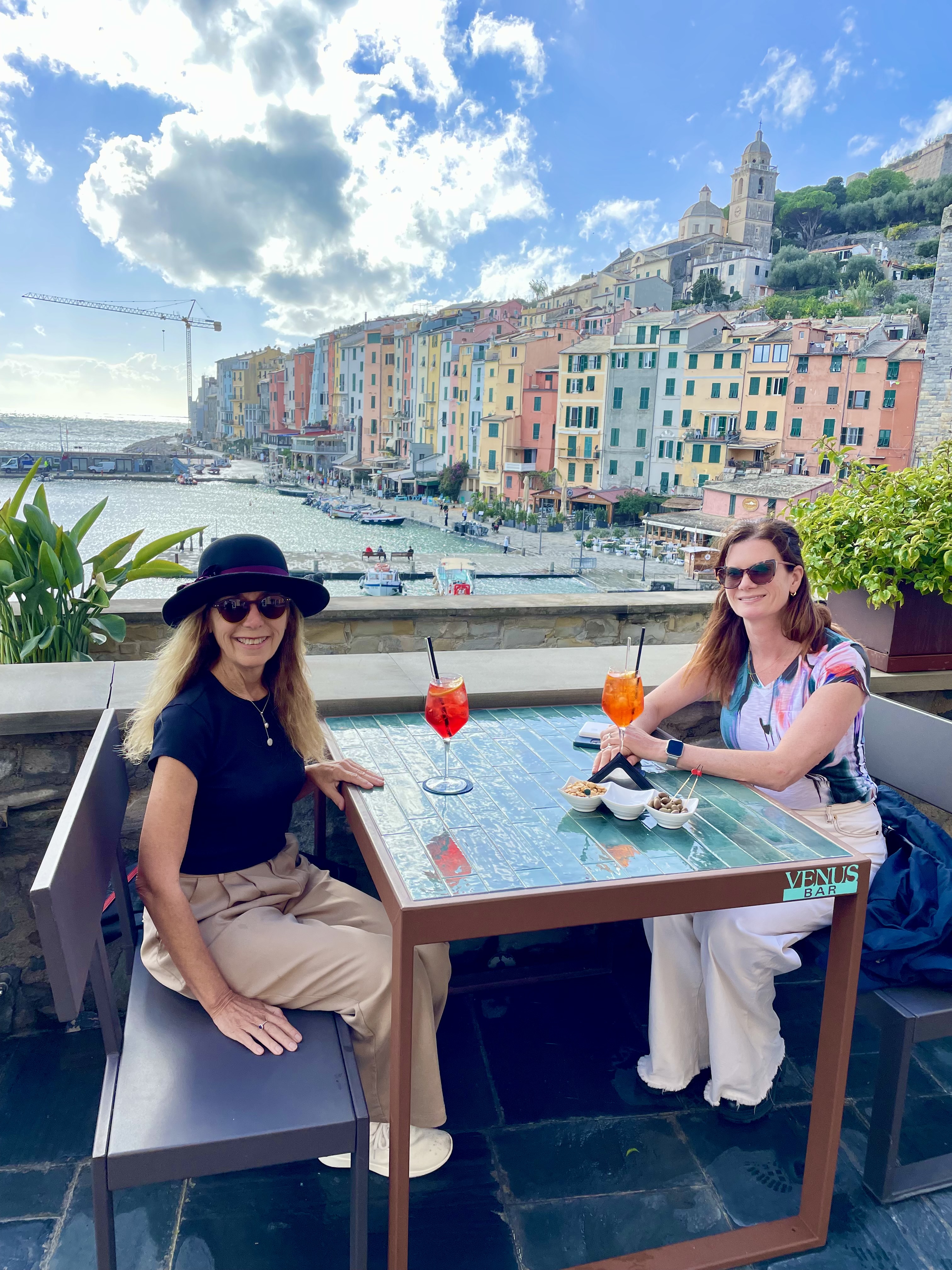
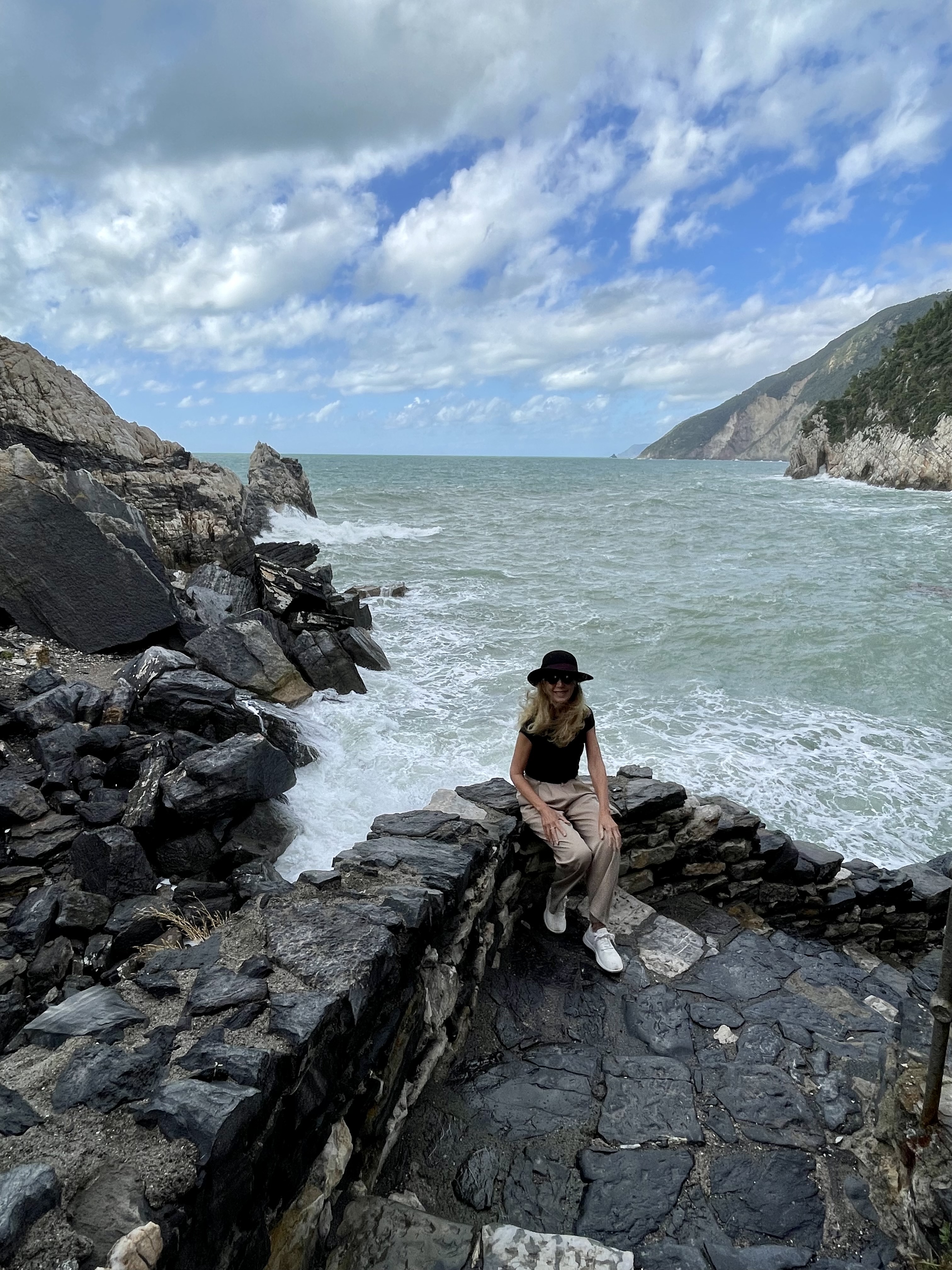
Yes, Cinque Terre is exciting and amazingly picturesque but so are many of the other coastal towns that aren’t full of tourists. Porto Venere is 45 km away and is absolutely delightful in every regard. Well known for being the home and favorite writing spot of Lord Byron, this inlet on the rocky shore is called “Grotta di Lord Byron” for the English poet who drew inspiration from it. If places can inspire creativity, this is surely one the best.
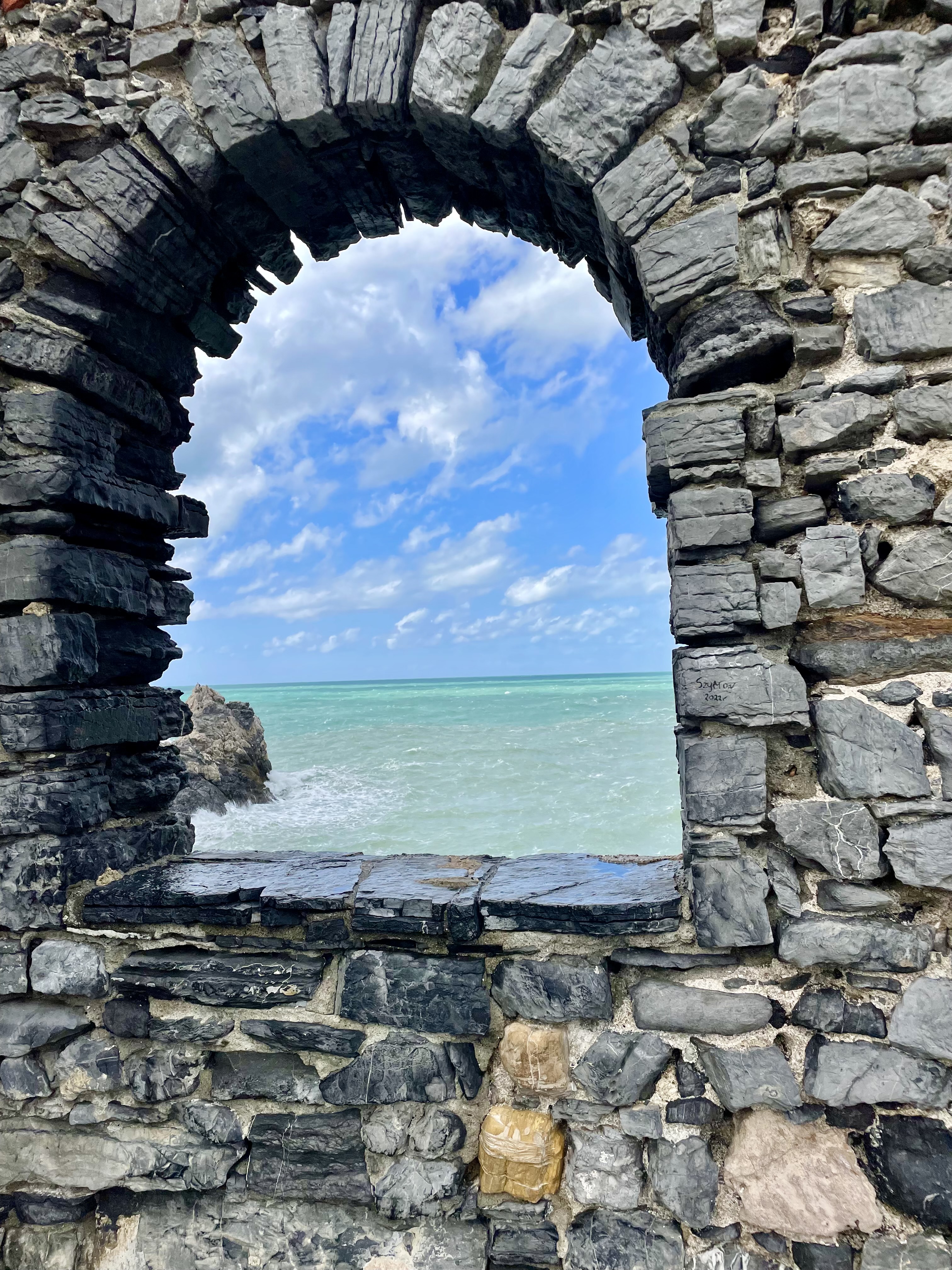
Out on the point, sits Chiesa di San Pietro (St Peter’s), a small, Catholic church built in 1198. It would be a magical place for a wedding. If it’s possible, the air is full of beauty and love. Somehow I breathed more deeply and felt peaceful while standing in it.

Walking along the shore, we took a break at the Grand Hotel for an afternoon spritz and were entertained by an imposing, one-legged pigeon insistent on sharing our peanuts and olives. After all, it’s often the little things you remember.
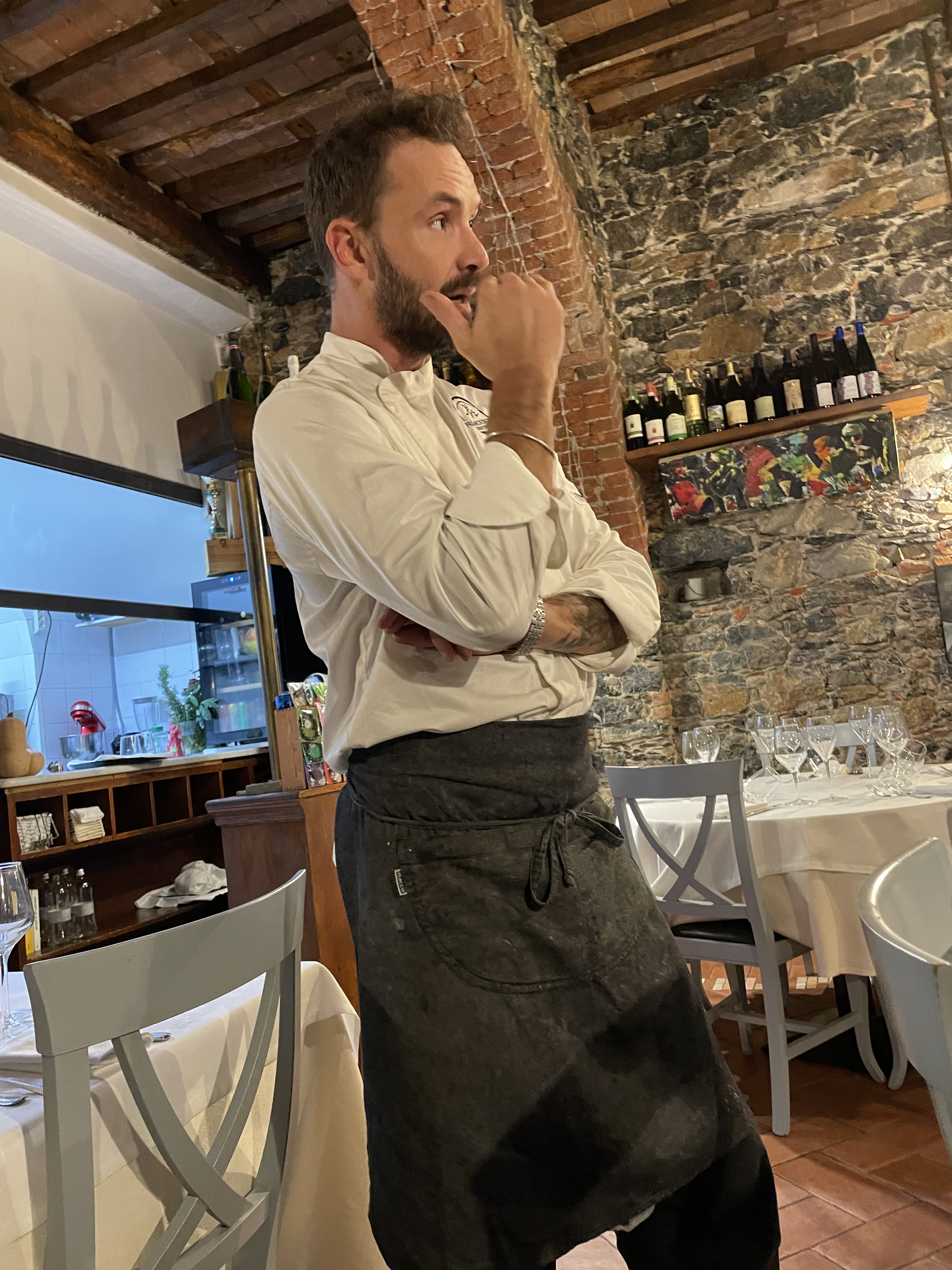
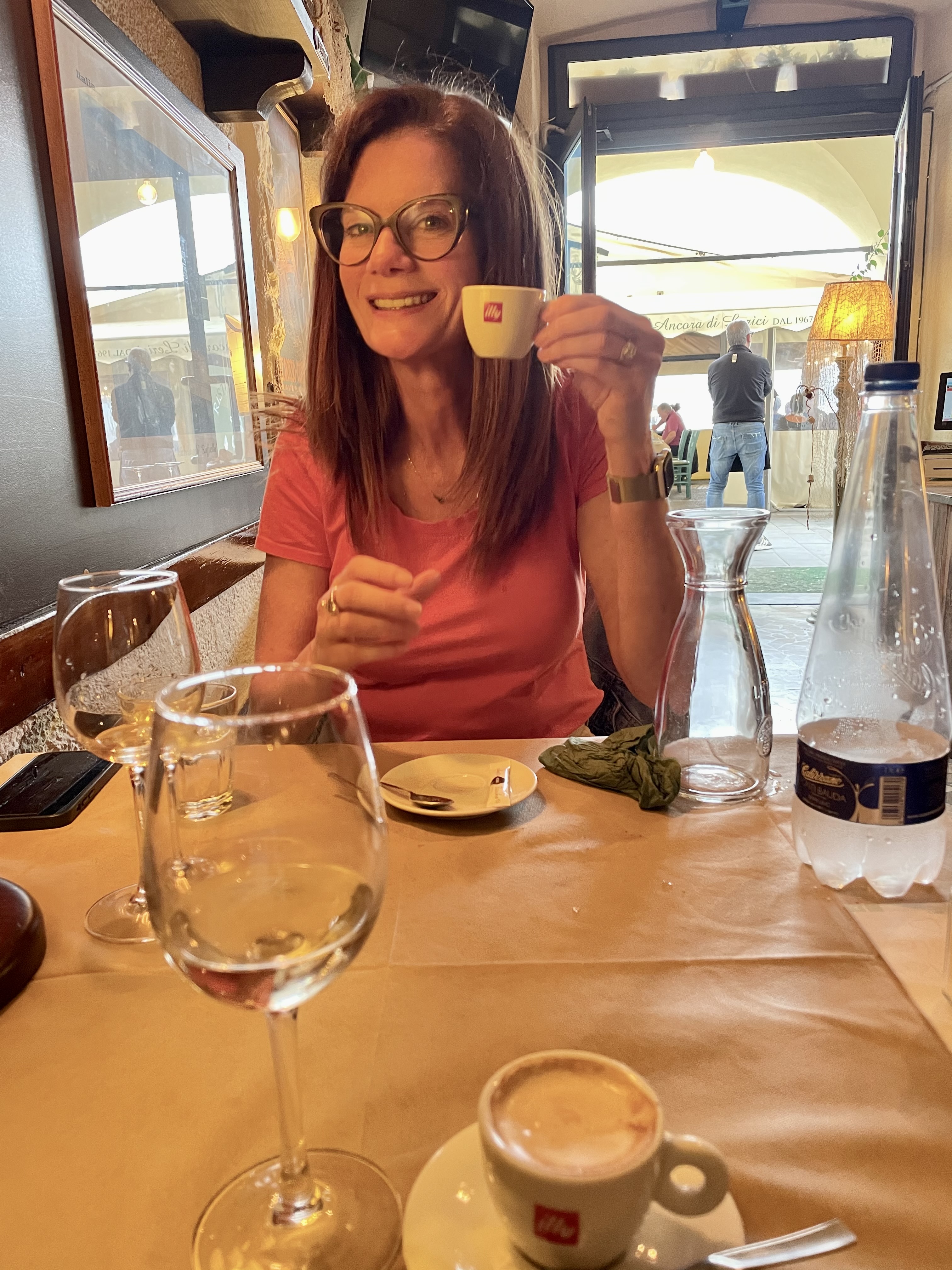
While every meal has been a culinary delight, dinner at Franceschini in San Terenzo might have been the best. We generally have an apertivo or an appetizer with champagne or prosecco followed by pasta and wine then an entree. Dinner isn’t complete without dessert, a liqueur to aid in digestion, and sometimes a coffee. My friend, Alessandro, is tasting tira misu all over the country in search of the perfect one. All this and the total bill for the three of us was about $60 (actually, Euros). Everywhere we dined, the chefs took great pride in their food and it showed. This is not the land of fast food or drive-through restaurants. Dining together is a cultural tradition. I didn’t gain any weight on this trip; we walked so much it offset the extra calories. The Italian obesity rate is 10%, much less than in the United States which is about 40% according to the National Center for Health Statistics.
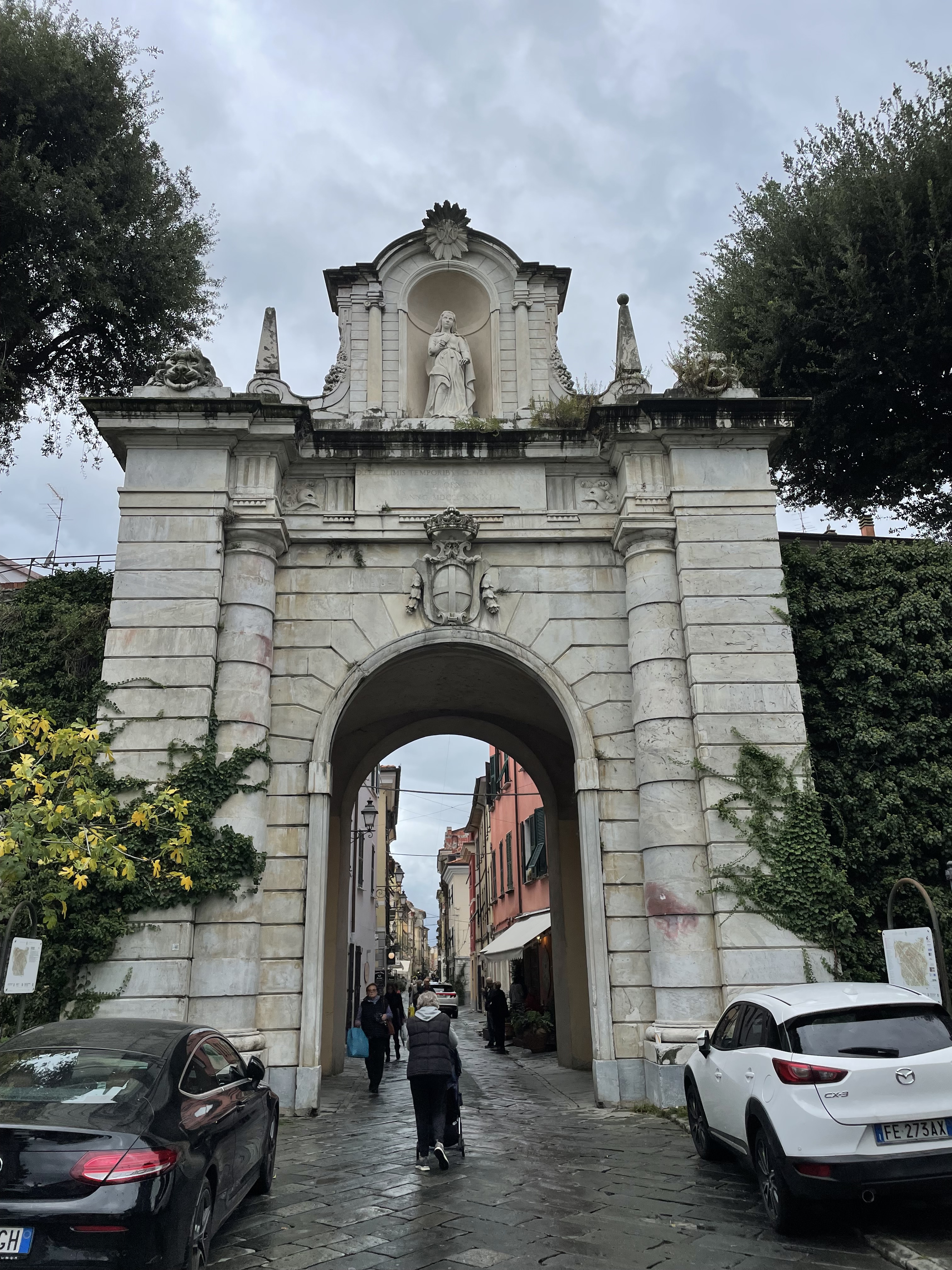
On my last day, we started in Sarzana, a lovely town that hosts concerts like Ben Harper in the town square. There’s a big fort and wall with two gates to the old town. The picture below is the Roman Gate and, supposedly, if a person rides a horse straight out the gate for 250 miles he/she will reach Rome.
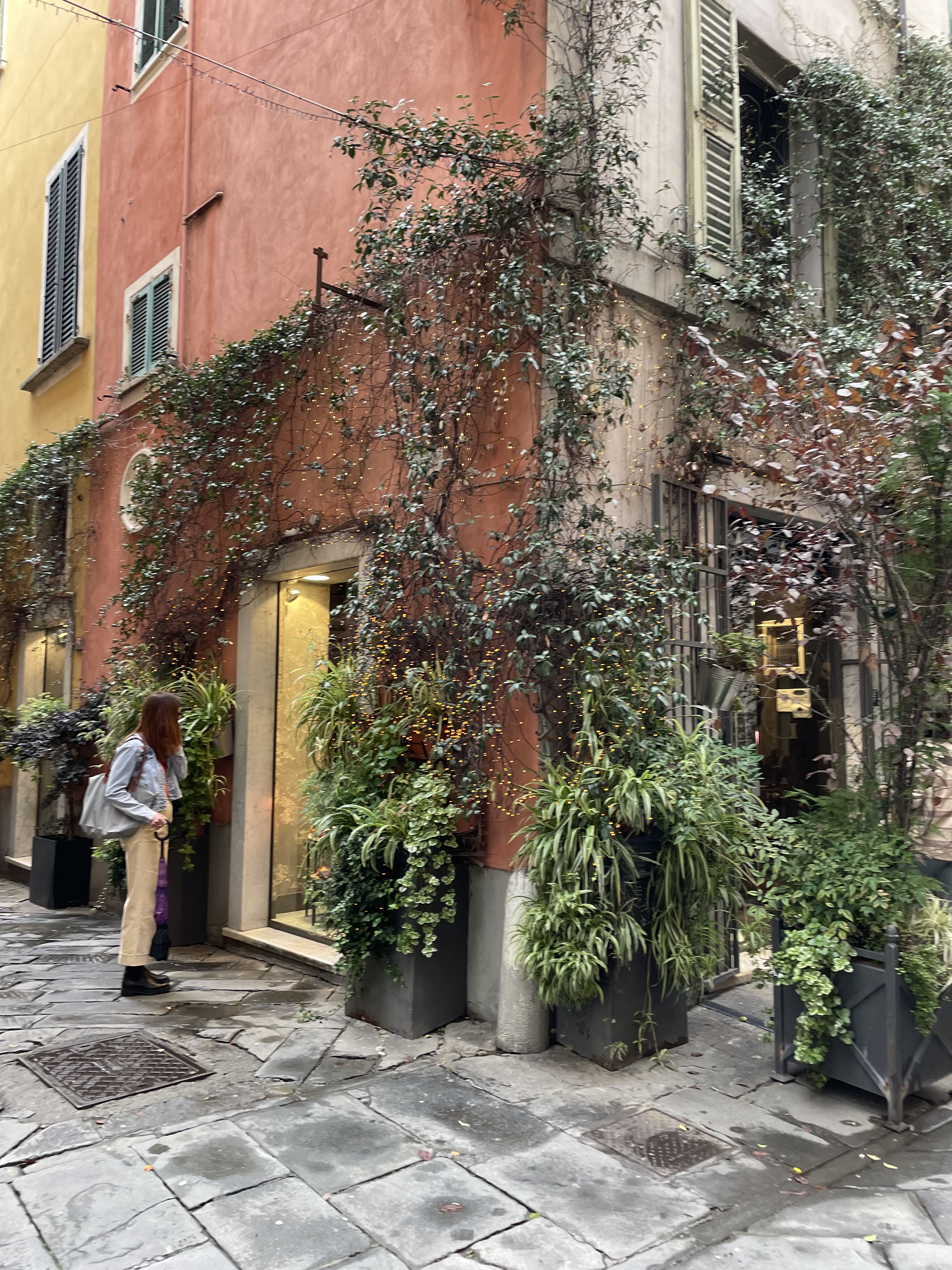
The cobblestone streets are lined with boutiques and small shops. Some had craftsmen working on-site such as a weaver, leather worker, and baker. The clothing and shoes were of excellent quality and not mass produced. The sales staff was professional and helpful — a sharp contrast to shopping in American malls.
We passed it once without notice then turned around to see the former home of Napoleon Bonaparte; proving once again that I live better than emperors of days gone by. Banished when the National Party was defeated, Napoleon found refuge in Sarzana then in Corsica.
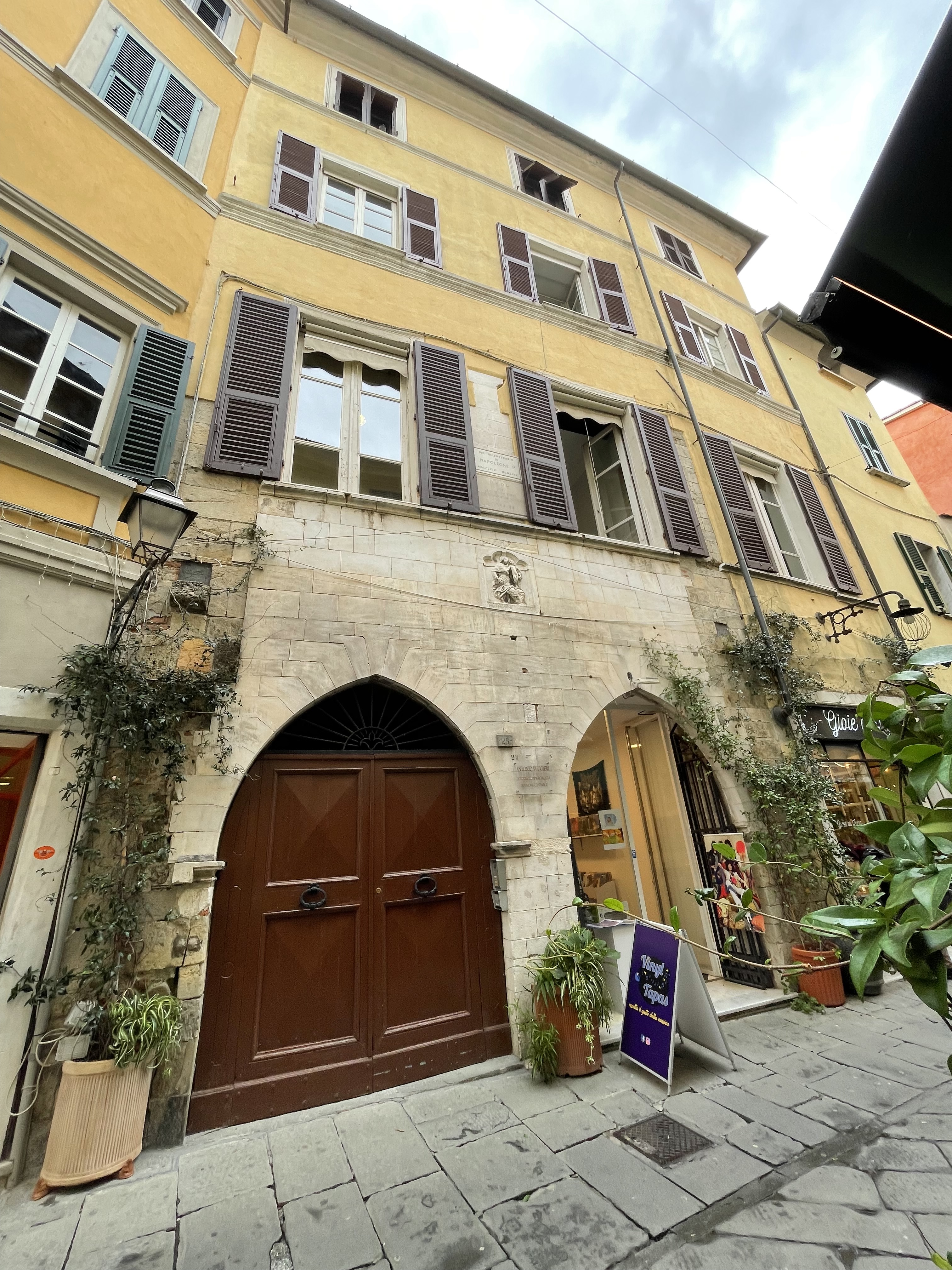
Leaving Sarzana, we drove about 10 km to Lerici, another gorgeous town with a big fort up on a hill overlooking the Mediterranean.
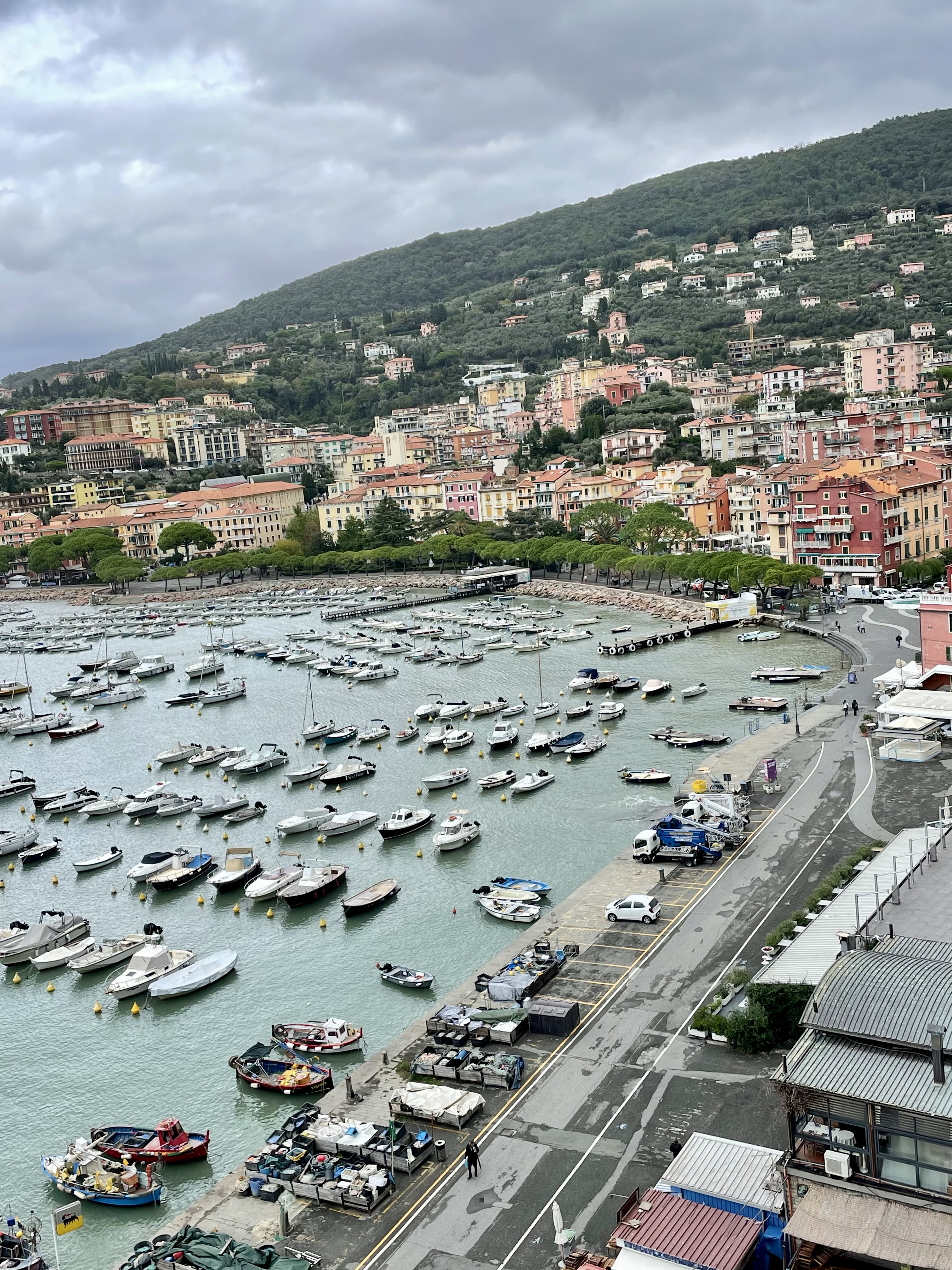
As I write this is sounds like we were racing around from town to town but it didn’t feel that way at all. Each village was essentially complete; designed for safety and community. The next town might be just 5 miles away but it has its own character and charms. We walked up and down streets, stopped for a leisurely lunch, and took our time. There was no agenda or schedule and the only real objective was to enjoy this beautiful country and each other. The easy pace with an emphasis on enjoying life was a unifying theme throughout Italy. For example, restaurants and stores close from 2 PM to 5 PM for lunch and rest with family. If you question why some enterprising cafe owners don’t stay open and get all the business, the answer is always that they don’t need to. They make enough to support themselves and have no desire to work harder.
After Lerici we drove up a crazy, winding road to the very top of a mountain. The small town of Vezzano Ligure is built around a church and monastery. Everything about it is special — the views from the top go on for miles & miles, to mountains in one direction and the sea in another. As lovely as this town is, I saw no tourists and very few people. I also saw no typical tourist places–no hotels or souvenir shops. It’s just a slice of Italian life with its unique history that has evolved into an off-the-beaten path, delightful village.
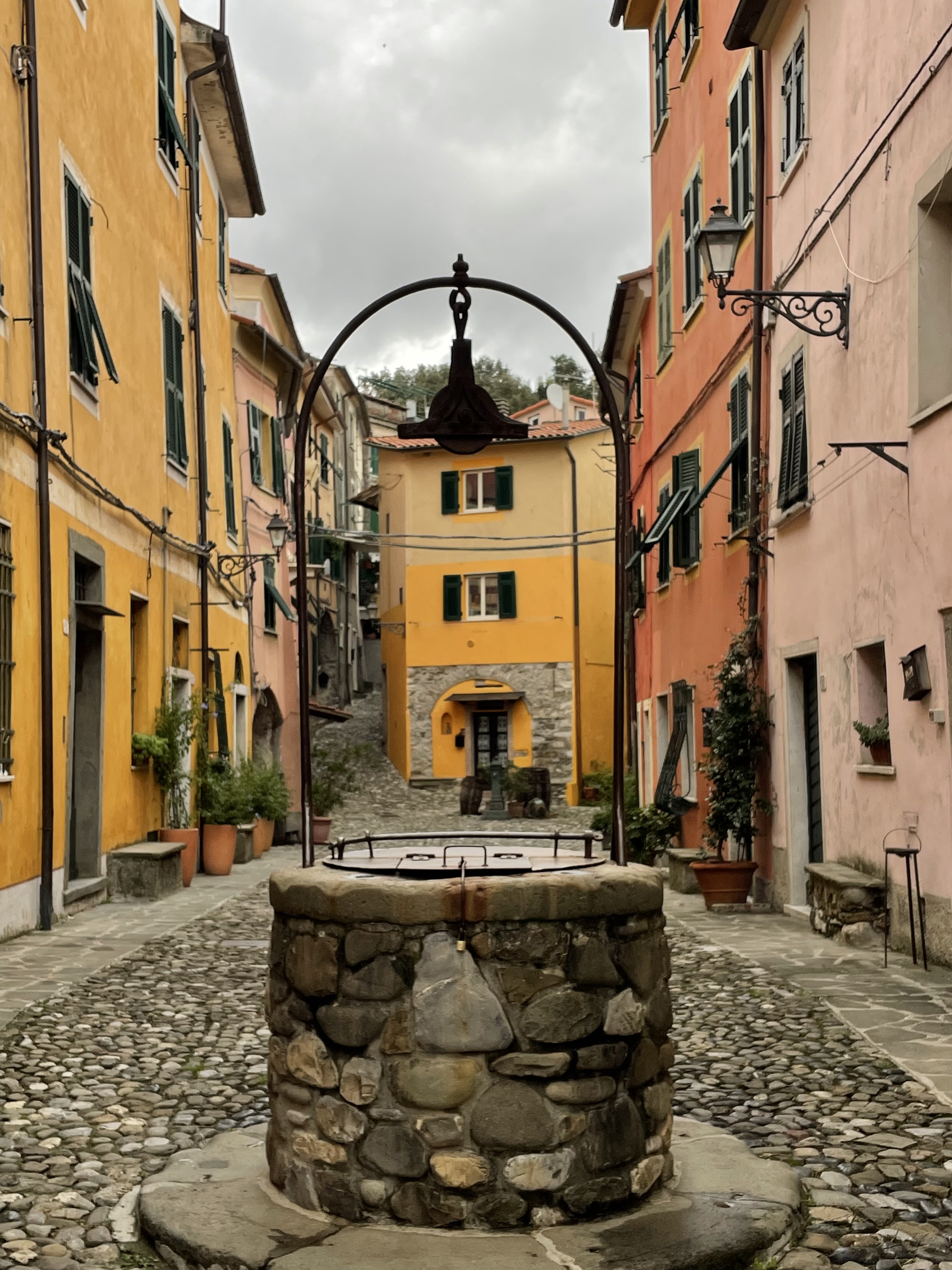
On the way down from the mountain top, we stopped briefly in Arcola where my host’s father grew up. The big house has been divided and passed on to younger generations. As so many of the big, old homes, it has stayed in the family and serves as a reunion place on weekends and holidays where cousins can play and adults can relax while maintaining familial connections.
I saw plenty of school children but none in uniforms. School hours are from 8 AM to 2 PM. The school doesn’t provide any food, students go home for lunch after school, and books must be purchased. There is no separate bus system for schools; regular buses suffice. Given the socialist government, this surprised me. American schools in our capitalist economy provide much more for students.
Ten days isn’t enough time to experience all of Italy but it’s enough time to give me an idea why people love it so much. The natural beauty, history, and culture are so rich. True, I say this about most places, but I must return to see other parts; perhaps, the Italian Alps or Sardinia next trip. The world is big and I’ve seen such a small part of it.
“You may have the world if I may have Italy” Giuseppe Verdi, Italian opera composer (1813 – 1901)
“The Creator made Italy from designs by Michaelangelo” Mark Twain (1835 – 1910)

 Kathryn Byler, blog
I always enjoy your travels. Love Helene
LikeLike
Thanks for reading. Hope to see you soon.
LikeLike