- It seems I’ve taken a water tour of deserts. I’ve been in the Mediterranean Sea, Dead Sea, Red Sea, Sea of Galilee, Jordan River and several smaller bodies of water including a waterfall at Wadi Boqeq and springs at Tel Dan. Wherever there is water, there is green growth and life. Just a few yards away the brown, dry, sandy desert returns. (The Dead Sea is the only exception since the salt content in the water is too high to support life.)

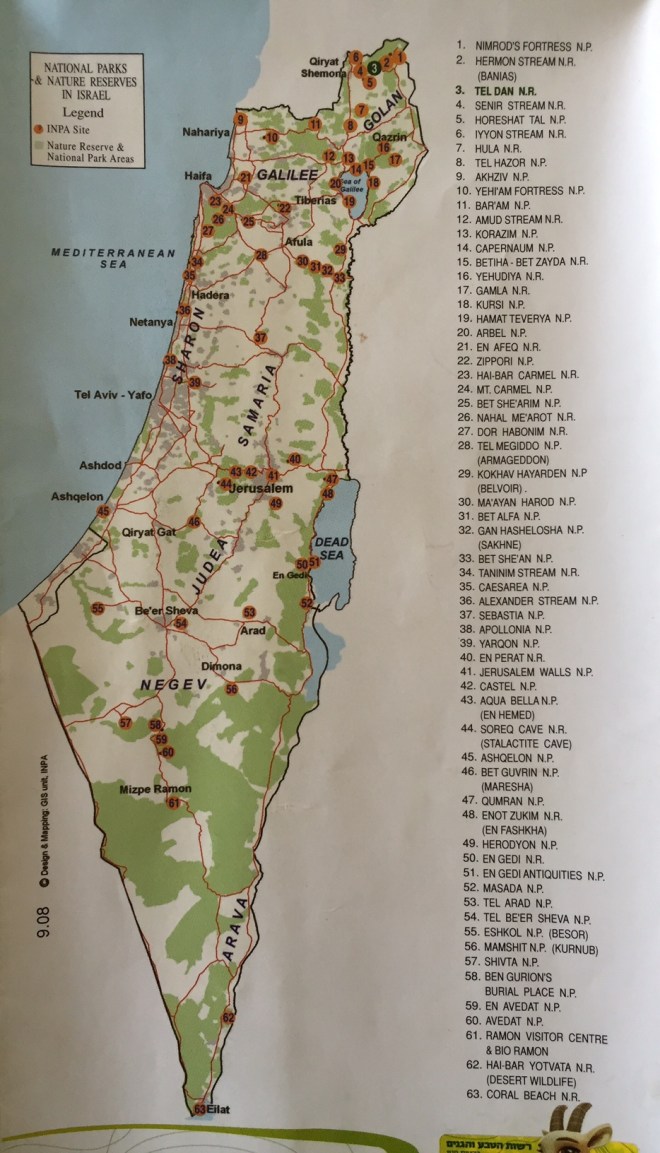
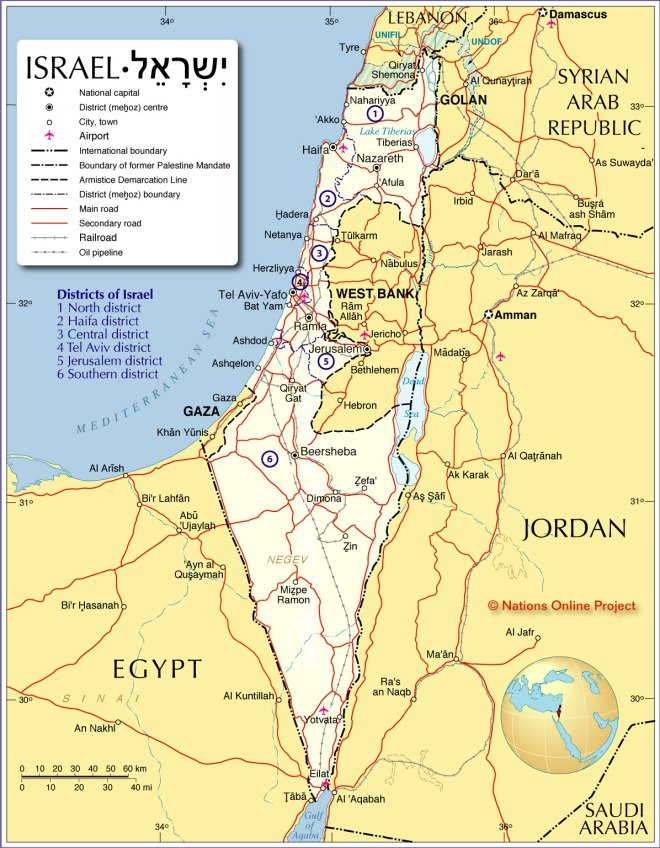
- I’ve been at every border of Israel — Lebanon, Syria, Palestine/West Bank, Jordan, and Egypt. The country is the perfect size for a two-week trip. Clearly, I need much more time to explore with depth but I made it to all extremes without feeling hurried and I stayed fascinated by my surroundings without getting bored.
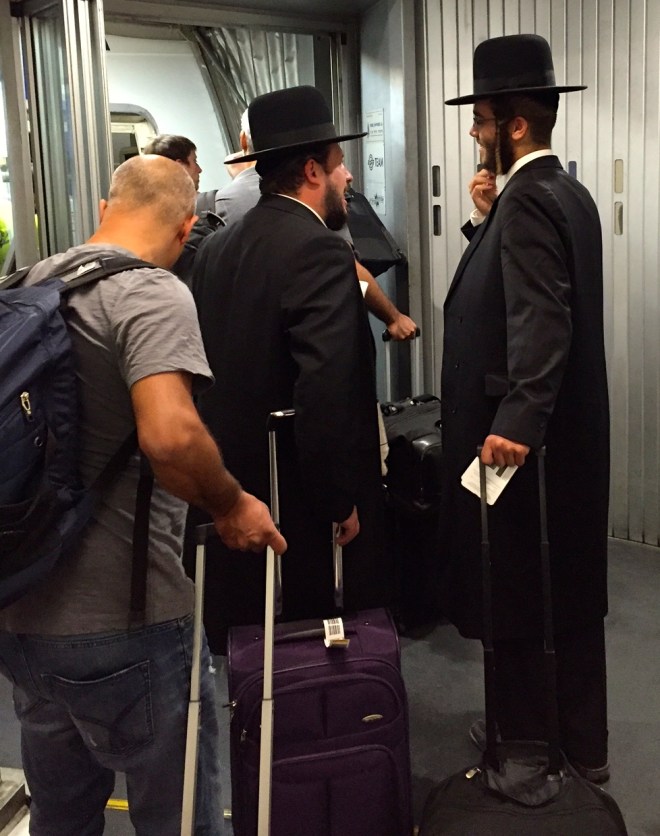
- At first blush, Israel seems to be a country of Jews and Arabs (75% Jews, 20% Arabs with 5% other) but it’s actually much more complex than that. The Jews are segmented into many groups. Historically, place of heritage (Ashkenazic light-skinned Europeans, Sephardic dark-skinned Spanish and Middle Eastern) divided the population with the Ashkenazic receiving preferential placement within the country allowing them access to better jobs, education and housing. The new influx of a million Russians added to the division based on country of origin. I also noticed a divide between the religious and secular Jews. While the secular population serves in the military and protects the freedom of the country, the religious block has huge political power and attempts to impose its beliefs on everyone. A small example of this is the mandatory closing of stores on the sabbath. This causes some discontent among those who prefer freedom of choice. Since Israel is a Democratic country built on Judaism, this can be a difficult balance.
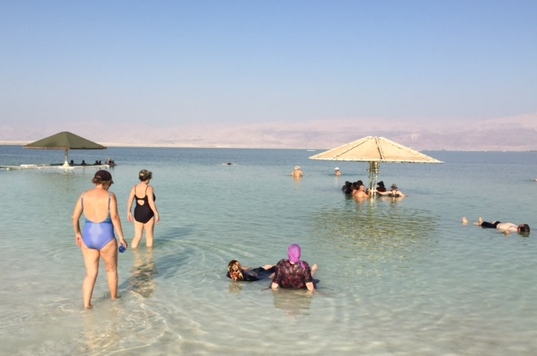
- Although essentially all are Muslim, the Arabs are also not homogenous. Some consider themselves Palestinians with Israeli citizenship, others are Bedouins and some are Druze. The Bedouins are traditionally nomads but I saw some setting up villages with primitive but permanent structures. It surprised me to see several bedouin campsites in the middle of nowhere with a car. It seems change comes eventually to even ancient traditions. The Druze are generally loyal to whatever country they occupy. The Arabs and Jews often share workplaces, streets, restaurants and entertainment venues. At the beach I’ve seen women in long dresses and head coverings (Muslim or religious Jews) and others in bikinis (non-religious Jews) sharing the water. I didn’t see them personally but I heard there are topless women sunbathers (Europeans).
 Working, playing together and even friendship is one thing but I understand there is no intermarriage. Under Muslim Sharia law, intermarriage is punishable by death of both the man and woman. (http://www.billionbibles.org/sharia/sharia-law.html) The Christian population of about 200,000 is much smaller but its members are also committed to their beliefs and feel called to live in the Holy Land. The balance of the population is a mixture of Samaritans, Assyrians, Circassians, Vietnamese, Baha’is, and others. That’s a lot of diversity, each group hugely committed to its own values, trying to live peacefully in a small country.
 - Several times I heard Israelis comment on how far they’ve come in 70 years. It’s true. What was largely uninhabited desert is now a vibrant economy with commerce, arts & culture, universities, outstanding facilities for medicine, scientific and anthropological research, and respect for the rule of law. Importantly, all people are free to practice the religion of their choice and the holy sites are open to all faiths. The architecture everywhere is formidable. I especially love Jerusalem where all structures are built in limestone so there’s uniformity and a Zen-like feel that everything blends in with the beautiful hills and rocks. Here are just a few of the new buildings in Tel Aviv.
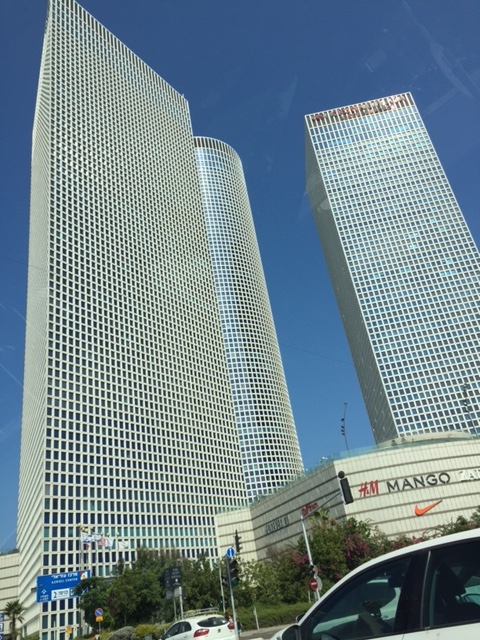
 Far from desolate, Israel is a major exporter of fruits, vegetables and flowers. Impressive gains in sustainable agriculture and energy are helping the entire world. “The desert and the parched land will be glad; the wilderness will rejoice and blossom.” Isaiah 35:1 While I appreciate all that, a Sponge Bob water park near the Sea of Galilee is too much for me. Where are the zoning and permit inspectors when you need them?
 - One quickly becomes acquainted with a kosher diet when visiting Israel. Basically, dairy and meat must be kept separate. One should wait four hours after eating dairy to have meat and eight hours after meat to consume dairy. Vegetables, fruits, breads and most fish are neutral so they go with either. Pork, crabs, and shell fish are never eaten. Breakfast ends up being full of cheeses, yogurts and dairy products but no meat.
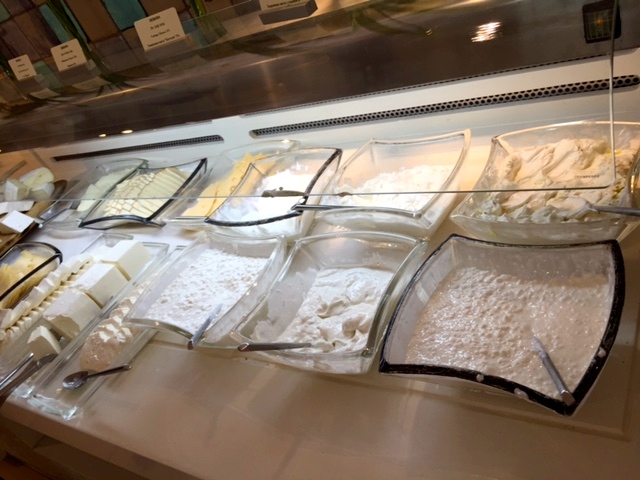 Lunch and dinner are meat meals with no cheese, milk or cream. Most of my friends eat only kosher foods but don’t keep kosher kitchens or worry about details such as timing. A law prohibiting non-kosher meats from being imported means that thousands of inspectors (and their families) are paid to live all over the world monitoring the farming, slaughter and packaging of meat. That amounts to a cost of about $770 million U.S. or 3 billion shekels annually. The cost of meat is then more than double what it would be otherwise which is a concern for Arabs and others who don’t choose to keep kosher. This is another example of forcing others to comply with Jewish religious laws. (http://failedmessiah.typepad.com/failed_messiahcom/2016/01/israel-spends-about-770-million-annually-on-kosher-food-supervision-driving-up-the-cost-of-food-by-5-percent-234.html)
 - Whenever I travel I notice small differences that may be inconvenient to some Americans. One such difference is toilets. Since Israel has a severe shortage of water, toilets have two flush options–a small one for liquid waste and a larger one for solid waste. Paper is put in a trash can, not in the toilet, as the water treatment plants are not equipped to handle paper. Entering into Jordan, public toilets are essentially a hole in the floor. I suggest you take your own paper and, generally, avoid them, if possible. Restrooms in hotels and restaurants are nicer.
- A close Israeli friend and I were talking one night and he made an insightful observation. All four of our parents started with nothing. His parents walked out of Iraq, refugees leaving their home, business and possessions except for one suitcase to begin life in a country where they didn’t speak the language. Neither of my parents had a high school education and were raised in the depression. That generation sacrificed and took risks, working hard to give their children better lives than they had. We’ve done quite well, thanks in large part to what they provided, but what’s more impressive is our children who are competing on an equal level with anyone in the world.

 I have no idea what another generation will bring but we’ve come a long way from the 1920’s to 2016.
 - I am not a historian or politician. I am not Jewish or Muslim. I make no claim of understanding the politics of the Middle East. In my opinion, war is horrible. Having said that, some things are worth fighting for. Regardless how unavoidable or necessary, deadly fights over freedom, over land, over anything are tragic. My own beloved country, the United States of America, was “stolen” or “won” from those who previously occupied it through a series of battles and wars. One of my friends/readers challenged me on my statement that what is now Israel was “largely uninhabited desert” 70 years ago. I know no answers to the problems that continue today but I found an interesting article on a blog written by someone who shares my surname. Although I’ve never met the writer and have no personal knowledge of the veracity, I share it in hopes of shedding light on a very different aspect of what life in Israel is like today for some. (https://cindydarylbyler.wordpress.com) Through my travels in Israel and Jordan, I found only beauty and good people everywhere I went. But I saw the memorials, the bomb shelters, the discrepancies between the cultures and I heard the comments and fears of my friends. When my 18-year old, Israeli friend left to begin his army service, he proudly showed me his uniform and talked excitedly about the experience. I shared his joy with the certain knowledge that this is not a game. Living under a shadow is not healthy and, even worse, when war breaks out each country sacrifices its strong, courageous, young people. I told my friend I will pray for his safety. And I am.
Concluding Thoughts on Israel
Published by

 Kathryn Byler, blog
Excellent blog Kathy. Informative and well written. Please keep them coming so I can vicariously travel along with you!
LikeLiked by 1 person
Thanks, Guy, I appreciate the feedback. Just recording my thoughts and experiences. Feel free to disagree or say something to make me reconsider. K
LikeLike